Before you press play: I’m a surfer at heart and I live in the tropics, so I rarely wear a shirt, on camera included. That’s simply who I am. If that bothers you, these videos aren’t for you. — Charles
Full Class Seven · Live Group Class · Free
The largest hack in history.Structure first. Then the tape.
This class was taught on 1 November 2026, a few days after the Binance hack, reported as the largest crypto theft on record. The question for the class was simple: how do you play it? The answer is the same as always: structure first, then the tape. Charles strips an ETH chart down to the only levels that matter, shows that the hack’s record volume pushed price only as far as monthly support before it was engulfed, and lays the current structure over a past range that unpacked the same way. Then the students ask the questions that matter: what would invalidate it, what are we waiting for, and how do we enter with a clear stop and a sensible size?
What the class covers
- 01
Only the structure that matters
A student asks which levels are actually important. You can draw lines that are accurate and still not relevant. On this chart there are three: monthly support (two closes), the prior lows and the wave four lows, and the only question at each is whether price follows through. Then the end of the C: an ending diagonal that overshoots, which is a Wyckoff spring once you tilt your head and see that it doesn’t have to be flat. Springs, tests and Elliott Wave are learned separately, but they layer: the B is the first technical entry, and the creek break with a control bar up is the later, confirmed one. The Wyckoff schematics, written out.
- 02
The hack, read bar by bar
The daily chart read with the Tape Whisperer: a range breaker, a multiple engulfing about 2.7 times easier down, then the day of the hack, the highest volume in a long time at the end of the C, followed by stopping power. Going under the water is not the same as breaking it; the deeper you push, the harder it gets. A past range is laid over the current one, slanted flat, and the sequence repeats: a selling climax, a slow low-volume drift, a test, a control bar. Funding is one more layer: by Charles’s read, roughly one fifth of traders were short at the earlier low, and several times that now. The tape-reading guide and the Tape Whisperer.
- 03
Invalidation, the plan and the patience
What would invalidate the count? In crypto the textbook rule bends a little because of leverage, so the invalidation is set at the start of the third wave. It is always a probabilistic bet: clear invalidation, layers of confluence at the area of interest, a safe risk to reward and proper money management. What is wanted next is a reclaim of monthly support, a neckline, a retest and the OTE. A student’s three-to-one is Charles’s first target, because he plays the wave count and runs the runners, and an invalidated count is welcome: it leaves fewer options. Homework: springs and tests. Elliott Wave and money management, written out.
Chapters
Tap any chapter to play the class from that point.
Transcript
Read the full transcript · timecoded
0:00 · StudentSo we should define which ones are important for us. For example, I know the resistance and support are important areas, but which phase of the Elliott wave is not important on the lower timeframe trends?
0:17 · Charles VincentYeah, so let me just... actually a really good thing that you brought up, then we can just assess what is structure, and not just structure, but what is relevant structure in this exact image so you can understand. Because there’s, again, like, even when you didn’t see this, what we were talking about before, Drew had some stuff drawn on, we had a class before, and we stopped that class and said, hey, we’ll finish this up and draw, you know, whatever you see on the schematic that’s usable, and he drew something that was accurate, but also not relevant, like not relevant to usable. So if that’s the case, like we can infinitely spin and draw things that have no actual use case, but our goal in this place is to somehow only focus on the things that matter real time. Right, potential upcoming for take profits and shit, but nothing other than that, because it’s very easy to just get distracted and not actually pay attention to what’s happening. So in this example, let’s just start from the lows and I’ll do it on this one just so you can see the granularity. But the point is this so far is a clear, on a larger timeframe, I don’t know if you understand this yet, but it’s a swing failure pattern up, which is again bullish, which shows also an impulsive structure, which is a wave one, two, and then of the wave three, this is one, two, three, four, five. So this is the wave four of the wave three. Right, so this is still a bullish structure. We see a clear ABC. There is all of the reasons that we talked about right here, except now it’s beautiful, actually, that the largest hack in all of history in crypto with the biggest volume candles only pushed down this far. And then immediately once the funds were said to be safe, had that level of stopping on monthly support, immediately engulfed right after it. so there’s a, the point is, is that that being known, we now have to focus on what is actually important. And so we go zoom all the way out. If it were yearly, I’d start there, but it’s not relevant in this specific example to here. There’s other stuff. But the point is, this Two closes. That’s monthly support. I don’t even know anything other than that for this picture. And then I go down the timeframes and see, yes, is that cluster still relevant? Is this still relevant? Yes. But is it relevant in this picture now? No. And so when we’re doing all these moves to assess reclaims, what is always the most relevant in all instances? Remember, we’re moving down. That at this point in time is the most relevant. Follow through, yes, no. Follow through, yes, no. Now, this is the lowest. So I need to know when that’s reclaimed, when this is reclaimed, and then more large timeframe, when this is reclaimed. That’s it. This is wave four lows. This is the prior lows. And this is monthly support. These are all the math. I don’t need anything else other than that. Does that make sense?
3:08 · StudentYeah, totally. Completely.
3:11 · Charles VincentAnd so that’s how we do it every time, right? Like just this. And now we assess. Now we can micro zoom in. [unclear] what else is on this picture that we can actually dissect and actually use to see what’s happening right now? Because now the wave count, the relevant wave count is where we come into play. And we’ve talked about a wave count being the end of the sea. And it’s actually beautiful that this thing printed since last time, because [unclear] us that we want an overshot, that end of a diagonal, the end, the spring of a Wyckoff accumulation. We want to see these things. So it gives us the interaction just like every other thing that is dramatic. We want to see what the actual interaction with it is with the reaction. Actually, let’s just use the end of the diagonal for now. You guys remember the Wyckoff image that we had a second ago? Yeah,
4:18 · Student[unclear] phases, the different phases.
4:20 · Charles VincentYeah, what you had preconceived to being that thing, right? Like, it’s not always that clean. And that’s how it fakes out most people. So we just have to assess, like, what is it trying to actually show us? Let me just get there.
4:35 · [not transcribed]A short personal exchange with a student, left out of the transcript.
5:24 · Studentso glad you put all these up in the, you know, with the site and stuff, it helped big time. Even this compared to like a static that, you know, somebody, if they were to jump on and put, you know, Wyckoff, you know, accumulation schematic in the internet, it’s going to come up with kind of a lot of the same thing. And this, [unclear] paints a picture differently. I think it just, I see it a lot differently than what’s typically floating around out there. So [unclear] they have to be mapped.
5:51 · Charles VincentAnd what I’ve found in my many years of just scouring aimlessly, almost was all the shit is old, and it’s not, it’s not labeled, and it’s not like usable fashion. So what the fuck? Like, where are we right now? Like, this is 1940. We don’t have the internet still, like, how the fuck are people not just making this better? So I just [unclear]
6:11 · StudentYeah, that’s a good point. That’s still like on old ticker charts, almost like ticker.
6:19 · Charles VincentSo anyways, this is a non candle, because it’s actually a better illustration of what we, the Wyckoff accumulation schematic. And last time, overall, just so you guys both understand, [unclear] you’re there to read, right? See her in here. Okay. This thing is the same as the other schematic that we ended last group class on, but the point is that this gives your brain more of an allowable variance of the down. There is, in the other one, I think it shows just an immediate spring back and whatever, but it doesn’t have to, like, you can have the spring, this is a spring, just so you guys understand, but the point is, in an example where it is flat, I drew this one, I brought this one, because this is the C wave, which is the ending diagonal, so far, of the fourth, which shows that it doesn’t have to be on a flat, it actually is oftentimes slanted, and our job is to assess, to use, to see it, regardless of if it’s flat. Like, take this, slant your head something like 30 degrees sideways, and it is the same thing. That is the leg down after the lower high, that is the spring. It’s the same. There’s no difference. Just like this, an ending diagonal does often overshoot the end. It doesn’t have to, it can be precision, it can also overshoot. This is what an overshoot is.
7:51 · StudentWith the head tilting, do you see that? Yeah, yeah. Yeah, yeah, crazy, right? Yeah. Yeah.
8:01 · Charles Vincentis how, and I want to break it down a little bit more. It’s so good in bed. I don’t know how the fuck that still, my socials are so invisible that nobody’s seeing any of these things or don’t come to the glasses, but it’s actually cool because we could just go linearly through this stuff as it’s playing out play it. So in In this thing, just I want to, so you guys understand, there are specific, usable... how do we play a thing for Elliott wave, accumulation, springs, tests, they’re all individual but they also layer. So what I need you guys to understand is in this example, this specifically, I want you to remember, I’m showing you from this point, is here, this and this is this and this. This point, that B, ABC, that B is the first technical entry of a momentum play of an ending diagonal, but also the overshoot of the end and reclaim of that declining line, which we don’t have drawn here, is also the first entry of the not yet momentum, but with intention. Remember, this is just reclaim and a test. This, if it control bars up, is the entry here. Just like this, that thing is here. We haven’t got the proper test. This thing, just so you guys understand, in a map sequence, like, I don’t know if you guys can see this, but from here to here is potentially so far here to here, but it doesn’t have to be just this. It’s just a, it’s just a lower high with a test and then an up. That thing, all of this can happen, and the technical entry, when this creek is broken and control bar up, is the entry. However, that’s a late entry, you might think. There are many...
10:20 · StudentIs it a range breaker, a change of character, does it matter what it’s called, you know, for that happening, and reclaiming that?
10:31 · Charles VincentWhat are you referring to specifically? Like, are you talking about reclaiming this line or this line or both lines?
10:37 · StudentSorry, that higher one where you said the proper entry, but that wasn’t your entry, like you’d be before that.
10:43 · Charles VincentI’m not saying it’s not my entry, I’m just saying, like, see this lower high? Yeah, that one. That’s a creek. Just like it’s a creek. Just like it’s a specific horizontal area of resistance in this instance that once broken is the technical, if you read how to play these things, that’s the entry. Because it’s gotten far enough past this to show us the volume tells, the reclaim signature, all this stuff, which is also here, which also usually equates to what is the retest after once it breaks. The point is that this is the proper momentum entry, but if we zoom in, there’s a much smaller one that also gives us the same tells. So those things I’ll leave until later in the class, but I need you guys to first understand, do you see that these are the same thing? [unclear] Like [unclear] actually understand, like this is this and this is also this. Yeah. Can you see that, Emad?
11:48 · StudentYeah, yeah, yeah, I can see that.
11:50 · Charles VincentOkay. So that’s the case. I’m going to throw a couple [unclear] things at you guys in a constructive way. So, Emad, since last time, I’m always working in my laboratory in the background. I made something that is, I think, incredibly useful. It’s a tape reader. It’s called the Tape Whisperer. And it actually tells you everything that I tell you. It’s actually like my brain into how to read the tape, but visually, as opposed to having to do manual math. And so I’ll just start from this candle because there’s a full block of text that shows the last closed candle story. So that would be this one. The point is that from here, this highlighted move up is a range breaker, which was an engulfing of the prior. So it tells us, just in this example, this move down was hit, it’s punching a wall, and this move up was an engulfing of this many multiples. And it’s, again, a visual gauge. It’s just this means somewhere in the range of five ease up. And we can see that actually in comparison to this. This is about two and a half. The point is that this now also punched a wall, which is this type of candle. And then this one engulfs, which is about 2.7 times ease down, and engulfs. Remember, it actually includes, it’s an ME, so a multiple engulfing, engulfed here and here. So these are weighed against this, which equates to that, which is a multiple engulfing 2.7 times ease down. That is a range breaker. And so the next one, this is the key. This is always what is the most important. This is when the Binance hack occurred. This is when the funds were said to be safe. No new external, highest volume signature for a real long time. And for bearish, which is the end of the C, which made no new volume, which is exhaustion, which is printed a level of stopping power after this of a very large signature. And so the next one, this is an engulfing of this one, which equates to 2.4 times. So it’s like a fucking... and this is, this is the pro version. You can switch it to the beginner if it’s too much to handle on one thing. But the point is, it’s all there and it’s all like, tells you what type of play and all of the things. It doesn’t repaint. It’s totally accurate to exactly what we’re So this is, we’re going to use this just for a visual for people who don’t understand in the recordings of what we’re talking about necessarily. It’s just a visual guide. But did anything on here not make sense so far?
14:40 · StudentNo, to me, it’s completely, it completely makes sense. Yeah.
14:47 · Charles Vincent[unclear] for this one, this is like the, I don’t know if it said it in the email that came for the class, but the point of this class was obviously if it was just us to carry on from last, which is the perfect segue into How to play the largest hack in all of history. That’s the goal of this class, because it’s a big moneymaker if you’re set up correctly. And so the point is, is same thing, just structure and tape, right? So we’ve identified structure. This is the monthly support. Just like the, remember last class, we had an area, it was a cluster of weekly support here. It was blue. You guys remember that? Yes. Yeah. And so that, just picture, just like the physics of water, that is the surface of the water. And as you press down, it gets harder and harder and more and more pressure. So just because we’ve gone under the water doesn’t mean that we’ve broken it. It means now we need to see the reaction to tell us, has it broken it, or is it actually being held up by the immense amount of pressure from being held down with max fear, with the largest crypto hack in all of history. And so this tells us clearly that’s what the case is. So think of it like depth, right? This is just the surface. This is maybe 10 meters down, this is 20 meters down, et cetera. And so as you get deeper, the pressure gets heavier, harder to push. And we are that indestructible rubber ball filled with air that is being pushed down. And it’s this, like, it just comes back up with this amount of ease. And so we don’t need, after a level of this scale of exhaustion, high bullish demand signature yet. in after the test in most cases so the point is it’s not a it’s not a worrying thing to only see this the fact is that we’re drifting up which is like it’s just there are no more sellers and we’re just floating back up on zero like it’s on negative or almost no volume so So what we want to do is, same thing, just read the tape and understand, in instances like this, we have examples to pull from where we can actually go back in time and we can see where were these things that we’ve already went over and we’ve already studied in depth. Where were they present and how did they look and how did they play out and what happened and how was it usable? So in this example, we’ve gone over this one already in a range before. But the point is, is that in this thing that is, and this is where it gets really cool, because you can kind of layer it together. So I want you guys to understand this is the top, right up here. And then we have the sudden move down, which was the, remember, at the end of this is the A, and then this is the B. So just recognize what I’m trying to show you side by side. So the structure, this is flat. This is sideways. If you just take this and just lift this side up so that it all pivots flat, can you see that this is the same? This is this. This is just a structure of another B print. Right? And the distance down, again, it doesn’t have to be equal. But the point is, is that this is this. And so where do we see that really heavy volume signature? We want to see it at the end of the C. We want us to clearly Clearly be able to identify the exhaustion at the C. They can all unpack differently. There’s obviously... doesn’t have to be the same. However, what we need to notice: the sideways drift on very low volume is not a negative. And the key point to identify is the, what is in this picture, the areas of significance that give us a region for tells. So for example, this in this instance is the order block, which was the failure. So this one here, this was the target for the automatic rally up. What was the breach of just burst above that water for one second, and then hits that order block, comes right back down. And then, I don’t know that this will happen, like in every other thing we talk about, but that is a precision CAP setup. Within here is a clear other ABC which we can go down. dissect and see all the things it’s respecting. But the point is, this is support. This is an order block. This is the ABC of what this is, swiping [unclear] reclaiming, and then again, I don’t know that this will happen like this. But the point is, is that the interaction, the first tell, we want to see a signature up to here, failing is totally fine. And then we want to see, is there a follow through? How do we gauge this? How do we actually use this? And so in that example, this shows, remember, most cases, support is not respected on the small timeframes. It rips past it. Like if this comes back down for a test here, that’s okay. People, like, if you’re zoomed in on a one minute or a five minute, like, oh, it’s broken. It’s going down. I’m shorting. That’s... It is designed specifically to do that thing, to elicit fear in a place where the market is already max fear. Like, we need to know that the signature tells us what we have, we have after this breaches down, if it does, sweeping the lows, reclaiming with whatever signature we need, again, on a different timeframe, these are different candles. But the point is, that’s the goal of mapping prior moves. And this is just one of many examples. The other example that is more on a large timeframe that we went over a couple times is, and I think Drew now understands this thing. So here on a map. [unclear]
21:00 · Charles VincentThese things are near identical, current, past. And if you look at the price, this, see where the current price is? This is directly and exactly here, in past. Crazy. They are happening in the same fashion, in the same place, in the same style. The difference is there is this drastically more higher amount of support built for this base versus before. So the slower movement is not a bad thing. This is more weight being unpacked. And again, I don’t want to go into divergences and all the crazy shit, but just pretend for a second. The amount of negative funding here was in the range of currently something like one fifth. So 20% of the people were short here that resulted in this short squeeze, but they are currently here. That is the current rate as of now. So that’s just one layer of confluence on top of all of the other things, on top of this exact, like, I don’t know if you guys can see this, but this move up, this one, two, three, four, five, to ABC, it’s the same. At the exact same point, at the lowest part, bouncing on what was support prior. Like, can you guys see this, or do I sound crazy? No, I do. So again, this is not saying that it will happen. It’s saying that in many cases it does happen like this, but most people don’t understand this is how it actually maps and plays out. And it’s if the things are correct, if the things are mapping accurately, if negative funding, if extension of C with selling climax, if fair value gap of prior move up, if mapped onto what is the low of the thing to that area, to the prior, do you see the resemblance?
23:07 · StudentYeah. trying to understand the the major move. Yeah, 12345. And yeah, I see the repeating pattern. I see the correction part. I see all of this, But I’m not exactly seeing the one, two, three, four, five, the Elliott wave in there. Okay.
23:30 · Charles VincentYeah. Yeah. So that’s a good thing you pointed out, because sometimes I just go past. So in this example we have, I’m just going to draw them separately so you can see, but in this there’s a, you can have one, two stacking. So, just for simplicity, I’m going to just draw like this. So yeah... sorry, you were going to ask something. I think no. Like, there is a one prior, there’s a one prior, and just simply, if we’re mapping the three, the start of the three, remember this is the one, two, one, two. This is the third wave. One, two, three, four, five of the third wave.
24:20 · StudentOkay. Yeah, no, I see. Yeah.
24:22 · Charles VincentAnd so again, this is very zoomed in, hard to draw precision, but the point is, what is the distance of A to B, C. And so let’s take a look, use the fibs, not guesses. And then,
24:43 · Charles Vincentlike, I can’t make this shit up, right? It’s crazy. So assuming that there’s all these hidden layers of confluence, CVD and funding and, and, and, and a whole bunch of shit and max fear, the world’s ending, there’s a new war, there’s fucking North Korea as well. And all this stuff while this is happening, if you remember, right here, this was Drew’s big entry while we were at max fear of a new war, at the worst possible, I mean, at the time it was a new war. But the point is, is that that thing, that’s how markets went oversold, spring back, because the max amount of people are short. And remember, roughly one fifth. So 20% of the people were short here. And now five times that are short here. Yeah.
25:30 · StudentSo much more pressure.
25:33 · Charles Vincentbest part about this, [unclear] again, this all is a 1-2. This may not make sense for a complex understanding, but this is a 1-2, a messy 1-2 or an expanded flat. However you want to, the map is still the same. This is the solving for X, which was a whole bunch of potential variables that are now played out and mapped. This is X. This is the 1-2. So this is the start of the third wave. And this is the third wave. [unclear] the first of the third.
26:04 · StudentSo like, and everything’s rolled out where you said, like, you know, it’s X, like it’s, this is a [unclear] -2, you know, like we’re here.
26:11 · Charles VincentWe don’t know. Like, like I thought this was going to go up to infinity. I thought this was the three and it showed characteristics of the three. However, there was still one possible leg that presented itself and that’s fine. And now there are no, we are done. We are in a triple three. It’s printed. It’s done. So [unclear] Yeah, and the longer we stay down, the more people end up shorting. It’s, again, coming from a place of no guidance, no experience, and just, like, trying it yourself with your own money and Twitter and whoever the fuck else you’re reading from. Like, it’s a really scary place where people do really stupid shit and they just learn. And that’s how I learned. The point is that this is just a repeating thing that’s playing out. So now, what I want to get you guys to do is actually map. I don’t know what’s going to happen. This can go fucking down to $1. I’m not saying that I have an understanding of what will happen. I’m just laying the layers of confluence, stacking above, and adding where I think is a value add. And right here is a fucking value add. [unclear]
27:17 · StudentI need to ask something, but I’m not sure is the right moment to ask it or not. With all the confluences, we have the most probability of going up, but I want to know what should happen that you consider that this situation is invalidated. [unclear] should be seen? Good question.
27:38 · Charles VincentSo just as an Elliott [unclear] the prior, so in all of these maps, you can’t have the fourth retrace into the first. So the second, if this makes it down So, like, we have
27:54 · Studenteven touching the one or...
27:56 · Charles VincentYeah, so there’s, in crypto land, there’s a slight variance because of the incredible amount of leverage. In this place, I’ve noticed there’s actually not as finite a rule as in what is the textbooks. And so, for example, my invalidation is here. It’s the start, which is, like, this is a one, two, three, four, five of the third. So my invalidation is just here.
28:18 · StudentCharles, would that be a wick variance, or like...
28:21 · Charles VincentYeah, like it... down, but remember, like, we’ve already had the biggest crypto hack in all of history, and this is how far down it went. Yeah. It was nothing. Yeah, like the quiet before the storm is how it fakes out people. Just understand, like, what I’m saying is already played out 100 times in front of us. You just have to pay attention. So, for example, if this is a wave one, two, three, four, five, ABC, the distance of A equals C, and at the end where we finished last class, it has one sharp shot down. does it come back and swipe? The B. And then what does it do? A really fucking messy test. And then the wave, one of the next wave prints. I’m not saying it will do this. I’m just saying if we had the, this was the top of the fifth and it’s swipe the lows at distance of C, all of the [unclear] laying confluence. And then we have this continued stack of what is the most easy way to, again, this is A little bit down the crazy rabbit hole, but the truth is that if you now slant this thing up, it’s the same map. Remember, the lower we are, the more pressure of the trend that is trying to present itself. So this thing can be the identical map to what we have current. Just remember in this example, this is the top and then the ABC, that selling climax, the really fucking slow chop, the, oh my God, it’s going to go down further, the tapping the B, the order block, coming all the way back down for retest, then the ABC before the control bar. Like, slant this. If this was this, this is exactly what’s playing out now. And it’s not here. It’s there and here and here and here and here, over and over and over again. Create the, what was the equal lows, selling climax through them, slow reclaim, then reclaim. Where is the... remember, there’s a hundred different styles of variant, but in this instance, this is the B, this is the low, this is the tapping the B, this is the chop, and then the up. Like, it’s just on repeat. It’s not what I’m saying. What I am saying is, if this example shows us, just like here, a breach down, a sideways chop of really, really slow, reclaim, a perfect CAP setup, and then adjust the chop, control bar, and all the way up, like, we can just have any variant of these. And so how do we play them? Like, what is the, from what you guys know? Do you have a gauge? Like, what do you think you should do in this in this exam specifically?
31:12 · StudentYou might be got a thought? [unclear] yeah, I’m thinking. Or anything that you’re putting out there.
31:21 · Charles VincentSo, I guess, like, let’s actually dissect it, right? Like, we talked about it before that you’ve never actually went over this and dissected it. So, let’s just dissect it. Because you can do this now. I’m just going to slap this on for ease. Oh, brother.
31:35 · StudentIsn’t that thing that he made cool? He made it too. Yeah, it’s crazy, yeah. Right? I don’t know how he makes this thing.
31:45 · Charles VincentLike, this is iteration 26. I had to fine-tune the fuck out of it. Like, it took me many hours. Like, any beginner can just hop on and it takes all of the noise out of it and just shows you, like, simply turn, weakening, these bars are exhaustion, and how much, based on the prior bar. This is, remember, no external, punching a wall, engulfing up, it would, on a pro, say a range breaker, and the differential between all the engulfed prior. would be the B, right? We just talked about what is the prior low that we had a bunch of equal lows swipe down, right? And then the highest [unclear] volume signature here, right? I’m comparing it to current. I don’t want to put the other chart on because it’s a little confused. But the point is, is that in this example, we had a slow ish. This is actually a really sharp fall. But the amount of volume like this is a high volume signature. This is not in comparison. [unclear] opposite is true current, right? So all we had was a range with what was the border block of the B. And then the climactic move, which in our current looks like it’s the sell off was all of this in one, one spike. And then sorry, one heavy candle and then a spike down and we’re somewhere here right now.
33:02 · Student[unclear] this is back the war talk. This is one like I first This is like, sell this, you know, sell your children and everything in. Yeah. Yeah.
33:11 · Charles VincentI told you to enter full crazy, like, I don’t... words, but here at the reclaim of the lows. Yeah.
33:20 · StudentAnd I’m actually doing, yeah, I’m doing this now with, like, you know, just maps, you know, where, yeah, anyways, you know, our whole conversation with, you know, funds and put, put things in. But like you said, it’s just the same thing playing out.
33:36 · Charles VincentLike, actually map this, right? So what I want you guys to do, and this is why, remember, I don’t need all the other shit. I just need this line right now. If there’s another area interacting, sure, whatever. I’m just looking for an overextension, for reasons you can’t see on this chart visually necessarily, but no solid follow through, with immediate or near immediate reversal, which, again, this could be the last daily print on what is current. But what I’m trying to illustrate is that in this example, so just visually, if that bar, the height from the middle line, illustrates 1.8 times ease. Look at this. 1.8. So two times two times two times two, roughly. This is roughly 800% ease after the spring control bar back into the range. That’s it. Right. Well, that’s the math here. And it tells you directly: turn. There’s no repaints. It doesn’t print it after. It’s like this as it prints, right? Like, after it closes, it tells you exactly this, and it never changes. The point is, in this example, it’s showing us an almost identical signature to current. But that’s split differently, because the climactic event was a forced push of one shot, and then zero follow through, which this is zero follow through, and a drift back up on low volume. Same thing. Just your brain may not be able to interpret that it is the same thing yet. Right? So like, for example, all we did was sweep the highs and fuck around for a bit, and then come back down to test. Like, I don’t know what will happen. I’m just saying, once this is observed, and the distance of C is here, and this is the lows return, we have a job to do. And it’s not sitting there and be like, oh, I’ll catch the next one. It’s fucking catch this one with a solid risk to reward.
35:25 · StudentAnd I know, and I know it’s not about predicting or anything, but I just got to say, I’m telling you, when he said, like, you need to do this. And this is a decision now that you need to make. Because when you look back, you know, we had a big, big conversation, many of them, and took the leap. And looking back in hindsight, it’s like everything he said, it gives me chills from like head to toe, that he was effing right. Like, I’m telling you, it’s crazy to look back on.
35:58 · Charles VincentThis is crazy. This does not mean I will be right in any instance ever.
36:01 · StudentNo, I know. I know. I’m not saying that, but like, holy shit, man. but it’s Yeah, I think it’s something that you say that it can mostly happen, but I cannot say it’s certainly going to happen, but the probability is really high. So that’s the way you’re interpreting it.
36:23 · Charles VincentYeah, it’s always a probabilistic bet. And that’s the best part, right? As long as we have the clear invalidations, what the fuck more do we need? Like, where we are, our job is to, as concisely, is as stacked with as many layers are aligning in our direction at the AOI as possible, pull the trigger, right? And with, like, safe risk to reward, we’re using proper money management. And we’re not getting fucking crazy excited. I only told you to do this last time, with all of the money you could possibly, like, sell the kids, sell the house, this type of thing. Yeah, because I was referring to spot. I was not referring to leverage. Right. And yes, we did leverage because I did it for you safely. But don’t do this yourself. And don’t, like, this is not an every time thing. It’s only when we have opportunities like this.
37:18 · Student[unclear] after us, you know, you know, just being so into this together, I am all in as well. And, you know, you’re [unclear] little in for like a regular rational person who has responsibilities in the family. [unclear] [unclear] not you all, no. [unclear] you said, and you even said to me, like, you know, have, you know, responsibly, you know, this is a time now we had this conversation last week on our call. Right. And you’re like, you know, responsibly, you know, I want to have this conversation with you right now that, you know, like we did last time with, you know, sell this to what you need to do. If it, if you were me, this is what I would do. And from that day, I’ve just been, yeah.
38:08 · Charles VincentTaking, you know, the caveat always my risk profile is not most people’s profile for sure. So don’t like it’s, it’s, it’s always separate, similar. That’s [unclear] first. Yeah, for sure.
38:23 · StudentAt the end of the day, I guess I, you, you know what you’re talking about? And I value, everything that you, you know, you put out there. So, [unclear] also I’m not a financial advisor. I’m not licensed to give financial advice.
38:34 · Charles VincentSo this is only for educational purposes, of course. Yeah, I hear you. I hear you. So now let’s assess, what do you do with this information?
38:47 · StudentOkay. Based on things that I’ve heard in this session, I just want to mention two of them. One was that when we see a slow reaction and then we see again, it’s going up. so it’s somewhere that we can expect to see a big move after the second resistance, the second support that that’s one part took my attention. And the other part is that you said, reclaiming the B can be one important entry in this kind of situations, the first entry. So those are the two. [unclear] things that I’m trying to, pinpoint and understand the whole move and find the good [unclear] Yeah. Good.
39:39 · Charles VincentAnd just understand in the B there’s multiple room where I can zoom in on [unclear] levels and it doesn’t necessarily make it clear, but the point. [unclear] that’s what I was saying.
39:51 · Studentwe, you was just saying with, where you were going to start talking on with, it being confusing about like the, I don’t know if he said that, the reclaim of the B and all that, but the blending, I guess together of, you know, where it starts to roll together, like, okay, well that would be, with that range breaker, the, first leg and then the retrace would be our second. You know what I mean? All that kind of rolling together. Is that what he’s referring to?
40:21 · Charles VincentI don’t understand what you just said. Say it again. Oh, geez. what are you talking about? Just be specific.
40:30 · Studentwith the structure, so with the legs and blending together, what was he asking from the low?
40:40 · Charles VincentYeah, like, where are the opportune areas of interest that happen to tell us we’ve reclaimed here, what to look for here, and then how to enter it safely. Right? Okay. Okay. That’s what I got from it. Yeah.
40:54 · StudentYeah. Yeah, yeah, yeah, exactly.
40:57 · Charles VincentSo let me paint a picture for you, because this is what I’m waiting for. So I’m already entered. But also, my high leverage is waiting. I’m not high leverage yet. I’m leverage. I’m spot. But I’m not crazy leverage yet. I will, but not yet. And so the point is, in this example, in multiple cases, remember, all we have is history, textbooks, and a whole bunch of backtesting on zoomed in timeframes and all this shit, right? So, like, probabilistically, the likelihood of this was oversold. This was max fear. This is actually, if you look at my, see my cursor on the one screen and the other screen, this is actually at the same exact point in time, right? Like, in price. This is an incredibly similar scenario. Except on a macro, we have just completed a wave two, and now we’re in the start of the wave three, and have way more support built on the right side under here than we do prior to here. And the largest crypto hack in all of history. This is with war. This is just war, not just air quotes, right? But the point is, is that the level of fear globally, especially for people who have no guidance, is fucking max.
42:13 · StudentAnd this is the time that we’ve been waiting for, kind of talking for, like, you know... I mean,
42:25 · Charles VincentI am adding here. If somebody wants to also add here, then do so. But the point is, responsible always, right? And so I say that with, don’t copy what I do, because that’s no financial advisor’s playbook. Responsible. But again, I’ve been doing this for a long time. So. point is, now, let’s gauge this, we have a drifting up this, remember, this is not a one to one, this didn’t unpack identically, this all unpacked in one candle, whereas this printed legs and clear down, like, is that the [unclear] Is that the B?
43:05 · Student[unclear] doing that one leg is even more aggressive, you know, with that sign of itself, right?
43:11 · Charles VincentWell, yeah, we want to see the C, in all cases, we want to see the climactic thing with the high volume signature, and then the reaction. That’s that’s the most easy to help. So just in a simple terms, I’m trying to lay this flat so you can see it. This thing, whatever.
43:30 · StudentCan you repeat the last part? Sorry.
43:33 · Charles VincentYeah. In all instances, we, so a tell, like, for example, when we have an area that is being messed with, I don’t want to see a slow move with a slow move and a slow move and a slow move. I want to see something climactic, right? Something, like, clearly with a massive differential build after what is a strong push with diminishing returns, and at max fear. These levels of confluence stacked, perfect. And then I want to see a counter reaction with strength. That’s it, right? Drifting, like this drifting, that’s telling us a lot of information. And I think we ended class somewhere where a control bar was right here, but then swing failure pattern, lower high, bounce on the order block, bearish order flow, like, what was bullish flipped immediately to bearish, and then the half. This is climactic. This is the definition of climactic, volume wise. The best part is, is that it didn’t make the result that you would think that the largest crypto hack in all of history would, which tells us a massive amount of information. so now it’s to gauge the reaction with this. And if it drifts up, remember, like if it were to continue to [unclear] continue to zero. I’m not saying that it could. I’m just saying this drift is a sign of non follow through this floating back up because there’s just so much pressure regardless of all the people trying to sell. Remember, there is a massive divergence. The majority of people are short right now. This is just the math behind [unclear] You can’t see on the screen, but the funding is massively [unclear] The point is just match these legs, right? I’m trying to get you guys to understand this whole thing on a flat is this whole thing that is flat. And then the leg down, the last leg down is combined like this cluster. See it as this cluster. I’m trying to match the timeframes, but I don’t want to get you guys too confused. So [unclear] that’s our C leg, right? Well, this is the last leg down, right? But the point is the thing is not a one to one. So this entire climactic fall was the same as this. The distance of C was completed, the push, and then immediately back with making no range lows. This has already happened in this one candle. Yeah. Yeah.
45:52 · StudentSo you need to understand [unclear] get more of an aggressive sell off on this time of around.
45:57 · Charles VincentLike that’s my [unclear] was. But the point is what I’m trying to say is like, if you need to identify what was the B, right? This, this last leg is this chunk, this failure. This is the B. [unclear] This is the B, right? The point is that that whole fall is this whole fall, except on this timeframe, we already went down and control [unclear] back up here, right here, the same.
46:24 · StudentYeah. Yeah. Yeah, I think the faster reclaim shows the stronger opportunity, I guess. Yeah.
46:32 · Charles VincentAnd look, like, but just map it, right? So prior lows, prior lows, imbalance, control bar, this, that’s it. That was this, right? And then the reclaim of the lows, followed through on a different timeframe, a little bit higher. That was this. Yeah.
46:50 · StudentIt’s so crazy where you’re running your cursor over past and over current. It’s like, oh my God.
46:56 · Charles VincentWell, it’s the same. But look at the, remember, what is the, remember, we’re rolling a bunch of shit together. So this is complex, I understand. But the point is, is that a push down, immediately retraced greater than, what is a sign of non-follow through while above the line. Yeah. That’s this. That entire move right here is this. Wow. And then the control bar above, this is a range breaker, above what was prior. And then the drift up. Right. Remember, you need to understand that there’s a math happening, invisible metric. So I don’t know if you’re aware of this, but I’ll tell you the gist that we’ve been discussing over the last couple of days. So currently, Binance is connected to a whole bunch of other things. So Aave, lending platforms, DeFi, this is the largest exchange on the planet. And so what happens is, when there’s a hack like this, the industry takes steps to prevent further contagion. So what it’s done is it’s locked Aave protocols, it’s locked borrowing on margin accounts on Binance. It’s locked the ability for people to buy. They can sell, but they can’t buy while it’s at the lows, almost globally, unless it’s spot. I’m talking margin and borrowing. So the point is, that is the case currently now. I know this because I tried to put more collateral to buy more, and I can’t against it, because they don’t allow it on all the platforms that I have access to. So this is happening globally, and people are only allowed to sell. And even with only allowed to sell, this is taking place. This is incredibly important. And pair that with the funding and the spike and the tape and C distance and all the shit. This is an opportunity. So the point is, again, just assume that’s true. Look at the tells of break up, high volume, low volume, high result, low result, right? These things. All [unclear] it? Yeah. Like something went wrong. Weird.
49:21 · Charles VincentSee that?
49:24 · StudentYeah. Yeah. What’s happened? I don’t know.
49:26 · Charles VincentEverybody’s just dropped. Strange.
49:29 · StudentLike there’s a countdown from 5-4-3-4-1.
49:33 · Charles Vincent[unclear] there was a countdown. I’m not, I can’t see the screen when I’m on chart. So either [unclear] we’re back.
49:41 · Student[unclear] Hey, hey guys, what happened?
49:46 · Charles VincentI’m not sure, but the countdown apparently says, see you later. [unclear] Okay. No problem. We were on a roll. Yeah. So, so where, what did you, what’s the last thing you guys heard?
50:00 · StudentI heard with us reclaiming [unclear] 50%. the, and then Emad had said something there where, it was a, I think he said something about more of a slower, he made something like Emad, you remember what you said there? Like it was a slower grind out. I can’t remember. Did I get to, yeah, we were talking about, yeah, we were talking about the fast way, claiming the, the, the amount of debt and the way Binance, stopped people to, buy that they can sell why they can’t buy at the middle of that. Yeah.
50:42 · Charles VincentAnd that’s the gist of it, right? Like the mechanical difference between these two things is that they unpacked in a climactic way. And then, we’re not allowed to [unclear] almost globally. Well, no, that’s it. Remember [unclear] who’s the people who can buy them and anybody with spot, no one else, which is the majority of people want to leverage like crazy, which is again, this is not a, this is not a bad thing, but this is like it is. And so to just gauge what it is, I’m trying to roll this stuff together [unclear] you guys can understand, but like this thing, this lower leg after reclaimed was tested and [unclear] what we’re trying to do is gauge, is there a high or low volume signature? Is this a high volume, high result test or something different? Is it respecting the area? Again, it hasn’t popped yet. Maybe it won’t, but the point is that we’re just gauging. [unclear] is a sweep. That is a low volume on what was the signal time frame so far. Again, it could be completely different, but we’re looking for high volume, low volume, definitely low volume.
51:55 · StudentIs that an automatic rally as well in there?
51:57 · Charles VincentYeah. A, B, C. No. Okay. Okay. it can be multiple, right? Like this is not a, this doesn’t mean it’s over. It can be ABC, ABC, whatever the fuck. And then we want to see the proper impulsive with strength move out of this. That change of character will present itself at some point, up, down, whatever. But the point is like, that’s the tell that everybody’s actually in. And again, it can just, it can drift like this for a much longer time than what people expect, which tells us again, the protocols are still probably not allowing margin borrows yet, which is fine, but recognize we have to also play it. Like, just think about what I’m saying [unclear] this timeframe. It looks like a slow move, right? Yeah. It looks choppy. Overlapping, corrective, sure. This is not a sign of strength, right? With all things taken out of the equation, that is not a strong follow -through candle, but it doesn’t have to be. We can just reclaim monthly support, at some point create a neckline, and then break above it. That’s all we want to see. And then the point of failure, [unclear] retested, OTE, pull the trigger, [unclear] those things, right? So, again, we’re just looking for what tells are available now.
53:16 · StudentBecause I, oh, [unclear] you go. Sorry, I guess there’s a fair value gap that can be taken after that reclaiming.
53:26 · Charles VincentThis one? Yeah, yeah, exactly. And so that’s, the targets are higher, but the point is that [unclear] is the play, right? So, always the easiest way is to have clear invalidations. So, in this example, remember, I’m not trying to play a fractal game to maximize exact things because they’re not exact. I’m just trying to say, What is the proper tell? Like, if you’re trying to extract here on a daily, simply sweep, punching a wall, control bar up, that’s the entry. This is the stop to target, but also TP1, TP2, TP3, whatever, right? The point is that there’s many different ways to play this. It’s just, like, the problem that I have in trying to communicate what I do is a, I think, unique one. So in all cases, you and Drew would be like, fuck yeah, I got that thing and it played out, and holy shit, that’s like a three to one or whatever. That’s great. I’m not saying this in a condescending way, I’m just saying that’s the play you guys are playing and this is the play that I’m playing. That’s TP1 for me. Yeah, I’m talking about with leverage, right? So I’m playing the wave count. I don’t care about any of this shit at all, like, not even a little bit.
54:53 · StudentYeah. That’s what I’m working with you to learn, is that stuff. Yeah, there’s different...
54:58 · Charles VincentI mean, don’t get me wrong, this is not a bad thing. People would kill for the ability to do this consistently. However, I’ve been here long enough and done this with enough weight, and small size and medium size and all the way through, to recognize my skill set on all timeframes equates to substantially more payout with substantially less work if I just play the higher timeframes. Yeah. I don’t have to worry about any of this shit. I practice all the time. I’m on charts. I’m obviously here. The point though, is that the amount of payout, even if I were to play this on a daily versus a weekly, or a one hour or four hour versus whatever, I can make profits in and out and scale and all this shit. However, I can also do so much more with just letting it run. Like, how many times in all you guys’ cases have you done something that’s gone fucking great, and you’re like, yeah, and then it just keeps on going. And you’re like, wait a minute, and your brain starts mentally calculating, like, how much would I have made if I just actually used a larger target? Why didn’t I use a larger target? So I’ve done that enough times to recognize I am only using larger targets now. Like, true, true. The ability to stack proper wealth from here, from anything like this, is to run the runners. Like, to run Amazon from fucking 17 cents to whatever, $100. Like, those things is what I’m here for. The ETH from $80 to $4,000. That’s a good move. But like, you scale in, you scale out, and you just take off what is quality of life expenses, and you just keep adding and cutting. And it’s not, like, much more binary, is what you guys are doing. In and out, in and out, in and out. And that’s fine for muscle memory, learning how to do this shit, required. Absolutely. I’m not knocking it. I’m just saying we’re looking at the same thing and taking very different trades. So it also requires a very different level of patience, which is not an easy thing to come by. I didn’t have it for at least the first four years. [unclear]
57:04 · Studentno, it does. Emad, you get what he does with like, and that’s what I find with Charles. He’s just like another, another breed man with knowing the structure, like no other around Elliott’s wave, which I just take a lot of pride in learning and learning it correctly, because there’s a lot of people that, you know, don’t. Did you get that? Where, like, you know, with his entry, you know, he’s not cutting at maybe a second or a third, like, he’s letting it run to the fifth and then cutting it there.
57:33 · Charles VincentLike, do you, did that part make sense?
57:37 · StudentYeah. Yeah. He’s targeting the big moves, and that’s what is playing out of all these situations. Yeah. Is that what you were, like, are you, were you learning to do legs like that, or like, where are you at? Are you able to run it like that? Obviously. Yeah. I think finally I should learn to do that. Yeah. That’s what my goal is. Yeah. It’s not easy.
58:05 · Charles VincentIt’s a lot of doubting yourself in between, but the math over time, I have, I have the fucking gift of hindsight. I’ve seen what this plays out to. I’ve seen what it plays out in both ends, right? Like short term scalping, medium term, all the things. But the point is, like, just, what is the volume tell? What is the sweep of the equal lows? What is the clear fucking stopping power failure after the climactic sell, and then the control bar back on monthly support? Like that type of stuff. So just mapping it all is so critical. Because, like, in this instance, we have swept one, two, three and a whole bunch of prior shit. And then said, not today, motherfucker, right? Like, immediately after. That’s a big imbalance. And even just, like, look, how much of an imbalance? Can you guys read that? So cool. 13 times. This engulfing is 13 times while reclaiming monthly support. I’m not saying that there is a demand signature we’re speaking of yet, but I am telling you that the distance of C has been fulfilled on this low volume correction, showing a massive amount of stopping power, with a 13 times ease directly following it. Right? That’s why I’m working on doing what I can...
59:26 · Studentman, the similarities are there. I get it. It doesn’t mean it’s going to happen, but holy shit.
59:32 · Charles VincentBut do you guys see, like, even in this range, can you see that this was a C printing, the distance and how to measure it. And this was a clear fucking exhaustion. And just like this is, remember, the amount of distance that this goes up relative. Can you hear me? Yeah. Yeah. The amount of distance that this goes relative up, that’s a 13x. Yeah. The amount of stopping power that this is, is a fucking, remember, this is a visual representation, calculated accurately. So this is roughly 13 times harder to go down, punching a wall. The math is accurate. Right. So again, do with that what you will, but the point is, like, just...
1:00:21 · StudentAnd when you mapped all that tool, that’s right. There it is. So you have it right there with the checkered line on the left, with the distance for the A to the C. Did you see that tool? I forget the name of it, but where you can track the distance from that tool right there. Have you seen that one? It’s a Fib extension.
1:00:45 · Charles VincentOkay. It’s just a simple tool. But the point is, is that, like, where are you looking for it? And what is the interaction looking for? We’re always looking for the climactic event at C, ideally. And then the immediate reversal, with, again, doesn’t require high volume. It just requires an imbalance showing something important, right? Remember, where does the other one fail? At the B. Where does it go down to? The test. Again, I don’t know what will happen. I’m just telling you that the layers of confluence are important. [unclear] yeah, and does this like, I don’t know if you guys can see this, if it’s too small, but like, this tells you literally everything that I would tell you in the reading per bar printed. Does that track, like, do you understand what this says? Yeah, that’s awesome.
1:01:32 · StudentYeah, because you have the pop [unclear] that come with it.
1:01:38 · Charles VincentIt’s per bar that this prints. So on the last closed bar is the only one that’s referring to it. [unclear] that’s awesome. So we’ve gone over a lot. What questions do you guys have?
1:01:59 · StudentYeah, I asked the questions that I had during the session. So no, I didn’t have any more questions now. But the whole thing is kind of showing me that there is a hidden center of gravity on the top side. So that’s why when we kick a price with some kind of, as you said, the biggest hack in the story, it can only move the price a little bit down because there’s a hidden center of gravity at the top that pulls the price to higher amounts. That’s the way I’m seeing it. Yeah, it’s kind of like a magnet, right? [unclear] I mean, yeah, like, there’s many different terms.
1:02:48 · Charles VincentBut like this, the simplest one is a trampoline, right? [unclear] The trampoline can shake, yes. But also when it doesn’t, that’s a tell. And just like a double bounce, if you’ve ever jumped on a double trampoline and double bounce somebody, like, it requires the initial stabilization and then the proper, like, timed punch. That’s how that’s how it maps. In this example, this is the monthly support. They can break past it, sure. [unclear] a monthly, remember, this is a fucking week past it. It doesn’t matter.
1:03:18 · StudentYeah, yeah. It means no matter what happens, the price is intended to go up. And you can see that with this kind of news, with this kind of events. Yeah.
1:03:30 · Charles VincentAnd it’s not like, again, it can drift sideways or go down to infinity. I’m just, the point is, is that after enough people see that, what is the tape telling us the thing, [unclear] entries will come in the sign of a change of character. That’s the, and when it breaks the trend line, [unclear] the next line, breaks the creek, breaks whatever. Those are the tells. This stuff you can scale and [unclear] sure. But the point is like high leverage. I wait for, I wait for proper entries. It’s fucking reckless to do otherwise [unclear] high leverage. Yeah.
1:04:00 · StudentAnd then we get all those rules of elimination with, you know, where we thought it was a third wave. It’s, you know, now, no, it’s not this. It’s actually this printing into a second wave. And you know what I mean? All those rules of elimination. Like we’ve had so many of them and now this printing, like it
1:04:19 · Charles VincentNo, it’s beautiful. It’s actually, like, this is the thing that I was trying to illustrate, and it doesn’t make sense when I’m saying it, in most cases, to most people. But the point is, when I get invalidated, when a count of mine gets invalidated, that’s brilliant. It only leaves fewer options to print, not more, more confusing. I now have a better opportunity to enter at a better, stronger... like, the possibilities of my next move being better increase, not decrease. Yeah, right. That’s the math to play this forward with, just like in a casino, right? Just the law of averages playing forward, mapped on top of that, we’re solving for a finite amount of variables. Every loss brings you closer mathematically to a win. Pair that with the amount that we’re actually solving an equation that only has a finite amount of things that we know the amount of. Like, give me that last fucking... like, confuse everyone for as long as you can. Yeah. And then it’s as clear as possible. And everybody’s terrified, from PTSD of never working out, that they don’t enter. That’s just, that’s what this is.
1:05:26 · StudentYou know, they’re clattering their teeth and they’re pale white and they’re just freaking the F out.
1:05:31 · Charles VincentAnd this is max fear. Like, this is what max fear... Again, we’re coming from a place where I’m telling you the opposite. So remove me from the equation. Figure this out on your own, while, you know, all you have is Twitter and stuff. Maybe it’s a little bit different level of fear, but the point is, is that, like, historically, if you didn’t actually look at what actually happens at max fear, it would be a very different, I don’t want to say feeling, but probably a confidence level to enter here. Right. if all that makes sense, and there’s no more questions, I have a task for you.
1:06:12 · StudentJust one thing, Charles. Yeah, it’s not a question, but I’m wondering that, what do you think is proper for me to work on the next week? And what do you think can help me to improve my way of seeing these things?
1:06:29 · Charles Vincent[unclear] I think that right now, based on what you’re telling me, like what we’ve talked about, you have a pretty clear understanding of reading the tape. Like, there’s obviously always room for improvement, especially when rolling timeframes together, that’s the kind of endgame of this. But the point is, your Elliott’s wave count is not present yet, from what you’ve shown at least. So whether or not you’re focusing on Wyckoff or Elliott’s wave, there needs to be some sort of recognition of bias, like a more clear understanding of bias. That way you can gauge better, that thing that we talked about, how many variables are left in the equation printing. You don’t have the idea that you need to have to bet with confidence directionally, right? Yeah.
1:07:14 · StudentYeah, great. Yeah, [unclear] think.
1:07:16 · Charles VincentYeah, so [unclear] I would, again, for me, the most valuable thing in all of trading is recognizing what is the difference between impulsive and corrective, and how to tell the directionality from impulsive, and also recognizing, again, this is a fucking massive ask, this is equal to or greater than the ask to read tape fluently on all timeframes. So don’t expect to get it overnight, but it is all on the site. Like, all of, if you learn the Elliott’s [unclear] page like the back of your hand and practice the fuck out of it, you’re golden. But don’t try to roll them together. So don’t try to read the tape while you’re doing Elliott’s wave. It will not help, yet. You need to individually learn them first, and then roll them once you’re fluent, but not before. This is the hard, it’s so difficult for me to say this and then actually be practiced behind the scenes when we’re not in a screen [unclear]
1:08:17 · StudentYeah, sure, got it, thank you.
1:08:19 · Charles VincentNo problem, and just for one, like, clear, concise direction between now and next class, study springs and tests and how to play them. That’s this whole [unclear] right now is a spring and test, what’s that?
1:08:36 · StudentA spring and test?
1:08:37 · Charles VincentYeah, this whole world right now, if it goes up, is that. So if you want a clear, concise thing only, springs and tests.
1:08:47 · StudentOkay, [unclear] Emad, if this helps, just my train of thought is, with the, and actually on Charles’s website, you pulled up the image with that schematic, but drawn in a different way when we were doing the head tilt and channels and stuff like that, but the spring and test on that one was a good image, I think, showing what’s currently kind of playing out. Right, Charles?
1:09:11 · Charles VincentYeah, like, the easiest thing to do is, yeah, on the site, there is the, there’s a section called springs and tests, I think, or something like this, just learn that, like, learn that as much as you can, and then this will be much, much more visibly easily played with, like, declining creeks, we have the, what is the proper, what is the reclaim, what is the retest, what is the, all of the things are laid out, but volume is the tell. Yeah.
1:09:45 · Student[unclear] all of [unclear] reasons.
1:09:52 · Charles VincentNothing? No. Okay, Ren’s good, she’s in the background. But anyways, so now, The homework for you guys is actually both that, what I already said. Study springs and tests and have them mapped out. Drew, this is directly pointed at you. Clearly, and without noise on your chart, so you can understand and simply teach someone from that chart. It has to be that clean, that somebody with no experience can look at the chart and be like, I get this. Okay. Okay.
1:10:33 · StudentOkay. That sounds good. I’m on it. [unclear] was going to say actually, best timeframe, but then I add, you know, what we worked together. There isn’t a best timeframe. So it’s your job to figure out. I hear you.
1:10:47 · Charles VincentI’m on it. Good. And then Emad, two things. So the, I don’t know if you’ve done this yet, but we talked about the Trustpilot review. It still isn’t shown from yours. And there should be an email from them to you to confirm.
1:11:05 · StudentYeah, yeah. I’ve tried it again. I’ve seen the email after you told me. I don’t know if you see my comment or not, but it’s removed after one day or two. And then I’ve seen an email from them. So I’ve tried to make a contact with them, but they haven’t resolved the issue yet. And the situation is not really clear for me. That’s what happened that they removed that email because they don’t have why that happened, but they say that we currently need to remove that from the [unclear] But yeah, I’m currently at that situation. Yeah.
1:11:53 · Charles VincentIf you could, at some point, just follow up with them. Cause it’s even, even just like you guys know the value that is being presented in these classes. No one can see me cause I don’t have the more reviews online, give me the more trust for Google and the algos to actually propagate everything. Like I’m almost completely invisible no matter all my socials pumping at all the same time. All of the, you know, here’s live class. Nobody comes, nobody can see it. And that’s so every, every little bit helps. [unclear] again, I know that’s not your job, but if at some point just reach out [unclear] get me like, [unclear] I’m still a real person. I still want to leave the review. Like how do we do this? That would be much appreciated.
1:12:29 · StudentYeah. I’ve tried to do that. I’ve tried to do that with your YouTube channel and I’ve, I’ve sent it to my friends and things like that, but about the trust [unclear] Yeah. But yeah, I appreciate your work too. But about the Trustpilot, maybe I can do it with another email. I don’t know. I try, I find a way to, to make that happen because the thing is really valuable. I, I’m trying to do something to respond. Yeah.
1:13:00 · Charles Vincent[unclear] VPN though, I think was the issue it tracked. Cause I even, Ren tried to do one and because she was on a VPN, it blocked her as being a bot or something. So if you have one, just turn it off for that thing. I think it would help. and then also the, like Drew was saying to the, the tape whisperer, I just put on the site live now. Again, nobody can see it cause they’re not coming to my site, but it’s there if you want it. just let me know. cause it’s in my opinion, incredibly [unclear]
1:13:28 · StudentYeah, sure. We’ll find a way for that. Yeah.
1:13:32 · Charles VincentCool. So, yeah, figure out, well I’m going to ask you guys, I’m going to, I’m going to, we’re going to talk about it. Where did you enter? What did you do? Are you still in the trade? What did you learn? All of this stuff next time. Sound good?
1:13:47 · StudentGreat. Thank you. Cool.
1:13:49 · Charles VincentNo worries. We’ll see you guys next week.
The class as uploaded. The recording starts mid-thought, as a student asks which levels matter. Charles edited it before upload: about 6½ minutes were cut in roughly 27 places, most of them a few seconds long. The longest are around 4:00 to 5:24 (about 1 minute 53 seconds in three cuts), 31:03 to 32:09 (about 1½ minutes), 39:40 (about 1 minute 10 seconds) and 65:20 (about 25 seconds). The cuts were found by matching the uploaded audio against the original recording, which also shows that nothing was moved or added. A short personal exchange with a student near the start is in the video but left out of the transcript. Attendees are labelled Student rather than by name. Speakers were told apart from the audio, so where two people talk at once a few words can sit under the wrong name, and lines from two students can share one Student label. Words the audio does not clearly support are marked [unclear] rather than guessed.
In this class Charles talks about his own positions and his own risk profile, including spot and leverage, and a student describes his own experience. That is their situation, not a recommendation: nothing in it is advice to do the same, and no one should copy anyone’s size. The facts about the hack are as reported at the time and as described in the class. The language is blunt throughout and is left in. It is a teaching class, not a track record, and nothing in it is a performance claim; the documented results live on the protocol results page, with sample sizes attached. Educational content only — not financial advice, and not individualised to your situation.
Live · Every Sunday · 22:00 UTC
The class runs live, free, every Sunday.
Open to complete beginners, with no sign-up. See the next class in your own time zone, add it to your calendar, or have the link emailed to you before it starts.
See The Next ClassMore recorded classes
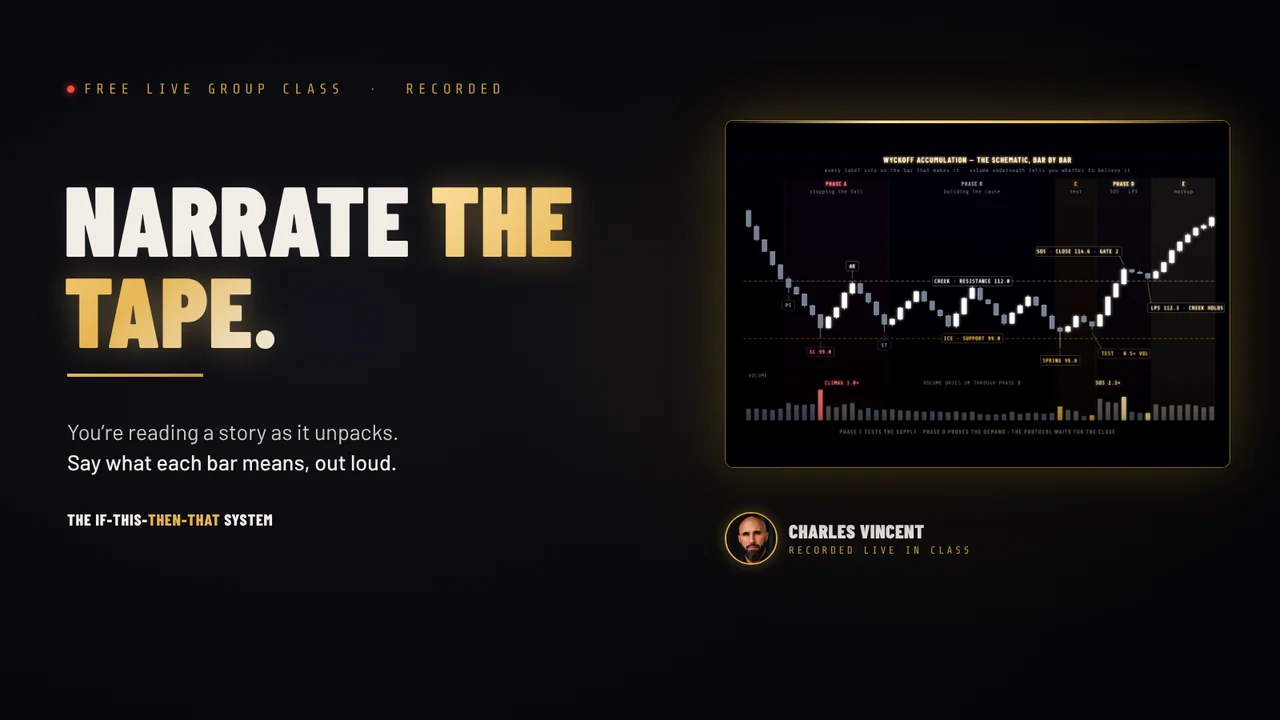 Live Group Class · 1:19:46Narrate the tape, bar by bar
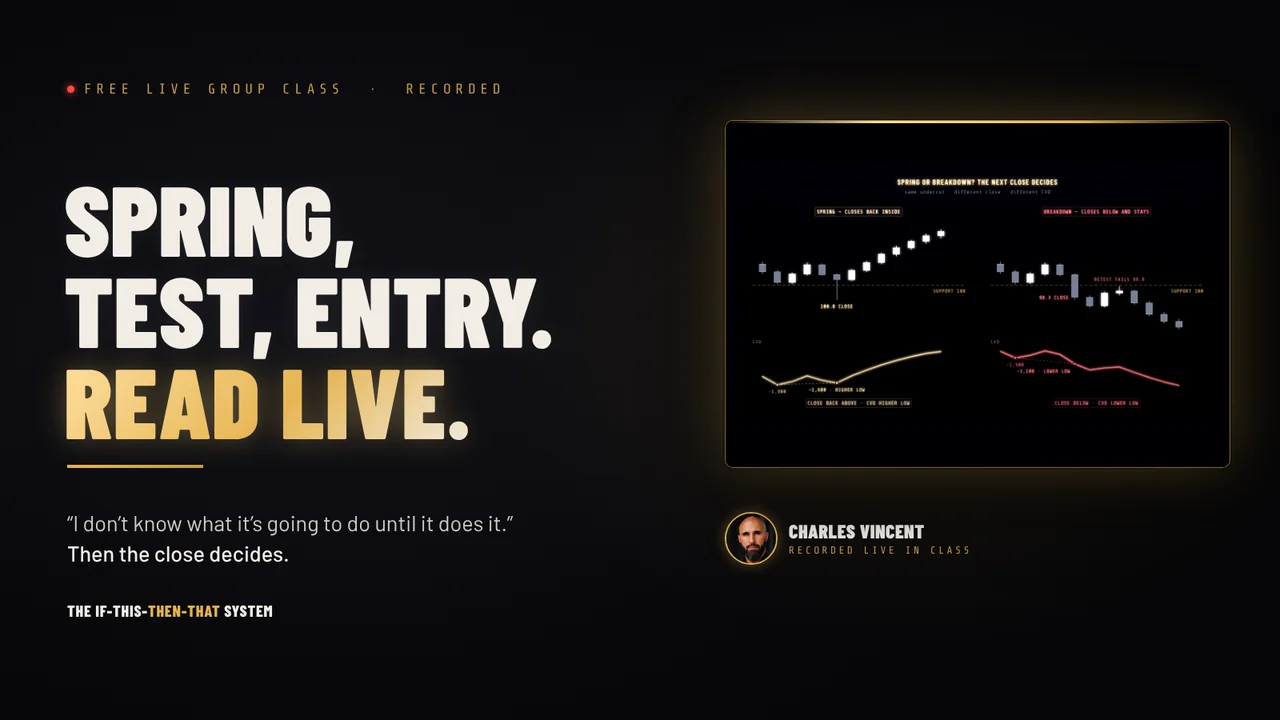 Live Group Class · 1:03:01Spring, test, entry. Read out loud
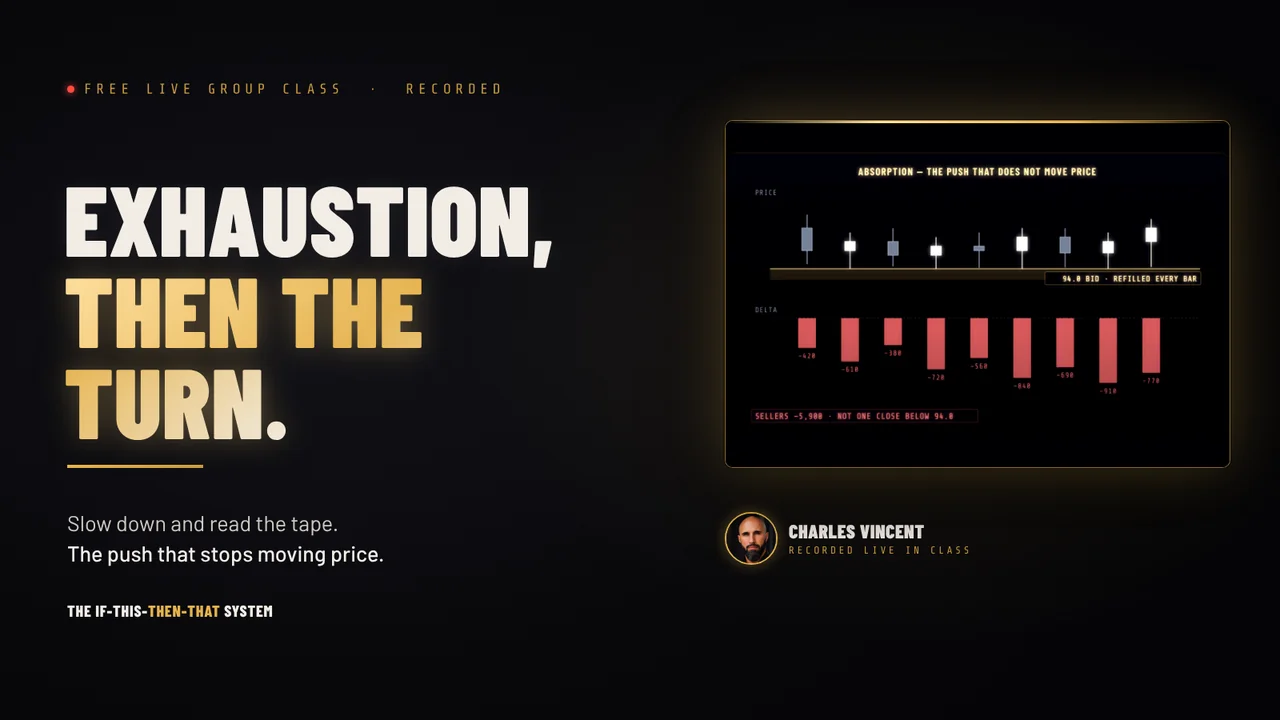 Live Group Class · 1:35:47Exhaustion, then the turn
 Live Group Class · 1:15:27Put a number on every bar
Separately, three private 1-on-1 coaching sessions are published with the student’s permission, and are free to watch. They are not classes: What are you looking at? (camera on), Structure, or fear? (camera on) and Elliott Wave, counted not drawn.
Want this one-on-one?
These classes are the group version of the work. The 90-day mentorship is the same method applied to your own charts, your own execution and your own mistakes, with Charles Vincent, three times a week. It starts with a free 30-minute application call, no card required.