Before you press play: I’m a surfer at heart and I live in the tropics, so I rarely wear a shirt, on camera included. That’s simply who I am. If that bothers you, these videos aren’t for you. — Charles
Full Class Nine · Live Group Class · Free
Leave your lines on.Then build the plan.
This class is step one. See what it builds towards: watch my edge in 94 seconds.
This class was taught live on Sunday 15 November 2026, with ETH sitting on support after a hard drop and nobody in the room knowing what would print next. It opens on a recount: Charles owns a wave count he got wrong, and the three rules of an impulse show why the deep drop was a second wave, not a fourth. Then the spring and test, with the line drawn from the highest point before the spring, and why the lines stay on the chart. Zoomed out, a line from five years ago is respected live, a weekly order block is swept twice, and Bitcoin sits on a precision point of control. The largest countertrend volume is usually the fourth wave, and an extended fifth narrows the options. Then the room drives: each student builds a plan out loud, entry, stop, target and the trigger they are waiting for, and Charles gives his own target and why. It ends on the arithmetic of one selling climax, about 9.6 times easier to push up, and homework: your own if this, then that for the longer term.
What the class covers
- 01
Recount it, then leave the lines on
Wave two cannot retrace past wave one, wave three is never the shortest, wave four does not enter wave one’s territory. A clean five up means the deep drop was the second wave, not the fourth, so it was allowed to go that deep, and Charles says plainly the mistake in the count was his. Then accumulation, manipulation, distribution in its Wyckoff form: preliminary support, the spring, the line drawn from the highest point before the spring, the reclaim, the retrace to the line, then the move. It can spring more than once. The traders who lose track of it are the ones who take their lines off. The Wyckoff method, written out.
- 02
Zoom out: what the line has to hold
The largest volume signature, a line from 2021, a weekly order block swept twice, and Bitcoin on a precision point of control, because Bitcoin moves the market. A strong move punching a wall with no follow-through has to fill its imbalance; a semi truck screeching to a halt can still curl around once the inertia is gone. The first sign of demand prints where it should, on a line from five years ago. Then the count: an extended fifth narrows the options, and the largest countertrend volume of the move is usually the fourth wave. Context first, the play second. Elliott Wave, written out.
- 03
Your plan, then mine
Each student builds a plan out loud: an order block with a decisive close either side, a change of character close with a stop below the swing. Charles pushes for structure over a mechanical ratio, then gives his own target, the sweep of the order block that started the whole move, and his entry: failure, failure, first reclaim, control bar. A large fall has inertia, so it has to stop and stabilize first. Weighed against the bars it swallowed, the selling climax was about 9.6 times easier to push up, and the trend is still down until it shows otherwise. It ends on the larger moves, tripping over dollars to pick up pennies, and homework. The tape-reading guide, written out.
Chapters
Tap any chapter to play the class from that point.
Transcript
Read the full transcript · timecoded
0:09 · Charles VincentDo you know?
0:11 · StudentYeah, cuz I wonder if you draw them after, but...
0:15 · Charles VincentYeah, my question is, before I do that, Emad, do you know what the rules are?
0:21 · StudentNo, not exactly. I know it can come lower [unclear] the bottom of the wave [unclear]. Yeah, that’s the literal only rule.
0:29 · Charles VincentSo the point is, is that when we were measuring this thing, and we kept saying the fourth, right, that was the name of this, the fourth, because this was supposed to be the third, and this, one, two, three, four, five, like that entire, this is a clear five wave structure, but this was not in the equation, not due to you guys, this is my fault for not counting, into the distance of projection of what the fifth should be. The point then, oh, if this is a full wave, this is a proper one, two, three, four, five to the top, then this is just the second. Yeah, this is not a, no longer the fourth breaching down past the entry of the first, this is a complete five, that the first wave is usually a deep retrace. That’s [unclear]. Yeah,
1:17 · StudentSo the correction, sorry, so the correction came lower than the beginning of the third wave in this scenario.
1:27 · Charles VincentYep, it swept the second wave, actually. Well, in this, remember, the actual, just to, this is a confusing map, this is the second wave, [unclear], so if it invalidates and invalidates everything down here, this is the, what’s it?
1:45 · StudentOh, I was gonna say, because that is a lower high, you know, really down to the, like, you know, on, if you back up, right, that first into the second wave there. Yeah, right.
1:56 · Charles VincentThis is, this is the first, and then the second, and all we’re looking for is a clear five wave structure, with a clear ABC, down to where was the low past the structure, but no below the break of structure. This is just a very, what’s the word, bird’s eye of it, but the point is, is that with the actual granularity of tracking this thing, that, that is the target where the majority of stops were waiting. And even when I said my own leverage stuff, like I’m, I didn’t kind of [unclear], but the point is that there is a math that is max fear, taking out the structure, [unclear] is, so just for clarity, the rules are wave two cannot retrace past wave one. Wave three, or wave four cannot reenter price territory of wave one, but this is not a wave four. This is a wave correction. So it’s different. Like if this retraced here, that invalidates the entire move of being impulsive. This does not, this is completely acceptable in Elliott Wave.
3:01 · StudentI know you might, it can be a bit confused. I don’t know if you are, if it is a bit confusing, but when you roll together, but if you take those three rules, like wave two can never retrace more than one. Wave three is never the shortest wave of wave one, three, or five. And then wave four doesn’t overlap wave one.
3:24 · Charles VincentSo this is a good example here. So wave one, two, three, [unclear], extended fifth, really sharp shot down to not just the wave four start, but also the wave two completely acceptable in bullish continuation. Yeah, [unclear] sphere. That’s just how it works. And then so again, not always the case, but it’s like same thing, five wave up ABC down. Where did we go down to [unclear] the fuck down? Like fourth is up here, right? So does that make sense?
4:04 · StudentYeah, I guess it’s reaches to a golden pocket that’s around the three point. Yeah, I guess that’s the Yeah, that’s why.
4:14 · Charles VincentYeah, exactly. And so now that you’ve said that I want to actually stack the confluence layer. So it looks like it’s I can’t see the room, but I see what’s just us. Is that right? Yeah, it’s great. Yeah. Okay. Okay. So now now we could build. So now I don’t have to [unclear] it right. Yeah, he’s he’s on a Yeah, he’s currently on a sleeper bus going somewhere. Yeah, that’s right. But but anyway, so so this thing, I want to map structure for you guys now, because this is really an opportunity to actually, it’s I fucking hate in a way, like, I love helping beginners and all this stuff. But sometimes, like, when we’re building up, if a new guy came in, and he’s like, he’s zero understanding of anything, I can’t say any of the stuff that I’m [unclear] to tell you. But the fact is, I can actually go over it. Yeah, and I have to really watch my words, because it will just, it will deter [unclear] will overwhelm it and not be like a helpful experience.
5:11 · Charles VincentYeah. And so so now, let’s let’s go over the map. So if this is, actually, at first, I’ll show you examples. So this is just a representation. There’s many other charts like it. I just don’t want to go over something too much [unclear], because it’ll just drag on. So what I’m trying to show you right now are areas. And this boils down to AMD. Do you guys know what that is? No. So accumulation, manipulation, distribution, [unclear] yeah. And so that also translates to trend. [unclear] broken with a spring, and then a test. It’s the same same thing, different different terminology. And so all we’re looking for, in this example, is a downtrend with what is preliminary support, right, highest volume signature, this is these three, one candle, that’s clearly the highest. And then that thing to be as one candle, a line drawn, we’re looking for, for a spring with a test to break prior structure, and then correctively retrace down to the prior line, then the move happens, then the real move happens.
6:43 · Charles VincentSo whatever form of ABC, this is, this just, sometimes it taps it precisely, sometimes it breaches it, sometimes it coils and fucking does whatever and then goes up. But I just want to drive you through guys, a history of how this actually unpacks when we’re looking at it. It’s again, I’m on a daily drawing these lines, leaving them here. It’s a [unclear] different story. But if you have a recognition of where we are, it gets really exciting when you see this stuff playing out, and you’re actually waiting for the interaction with it. So it’s not like a negative. But the point is, it happens in both directions. And the gist of it is it is a swing failure pattern, in simple terms, and it can be up or down [unclear] no difference. Right, so [unclear] you’re always drawing your line off your preliminary support. [unclear] line is always drawn from the highest point prior to the spring. Okay, that’s how we know it’s the level that must be reclaimed, and then tested before the proper volume comes in.
7:39 · Charles VincentIn all cases, right, like whenever we have that thing, sometimes it doesn’t play out like that. But sometimes it beautifully does. It’s literally just the create the line, seemingly channel fucking correctively forever, give us that straight shot of what is in here, a five wave to breach prior high to correctively. This is our [unclear]. A, B, C down to where we are currently, coil, then glow. It’s probably one of the most simple yet powerful tools that we have. Right? Yeah, the problem is people don’t leave these lines on and they lack recognition because what they’ll do is they’ll be like, this is my chart. Like on a fucking one minute, they’ll be here. No comprehension of what was before. No, no tie of its importance and structure and whatever it was. The actual thing that’s driving this. It’s a very dangerous game to play without actually recognizing what support is. And so that’s why emotions are driving so much of it there. Hey, well, it’s, it’s not that it’s just be objective.
8:38 · Charles VincentLike, right? No, when you’re wrong, know where your invalidations are, but also recognize if this is the thing that repeats over and over again. And we’re always waiting for the proper prior break of structure. Like this thing, just a tick above it, correctively goes down where to the prior line that that’s strongest preliminary support. Or again, in the sense of support. [unclear] clear ABC distance down, whatever the math of the wave count, it doesn’t matter. Like we very well could be right here. I actually think we’re right here in something like this. Right. And so we’ve already swiped the yes, but it can do it multiple times. And so the point is that we’re also somewhere similar to here. It’s just go down spring, break the thing ABC, then the move. So What this means on a larger scale, we can do it multiple times as well, which is I showed before the class started, there can be one spring. Another move up and then the proper move.
9:44 · Charles VincentBut before I show you structure on this one, did that one make sense? Yeah, you might be good for that. Yeah, yeah. Yeah. So now let’s actually zoom out. I want to talk about what really matters. What if [unclear] whole thing is entirety of it. Remember largest volume signature, right? Yeah. Yeah, that’s crazy. What if we’re our entirety is a multiple repeat of a really messy what is it ABC while springing testing higher high, higher low impulsive move from the lows swing player pattern back down to not just what it was initially. But [unclear] yeah stacking while we have, remember, all of these things matter. This is
10:52 · Student[unclear] Charles was that first line back 2000 what 1920 21 21. Yeah.
11:01 · Charles VincentSo remember, weekly order block two swipes. We are on remember so long ago drew that when you drew that accumulation schematic at the bottom of here. Yeah, that support those double closes. Yeah, that entire top shelf of that accumulation schematic is here. And so that I mean, again, when it stacks them all of it, but [unclear] are bouncing swiping below now above the sweet spot. And then the so And that’s on a weekly. Yeah, like, we’re getting lower on That’s crazy. There was a precision. What was the [unclear] it is. I think it was Bitcoin. Bitcoin, or I’m pretty sure it’s Bitcoin, was precision POC. Yeah, there it is. And this is one of the mistakes that I made, well, I still make, is that I don’t look at Bitcoin enough because I’m more interested in [unclear]. And so what we have to understand is Bitcoin is the mover of the market. And so if this is whatever the fuck this was different between ETH and Bitcoin, this is a clear as day five wave with the exact fifth of the first fulfilling, ABC, all the things, distance of C complete.
12:39 · Charles VincentBut also, if we’re on the strongest structure of all time in Bitcoin, while it’s on the pot, while it’s on all the things we just talked about, this is a incredibly bullish sign. This can go down further, but there are multiple levers that are being pulled right now for retest. And so now our job is to just wait and see the interactions with what we’re actually looking at. And so in this instance, there are, I don’t want to, the amount of these things that can get wicked through and then people will take the lines off. This is a difficult ask to retain this stuff. And so just simply like stack them, see if they’re respected. I don’t know that this one will be, it looks like we’re not using this one anyway. So I just am showing you to the largest move, the full candle down prior to the largest move is how we draw [unclear] order block. And so that thing, it’s been wicked. But if it gets stair stepped on and then respected and then control barred up, it’s the same as any other POC or support or whatever.
13:50 · Charles VincentAnd the fact that these things are lining up this amount of precision closes, like that, that is an incredibly strong area. Like visually the strongest area on all of the charts that has the most stacked level of confluence. So whatever the fuck this does, it doesn’t necessarily matter right now. What we’re looking for is when it stabilizes is to show us respect and then give us a control bar either through something created on it or from it. So like our change of characters on a higher time, much higher timeframe, right? Like out of it. I mean, it doesn’t matter necessarily. It’s just that it is clear and it’s a signal timeframe. So for example, like this thing, so far, if we’re starting to move, remember we talked about whatever the, actually we’ll stick on to it. Yeah, [unclear] one came in yesterday, right? Where it just wasn’t that one came in yesterday, right? Where the counter trend, you know, candle that you just wrong. Oh yeah.
14:45 · Charles VincentThe first sign of actual demand coming in at the place that it should. Yeah. Like if it wicks the lows, I can show you a bunch of examples that it sweeps the prior was this, this, what is the fourth sub wave prior
14:58 · StudentAnd then just rockets up. Yeah. Cause Emad member, you were asking that. Did you, is that what you’re asking about the fourth wave or am I confusing that?
15:07 · Charles VincentI’m sorry. My count confused both of you. My, my, this was the third wave count. This was the first wave. We’re not on the third. Yeah. Right. Yeah. Coming down to go into it. Yeah. And so the point is we have now remember on a, on a smaller timeframe, we have bounce on the line, [unclear] the line and control bar it on again, smaller timeframe out of this stuff. [unclear].
15:38 · StudentYeah. On that weekly candle, the way I see it, I see that can, can, yeah, I see that it’s something like [unclear] internal, external theory that is It’s getting the fair value gap, which is an internal imbalance, then it’s going to move for an external one, which should be somewhere around 3.5 or something like that. And maybe we are on the manipulation phase right now. And we maybe see a fake breakout on that box that you drew there. Yeah, yeah, like, like,
16:25 · Charles Vincent[unclear] is the, because of what you just said there, I’ll point this out. When we have this incredibly strong move that is punching a wall, essentially, and not instant follow through, again, two hours still close, but the point is like, there’s a gap here. And so its job is to stack to fill the imbalance. And so this thing, again, I don’t know what will happen, but [unclear] thing coming up, either this, or something like this, or whatever this is, that neckline, that downtrend, that creak, that, that, what is the range with the control? Yeah, that’s what we want. Yeah. Like, yes, fill the imbalance. I’m actually I’m long from down here to cut here, only because this, this is a move that is not, it’s not done yet, to my opinion, whether that’s sideways or whatever. What you just said is accurate. And I blame that. But the point is, a fake, like another, you know, grab and then, you know, a mark down more. Well, it’s a target, right?
17:47 · Charles VincentSo I just picture them as, remember, what is this wave count? This can be fucking anything and turn into anything. But so far, there is a gap here. There is an order block here. There’s what is resistance here, there is a clear a B so far printing that with the C projection is somewhere at the range of here. I don’t know, we can go further or whatever. It doesn’t make a difference. The target so far with this member count read the tape. What is this versus this versus this? At least double right? Yeah. So if that’s the case, and then very low, retest volume, immediately control bar it up with strength, this can just channel we’re under or resist this is totally acceptable. What we’re looking for then is remember this to be control bar down or something that invalidates this what is bullish order flow so far. And so again, the only reason I’m taking this thing is because on a much smaller timeframe,
18:44 · StudentThis printed [unclear] at the line right the other lines with those white trend lines to off of the 2021 and the other one that you drew right here. There’s also that support there too, right? Like it’s just the strongest portable time.
19:01 · Charles VincentLike this is hard. Yeah, right. But the same math applies right that that semi truck screeching to a halt. It doesn’t like it can smash the wall and its backing can still fucking curl around [unclear] like, it’s a very common thing to do that and then go up. Right once the inertia is slowed. So I don’t know what will happen, but we just play what we can. And so what we can right now, this is resistance. There’s a bunch of targets up here. This is showing signs of strength with respect of the areas. However, it’s not showing clear impulsiveness yet. It’s showing the first tell in the entire fall of some sort of demand and imbalance. That’s the best part. [unclear] the area that we wanted to see it. [unclear]. With a clear risk. Remember this line. Yeah, that line is from five years ago. Perfect respect. Yeah, that’s crazy. That’s wild. So again, it’s not a just like that line took a long time to play out in this.
20:03 · Charles VincentIt could go fucking completely meaningless. It could mean something very important. It doesn’t. Yeah,
20:10 · StudentBut I think he might. I don’t know. He sounds, I don’t know, sounds pretty, pretty right with what he said. I don’t know. Not that we ever know, but you know. Yeah, something that I learned here, which I don’t really like is that we have clear two phases. First, we try to understand the context, try to understand the environment. And I like the separation that the second phase starts when we try to [unclear] things that we know how we’re going to use this information. I really like that separation that you made and I do learn through your thank you for that. Yeah, he does it. Yeah, and you’re if this and that definitely you lay out some of this great foundation pieces. Well, the point is like
21:01 · Charles VincentIt’s I don’t, how many times I say this, this is the dangerous part, right? Like when I speak, I speak with a matter of fact kind of tone. And so if you don’t know the context of which I’m speaking, which is all this and that, then you’ll like a new person coming in and be like, he said it’s going up and then it doesn’t go up. He’s an idiot or whatever. Like, no, I’m waiting for the trigger for it to show me the thing before I actually make a move. That’s always in all cases. And so the point is like, and we’re planning and we’re at the same time, we’re planning for all scenarios, you know, so that we’re at least for what we can prepare for. Yeah, right. And that’s all it is. Right. And so like in this example, the key and I guess it’s actually a really good real time and we don’t have super beginners to contend with is that what do you guys see?
21:49 · Charles VincentWhat is the so for example, say right now is a you’re hopping on and you’re looking to find a trade. We’ve laid out enough structure so that you guys can kind of throw your own spinner or just add what I [unclear] I used or or not. What did I show you that you didn’t see? And then what do you see that you can now use in this example? Here, while you guys do that, I’m just gonna make a copy in the background so I can hear you just just I can look and see the screen too.
22:26 · StudentOkay. Yeah, yeah, I can go. The way I see it on this two hour chart is a big move impulsive move to the down direction. And we are currently in a [unclear] one that is against that direction, which is a bullish correcting one. So in lower timeframe, I expect to see lower prices. And I guess in this timeframe, we are in a bullish move. That’s the way I see it in this timeframe and in this candles.
23:09 · Charles VincentSo do me a favor, you know, just that’s you’re not wrong. What I want you to do, though, just if you can, and if you can’t just say, so it’s no problem, is that show me from what is the V wave talk? What is your way down to current?
23:27 · StudentYeah, I need to see a little more. And I need to see more candles. Sorry.
23:38 · Charles VincentSo if this is the start, and remember, we’re talking about if this is the entirety of a this is a double zigzag, right? So one move, the connector, the other move, and then this is the connector of them all. So this is the actual A, bottom, B, top, and then the start of the move.
[about 2 minutes 36 seconds were cut here, while Charles was away from the desk]
23:57 · StudentBut the last thing we heard with you, you were at that B top, and he was trying to do a count off there, right, Emad?
24:07 · Charles VincentYeah, so let me streamline this so you can kind of understand. And I heard, I don’t know how much you didn’t hear of me, but the point is, you said subjective, but the key is looking at it like this, there’s a million different interpretations that we can add to it that are absolutely, in many ways, subjective. However, if we start from the top, what is the clear one, two, three, four, five, [unclear], that tells us this wave one is out, done, we’re now wave two, and we’re starting from wave two down. And so all we have to do then is use that repeating set of rules, does one or does two retrace past one, is third the shortest wave, does wave four retrace into wave one territory, if not the same as this map, again, this takes drawing the understanding the triangles and all this stuff to actually map what is the fourth. But the point is, if you can’t count it, I don’t want to go down the ravel because it’s more advanced, because this is choppy, impulsive is much cleaner.
25:07 · Charles VincentBut the point, like, clean impulsive is much easier. But the point is, from here, can you see that this is a wave one and two? [unclear], one, two, three, four, five.
25:25 · StudentYeah, now I can see it, and I think the trick is that we should find the wave three the longest one.
25:33 · Charles VincentYeah, exactly right. And so the wave three, now, if this is the start of what is the wave one of the wave [unclear], then we just use that math for so one, two, three, four, this is a clear five wave within here with a sharp four to an ABC, right. So now, it looks like we have an extended fifth, right, because this this move is just from from here to here is longer than this. So that checks out wave two does not retrace. So now we’re looking at an extended fifth. The extended fifth has only so many options of what it could be. So that’s where it gets really cool. We can actually narrow this down. And don’t get me wrong, there’s more than one option, but it’s still just an extended fifth. And so what does that mean in an Elliott Wave rulebook? Well, all of the rules still apply. We just have to map. What are we looking at from if we can differentiate between is there.
26:28 · Charles VincentRemember, I don’t want to roll time frames because it’ll get really confusing. But within this, there is a clear wave count as well. There are triangles. There are all of the things. However, there’s also a one, two, three, four, and then a potential five somewhere around here. So the fifth of the fifth of the fifth extended could be multiple different things so far. Can it turn to something else? For sure. But so far, it gives us a clean because remember, what are we looking for in the signs of an ending of a move? Well, what is the first large countertrend volume? That thing is usually the fourth wave.
27:12 · StudentSo that’s a big one that you just said, I think there that countertrend signature is a lot
27:19 · Charles VincentOf times founded the fourth wave. Yeah, it’s I mean, it’s the move before that stops the move. So just just watch the look. Look at this. Yeah, makes sense. See this move. Yeah. The largest countertrend volume of the entire move. Yeah, right. And then the fifth wave. [unclear] can also have [unclear] what I’m showing this is the fourth wave, right? So this thing, there is another preliminary supply in this fourth wave that you can’t see on this chart, but it’s here. And so the point is, we wait for that to print, and then we get excited about catching the last leg to flip to whatever. But this is not the time to go further down yet. And again, signal timeframe is critical. But so far, we have a clear run with whatever wave counts you can figure out. This is the largest countertrend volume signature. So should this get swept if it is a support, if, if, if all the things right. And so our job is to just count and especially if we’re on an extended fifth, like so far, this thing, what is the largest volume signature countertrend volume signature that qualified this being followed through past but also they remember what we’re talking about an extended fifth.
28:44 · Charles VincentSo that shows us the math that this is very likely the nearing the end of the third wave. But it should be extended past or the fifth, which is this, which is the fourth of the fifth so far. That’s crazy how much you know, my god, well, no, it’s not what I know, it’s just the like, the linear sequence of applies. For sure, but it’s like the rules of elimination, but just having the Rolodex of like, you know, in the fifth, it can be the truncated leading ending, you know, all this stuff, right? So [unclear] almost get stuck with our traditional bias of like, what a fifth wave should look like, there’s many variants, right? This is one of the things Yeah,
29:25 · StudentDefinitely. And so, you know, releasing knowing that there are those variants, but the rules of elimination, like you said, too, but just bouncing into, you know, it could be a truncated fifth.
29:39 · Charles VincentAnd that it’s just well, when it’s overextended, [unclear] often is. And when it’s remember, if this is to be a bullish continuation, this is definitely overextended. And are we on support? A whole bunch of yes. Right. So what that means in time, I don’t know. We’ll see. But so far, this is PS. That’s all we need to know. And this is the what showing the fourth of the fifth wave extended. This is not a continuation down. Could it turn out to be? Could it show me a clean ABC and [unclear] down to infinity? Yes. But also, it could stop and it could show us a control bar back reclaiming a [unclear], whatever, whatever the thing is. Right. So right. I don’t know if that helped, but I’m going to shut up now. And I want to see from that same question I asked you guys, what do you guys? Oh, I have to take the puppy out. Just I can still hear you’re in my ear.
30:33 · Charles VincentJust try to say what you see and how to play. I’ll be right back here.
[about 41 seconds were cut here, while Charles was away from the desk]
30:37 · Charles VincentI don’t want to I’m not trying to boast or anything. But this bucket, I just walk out to take the dogs out. It’s so beautiful. Oh, man.
30:46 · StudentOh, I could just imagine I know. I’m thinking of that picture you sent me off your back deck patio there with like, you know, the water and it’s not right now except with like a low lane mist over the lake. Oh, my God. Yeah. Oh, [unclear] I’ll be there. And the pups are so quiet. Usually they’re, man, they’re going at it. Usually. [unclear] behave for me and sometimes not for her. Right. Love it. So I don’t know for me, I was trying to watch on the [unclear] want me to because I don’t want to spin off like I can do Charles. [unclear], with the daily closing in an hour and a half, don’t be decisive. What?
31:34 · Charles VincentBe decisive. Okay. What I want you to do is say two things. The reading the tape, so current differential and where do we sit on support and resistance. And unless you draw on it, don’t have all the extra stuff on because it will be confusing if anyone watches it as well.
31:56 · StudentRight. And sorry, and can you say that again with the... All of you right here are going to help.
32:04 · Charles VincentBefore that, I’m just referring to this zoomed in move. Whatever timeframe you want to go on. But right there, if you were to try to catch a play right now, how would you do it? What would you do? That’s it. Okay. Okay.
32:16 · StudentYeah. Okay. Okay. So for me off of this. Okay. So for we were talking on the two hour here, I would be currently watching for let’s see actually if I can drop it down. But with a break of structure, Charles. Let’s see here. It’s trying to look because, you know, break of structure. Charles, let’s see. Is this something I can watch for?
32:59 · Charles VincentI mean, you can, but remember, until you have a completion of the fifth, don’t expect it. Right. Or this is C. Okay. Yeah. Okay. The completion of the [unclear] or at least a C. Okay. Right. Because when you talk about also the B, this is a B up here, right? Yeah, just just I just want to say something that hopefully will add context. Do you remember the Binance hack? Okay. Yes. Do you remember the mechanic of the Binance hack after it occurred?
33:33 · StudentI can’t recall exactly. So
33:36 · Charles VincentThere was a massive, like a large cell candle, like a control bar down, followed by no continuation. Right. And after that printed, I’m not saying we’re done here. I’m not saying that’s this. I’m saying the mechanic of it was in that intern time, there was a drift that occurred on very low volume to fill the gaps. [unclear]. That thing. And then it had an exaggerated seawave. We don’t have to have the retrace within that. Right. Right. So we’re looking for then our targets of if this thing were to drift, where would it go to on almost no volume?
34:23 · Student[unclear] maybe I will ask on that one. I think he was just talking about that earlier with, you know, potential targets.
34:31 · Charles VincentWhat he said was bang on. I’m asking for illustration of that thing right now. What would be the trigger to catch it? What would be the stock, etc. Like if you were to map this as a trade, I’m not talking specifically for cap. You can if you want. But what would you do to use that information? Whatever you can use to extract profit from this picture. Tell me.
34:54 · StudentYeah. Okay. So potentially for that, all I can think of is be to catch along potentially for that.
35:04 · Charles VincentRemember, control your thoughts, right? Like, what are you talking about? How? Okay. What’s the entry? What’s the stop? What’s the target?
35:13 · StudentRight. Okay. So based on the time frame that we were talking about. Okay. Well, I got to go to the bathroom bad, but I got this. Okay. Okay. Give me a sec. I’ll be right back. Show me what you see. Yeah. I don’t like the long idea here. I guess it’s a little bit risky. Yeah. As I said, I Yeah, and that’s the short idea. The thing that I see here, I expect a correction. But I’m not sure that we have this thing or not. But maybe we can have another extended fifth wave before a real correction because of the extreme fear in the market. [unclear] I mark the real order block that I see here, which is Doji before all these moves, which my order block, I guess you can see it here. [unclear] you see my screen? Yeah, yeah, I can see your screen. The last bullish one with the last Doji bullish move. Yeah, this one. Yeah, I don’t remember the exact naming for this, but I know that it’s [unclear], it’s a rest before a move down.
37:08 · StudentSo I mark it as an order [unclear] here. So the action near this level is important for me. If I see a real close over that level, I can be, the situation shows me that, no, not the whole one. Yeah, yeah, yeah. [unclear] the trend line on the bottom. You mean? Yeah. Okay, the price displacement and the power of the candles, the strength of the candles on both sides in this zone is important for me. [unclear] any close over or under this zone can show me the next target. So currently, I’m not in long nor in the short positions, but I wait and see which part is going to take the size. If I see a strength by reading the price displacement and volume on both sides and a good close over or under this zone, I’m going to for a short or a long with a stop loss over the other side of this zone. It’s considering the [unclear]. That’s my idea. That’s my plan.
39:01 · Charles VincentThat’s good. So now just do me a favor and expand on that. So what you said is the stop, the direction, what is the trigger for the thing? Now tell us the targets and I’ll just be right back.
39:17 · StudentYeah, should I say no, or I wait for you to come back? [unclear] go for a key step in the way. You can see it. I have to get the puppies
39:25 · Charles VincentFrom not running away. There’s one fucking escape artist.
39:30 · StudentYeah, okay. If it’s in the short scenario, I expect to see another move or with a length of the previous fifth one. So I go for something like that, for something like say, three to one risk -reward, I’m just saying some approximation, it’s not exact, something like that, I guess, three to one, I’m not trying to take full of it, full of the move. So three to one risk -reward is good for me, in short scenario. And in [unclear] scenario, I’m not sure the target, I should see good levels, good selling levels, good resistance and good order blocks on the top side. So these can be my targets on both scenarios.
40:41 · Charles VincentSo that’s good. Now what I want to do is walk through kind of a, did that make sense? Yeah. Okay, so what I want to do is show you guys what, what I’m outside is, is very good for objectivity and understanding, we’re waiting for the trigger, right? Like if you’re getting in here, right? Like there was a spring lower and whatever, but the point is, so far, aside from all the other things, if we’re just on this structure, nothing prior, there’s a rough understanding of regime. We’re just looking at the imbalances to show, is this more strength to follow through up so far? And is there a continuation down so far? And so just reading the tape, just simply, if we have that, if we have that thing which took place, which is the first sign of, again, I’m saying strength in our relative basis, is there a reaction of a differential that we’re looking for with some sort of move that has a continuation? This is still highly corrective, but what we’re seeing is multiple instances of range breakers printing and closing above range.
41:44 · Charles VincentAnd so again, does that help you right now? Is that Emad’s trigger? No, but just as a further context window, does that make sense for helpfulness? [unclear] does that in any way? Because remember, just think about what I’m saying. If we have a move that is a clear differential, is this so far the completion of it by any means, by the tape? Is the tape telling you that the move is over yet? Or is it telling something different so far? I’m not saying there’s a trigger yet. I’m saying your observation of what’s unfolding as it’s unfolding is key. So just reading the [unclear], does that tell you anything of value? On any time frame? True.
42:55 · StudentFor me, it does. Emad had said something there. I don’t think he liked the idea of the long. He’s waiting for the trigger. He’s waiting for the branch of each direction. [unclear] sure. Yeah, yeah, being open, open to both. But like, is it anything with us coming off those lows and like we’re making, you know, we’re stair stepping up. I’m not saying by any means it’s bullish, but with us sitting on the preliminary support. And if we do get a strong, you know, call it a, you know, a strong change of character or something out of this.
43:33 · Charles VincentThat’s, you know, that’s, that’s a support, right? Like we’re sitting on there right now. Yeah, but there are also many other ones that we don’t have drawn on here, right? And so the point is the larger, the largest of all, have just now control bar up. Right? From that place with what is so far PS. And the question is always, is that thing completed? Because remember, just in terms like the wave, the tide is going this way. Yet we have a rip of a wave sucking it back out. It doesn’t require nearly as much force to get that fill that is the empty pocket. Where is the empty pocket? That’s always the question, right? Like, these don’t pay attention to the extensions of something different. But the point is, is this thing a coiled bull flag, a pennant, a triangle? Or is it weakness that’s not making new ground worth speaking of? And if so, what is the prior to breach of the what is the order block?
44:36 · Charles VincentIs there are there tells showing us the internal how this is actually unpacking or not? That again, like you do whatever you want with your triggers. But the point is our job is to assess as this is unpacking, what is taking place? Bullish order, bearish order flow. Bullish continuation, bearish continuation. Range just straight sideways, indifferent. Also there’s an option. But what you might just said is that so far, it’s [unclear], which is fine. He’s not wrong. But internally, is there a bullish order flow or something showing negative failure or weakness? I think it’s bullish order flow. So far, just higher highs, higher lows, right? And so, right? Is this a strong continuation? No. Are we on also? What is it for you guys Sunday night? This is a high volume time. Yeah, right. Yeah. So, so. These things taken into account. What do we gauge? Like, has this shown us punching a wall? That is the prior order block that is the golden pocket, and then range breaking up with continuation?
45:51 · Charles VincentIs that a move? Sure, could be. Are we in it at the right or are again, this is a separate conversation. What I’m trying to get from you guys is to assess how to if targets remember, Emad is going to enter if here for whatever the trigger is to whatever the next step is. [unclear] as far as what are we in this area? Like, what do you see true for resistance? What would you, what would you catch? Like, where would you, what would your targets be?
46:22 · StudentYeah, so I would, you know, I know, I know Emad had talked about that three to one R.
46:30 · Charles VincentThat is, I’m just wondering. The trade aside, what I’m asking, like, this specific three to one is a very mechanical way to look at it. [unclear] it’s not wrong. It’s just I’m asking you to assess structure from what you can see right on this chart.
46:45 · StudentYeah, on, on this chart, I would be looking to take so a minimum of, you know, a minimum of 2.5 rate that we talked about was not the [unclear]. I don’t care about that. Yeah. Yeah, yeah, right. I would be I would be taking it. [unclear] this swing. [unclear], I don’t know if you can [unclear] this. Okay, so that would be on yours back on the 14th. So for structure, um, like, I would be looking to take it up into structure. Oh, sorry, just a sec. Can you see it now? Okay. So dropping down, I think you have it on 30 minutes.
47:48 · Charles VincentThe timeframe I had it on doesn’t matter. I’m asking you to show me.
47:52 · StudentYeah, okay. Just for a target, I would be looking to take it to a next swing. If I’m looking for a change of character here, I would be just eyeing for what we’re looking at on our screen. I would be looking to take it up to, I just want to look at, structurally, with our ABC that was printing, and then with our preliminary support. I would say that my first target would be for the next swing up here.
48:30 · Charles Vincent[unclear]. And where would your entry be? What would it be? Yeah.
48:34 · StudentYeah. So, you know, potentially TP1 there. And then my entry would be a change of character. TP1, you’re saying you have more than one TP? Sorry. Say that again. No, right. My full, right. No, for my target, that would be my full right there. [unclear]. And then looking for a change of character to break out of here. So with the, like, I still think that there is a bit of bullish price order flow here after we came off the lows yesterday. But, you know, like, I just don’t feel that clear indication of, you know, we have an entry yet, like, Emad was talking about. [unclear] would it be? Right. Okay. Yeah. It would be a change of character closing on a higher timeframe breaking these closes.
49:41 · Charles Vincent[unclear]. So you’re saying a control bar closing past that? Yes. Okay. Yeah. With a close, not a link. Okay. And where would it just not be?
49:54 · StudentMy stop would be at the previous swing before that’s taking it pretty low. I would take it for the swing. This is where everybody would get, you know, if we are... Well, it’d be from my previous swing here. Okay. So... Oh, and actually it’d be .4. Sorry, with ETH, we do .45 % below the swing just for a bit of an offer.
50:24 · Charles VincentYeah. Okay. So that’s good. Now, I’ll tell you my targets, the reason why they are where they are and all the things are... Can you guys see my screen? Yes. So same thing like... I already know it’s going to be way higher. No, it’s not a... It doesn’t matter. Again, if this plays out, this is not the move I’m going to take care of it at all. This is just an end term. I’m sitting in the front of the turret, so I see a thing. I’m going to use the thing. [unclear], zooming in to see what is the actual first tells of this, like, go way down, watch the sweep with the Reclaim with how many engulfing that thing while breaking the trend line and retesting perfectly. Like, this is a really clean play. Where to? Can you hear me? Yes. Okay. This came in so glitchy. Anyways, so this thing, so far, like we talked about, where are the targets? What is invalidation, but also what is a high probability?
51:31 · Charles VincentFrom a more zoomed out picture, the sweep of this is my target. Wait, hold on. Yeah, right here. Right around there. Somewhere, I can’t remember the exact number, but the point is that my invalidation currently is a low, because that was a solid R, or I’ll move it up as the, like I said, the order breaks. Your stock, sorry, what was that, the low? The invalidation currently is that. Okay. Yeah. Once it prints up that, pass that order block, then I’ll move it to the, what is the below the order block. But the point is, is that, that point here, that’s the sweep target, for me, full cut, to whatever happens after. What made you choose that target? The order [unclear]. Oh, okay. No, no, like, let me show you. So, remember, what is the start of the move? This, right? Where did it go to prior to moving? [unclear] is resistance that failed, that started the entirety of the move, right? So this thing, the highest, most lucrative target that it shows still continuation is to sweep the multiple stacked closers at the order [unclear] that originated at all.
52:58 · Charles VincentWill it make it there? I don’t know. I have no idea. But this is where my targets are, and I’ll trail my stop. And then whatever happens after is a completely separate conversation. But this, so far, that’s the start of the move. So these two, I’m a couple ticks above here. Hold on one second. Okay. Yeah, meanwhile, I think that’s where I was going to say for my first target. And I’m like, oh, it’s going to be, you know, too high. [unclear], we’re in a vacuum, right? Like, this is a low, low volume area. It doesn’t need a lot of follow through. It just has to have some sort of exact, like, even in terms that you guys remember. [unclear] drift up here, that what is the first sign of something, followed by a really choppy follow through, and then that exaggerated C. Like, that thing, that really strong move that gets the majority of people long before it goes down. That is a common occurrence in this type of thing.
54:07 · Charles VincentSo, where would the targets be? Here. On this timeframe, it’s different. The point is that somewhere within this range, that order block is where I would look for failure. Is this the right timeframe? But the point is, somewhere within this region. And so, again, different conversations, similar math, though. But within this place, that’s what I want to see. [unclear], what was your entry in it? Like, was it the range breaker out of all this that we’re in currently? Well, I’m watching. I’m sitting here counting. Remember, I’m looking for this with this to be reclaimed. So, the first sign of high volume failure, followed by a second sign of high volume failure, any of these zoomed in with a differential that shows me pause. [unclear], not continuation failure, whatever word you want to call it. The stack of these, and then the continuation [unclear] bar back up. Like, that plus that, plus that, all stacked up, shows an imbalance. After a failure, after a failure, first reclaim.
55:13 · Charles VincentWhat about for current price action, where we are? I don’t care what end is. I’m in the move that does the thing. I’m playing this. Yeah, I know the big one. Yeah, for sure. I don’t get anything from that. Like, all of the weight goes to what the move I just said initially, in the beginning, for this thing. All the inter -meters, I don’t care. I’m just looking forward to, yeah, like, like, remember, what happens? Just just think about it, right? Like, just in the background. Oh, yeah, they’re the best. So what we’re looking for is remember, this is a large fall, there’s a lot of inertia, we needed to stop, stabilize and then show us the thing. If it wants to do one of these, I’m okay with that. But don’t expect it. [unclear], like, this thing is actually a very similar mechanic to where we are now. But all it is is just show us that first sign of [unclear] is the wrong timeframe, but preliminary support, break back to an area of resistance, swipe some sort of structure, and then do the actual reversal.
56:30 · Charles VincentThat’s the trigger. I don’t know that will be the same here, but I’m looking for either a sweep reclaim with control bar, the control bar and above a thing while breaking all the other stuff. That’s the point of this.
56:43 · StudentYeah, okay. Yeah, do you see that you mod with like the higher timeframe where he marked that off what he’s like the big move he’s waiting for. Sorry, I missed it. Oh, I was just saying, did you see that with like the big move from the lows, like, Charles, what am I trying to say without confusing here.
57:10 · Charles VincentYeah, just asking if he’s on current. Yeah, okay. Yeah, like whatever this is. Did that make sense? He’s saying. I think. Yeah. [unclear] remember largest volume spike down. Carry it forward on a larger timeframe. This is the proper move that I’m looking for. Okay, wind up confluence to be now stabilized upon. And then whatever, whatever range it creates or thing, I’m looking for this, this type of sweep punch a wall high volume [unclear] look at that. Yeah, that thing in itself is, in my opinion, this support right is that is like this move this retrace to here is a brilliant entry for long to where a separate conversation. But what I’m saying is that thing by itself, that is an incredibly just do the math, like, while we’re here, I want you guys to just map this for me. So remember, this is a selling climax. This is a [unclear]. No control. No, no [unclear] below. Weigh these two for me.
58:27 · StudentOh, I’m so good at this. The tape was for [unclear] You might also have the tape was for but if you [unclear] of anything where it is. Okay. It’s just trying to load for me to set. It’s also like Yeah, it’s like super slow in my area. Okay. Not giving me on the pro I’m just gonna switch it So that math is wrong. [unclear], it’s totally wrong. Here I’m gonna do I’m gonna do [unclear]. So it’s just I’d call it times the spread. Okay, and then I call it about 1.2 times the volume.
59:43 · Charles VincentSo remember, what we’re doing right now is we’re weighing it against the moves it engulfed. This is, we can just do this separately. That’s totally valid. But also there is more weight that it does actually, that it did earn. So just this, an eight times spread difference. And then what’s the volume difference and what does that equate to? Roughly. Yeah, it was about nine, just under 10, 10 times the ease to push
1:00:11 · StudentUp. It is 9.6 times the ease. Sure,
1:00:15 · Charles VincentBallpark, right. And so now if we add all the rest of them in, that’s a completely different conversation because this is the actual climax. And so the point is that, is that to be met with some sort of immediate role? Probably not. But the true tell is, is there a follow through or is it another stacked shot sign? And again, whatever timeframe, the greatest signal, is this a move up, right? Is this a bullish continuation or not? And so this thing, whatever, if we just zoomed out and call these dailies or three days or five days or weeklies, this is what I’m looking for, something like this. And then in a very, just things print linearly, we have just sprung. We’re somewhere within here. We’re going to swipe that fucking order block and then sweep the lows and then print this over the next coming days, whatever. That’s what this could potentially. [unclear] could happen too, right? Did that make sense? Yeah, totally. [unclear] do you think, so do you feel it is making bullish order flow right now or can’t say right now?
1:01:27 · Charles VincentI don’t feel I can see. Okay. That’s why the whole question of asking to read the tape mid channel, I’m looking for, is there a increase of bullish volume or increase of bearish volume, increase of bullish result, increase of bearish result? Right. Which is it? Increase [unclear] bullish result. Yeah, simply right. And so just just compare. Remember, whatever timeframe you want to go on, this is not strength. It is a range and then immediately double engulfed with half the volume and then another range. Yeah. And then another imbalance. Like, yeah, I don’t know what’s going to print. I don’t know the follow through. But the point is, it doesn’t need much in these vacuums, these pockets, right? Just to pop up where to. And like, it doesn’t matter. Yeah.
1:02:16 · StudentAnd even like this current price candle, like, of course, you know, it’s just started and it’s saying really nothing right now. But we get a close above all this. It’s again, just, you know, it’s all pointed in bullish, you know, right?
1:02:32 · Charles VincentYeah, I mean, this can continue on forever. It can continue down forever. I’m not saying I’m not calling either one. I’m just saying I’m waiting for whatever the range to be created just like here. But on a larger time frame and then control bar up with actual with intention on a clear daily, like we’re on a very small time frame, right? Like, what is the simple terms? Hey, is this a downtrend or an uptrend? A downtrend. Yeah. Does it show yet signs of an uptrend? No. [unclear], so I want to I want to be on the highest signal that shows me the clear wave structure, which is something like a three day. And I want this to tell me. Yeah. I’m not saying this is that will be the end one result. I’ll enter earlier. The point is that we’re still in a downtrend. Yeah. So I need to show me an evaluation of the current downtrend. How do we do that? A whole bunch of different ways.
1:03:35 · Charles VincentBut let’s just remember simple terms. The highest probability is that this thing, whatever it is, wherever this actual line is, will reach up. And fail and roll and retest or something. Again, this is not a precision line. But the point is, wherever the thing exactly is, that I want to see broken with strength and then optimally tested with strength. Bullishly. And then also the neckline creates. Does that make sense? Yeah. Yeah. So, do you guys have any questions? No, I don’t think so for me.
1:04:29 · StudentNo, I don’t have any.
1:04:31 · Charles Vincent[unclear] so, do you guys have any interest? I know, Drew, you’re kind of just following along for the larger moves, but do you guys ever intend to play the larger moves yourself or is it always the smaller stuff?
1:04:56 · StudentTo me, it’s not yet a move to the larger moves, but the way I see it and the way I understand you’re telling it, I see something that works to invest or something like that. That’s the way to trade or things like that, but I see the potential for a big move, so I see that as something invest for
1:05:26 · Charles VincentFuture, but not for the trading part. Yes. So, like, no leverage, no liquidation chance, just basically like a DC. That was crazy. Was that right? Can you guys hear me? Yeah, I can hear you. Sorry. I don’t know what it sounds like on the background, but there’s probably no voice. Usually I read manages the crazy boy in the background.
1:05:56 · StudentOh, that’s all good. She’s not here. Yeah, no, he was just saying, [unclear], what did you say there that it wasn’t, you’re not necessarily doing the bigger moves,
1:06:03 · Charles VincentRight? [unclear] only high leverage is what the high leverage, right? But as a long term potential for investment, that makes sense. And that’s that’s the right way to do it. [unclear] long as you don’t get what is the term, tripping over pennies or tripping over dollars to make pennies kind of thing like that is such a critical, especially in this place. Like I’ve been here since I bought my first bitcoins at $1 ,000, right? Like I’ve been through all the cycles, all the ups and the downs and with way less experience. But the point is like I now have an actual representation of what the math forward looks like. And most times in the beginning, we’re just trying to like grasp, you know, the basics. And this is important. This is the fundamentals of it all. However, there’s other math playing in the background that you should be aware of. Yeah. That if I [unclear] I could tell myself my past self what to actually look at, it would be that first and foremost.
1:06:58 · Charles VincentYeah. And so, yeah. But but how do you do that? That’s the question, right? Like, how do you actually while all these, you know, intern moves, whatever are happening, how do you actually project that math forward? This is a how many holes can be poked in the past performance does not guarantee future results conversation you’d have with yourself in all the I don’t know what I’m looking at times 1000 backwards. This is a difficult conversation. But the point is, there is a math playing out. And so just simply inflation with anything that is a finite or near finite. [unclear] the dollar. It’s a long term game that only goes in one direction. There will be [unclear], yes, but also asymmetry in this place is completely insane. And with that comes extreme volatility. So I don’t want to go off on a tangent. But as long as it made sense, we’ll pick up here where we left off today, next time. And then what I’d like for you guys to do, if you can plan and then Drew, I need to [unclear] this.
1:08:10 · Charles VincentTry somehow to be objectively not mirroring what I’m saying. And come up with the both of you guys, if you can come up with a game plan to if this then that longer term, because I already have my what, again, macro structure and whatever. I’m not done waiting. I’m just I’m here. I’m just waiting. So [unclear] would be helpful if you guys forced yourself to come up with some sort of longer term actual entry plan targets and stops and all the things. Because that helps your brain map what is actually most important in this place. Okay, and the longer you don’t do it, the longer you don’t learn it. That makes sense. Totally.
1:08:53 · StudentSo yeah, no, definitely. And thanks for pushing us to you know, like with with this stuff and putting these on [the video ends here, at 1:08:59]
The class as uploaded. The recording starts mid-conversation, a few seconds into a question about the rules of Elliott Wave, and ends at 1:08:59 as Charles sets the homework; a short exchange after that is not part of the upload. Three short stretches were cut: under a second at about 21:14, about two and a half minutes at 23:57 and about 41 seconds at 30:37, the last two while Charles was away from the desk. Both are marked where they fall in the transcript. Before upload the webcam picture was colour-corrected: the camera drifted yellow, then strongly orange and red as the sun came up, then hazy against the window, so the face inside the round webcam frame was brought back to a natural tone throughout. The circle is also blurred for the eight stretches when Charles steps away from the desk, mostly to let the dogs out; the audio runs on underneath. The charts, the audio and everything outside the webcam circle are untouched. Attendees are labelled Student rather than by name. Speakers were told apart from the audio, so where two people talk at once a few words can sit under the wrong name, and lines from different students share one Student label. Words the audio does not clearly support are marked [unclear] rather than guessed.
In this class Charles talks about his own trades, his own targets and the cycles he has traded since he bought his first bitcoin at $1,000. That is his own history and his own risk profile, told as context, not a recommendation and not a track record: nothing in it is advice to do the same, and no one should copy anyone’s size. The students’ plans, with their own stops and targets, are their situation and are worked on in the open as examples of how to think. The multiples read during the class (about 9.6 times and so on) are readings of single bars at that moment, not statistics, and the live market went on to do whatever it did after the class ended. The language is blunt throughout and is left in. It is a teaching class, not a track record, and nothing in it is a performance claim; the documented results live on the protocol results page, with sample sizes attached. Educational content only — not financial advice, and not individualised to your situation.
Live · Every Sunday · 22:00 UTC
The class runs live, free, every Sunday.
Open to complete beginners, with no sign-up. See the next class in your own time zone, add it to your calendar, or have the link emailed to you before it starts.
See The Next ClassMore recorded classes
 Live Group Class · 1:29:12Ten times easier to push up, read live
 Live Group Class · 1:13:39How to play the largest hack in history
 Live Group Class · 1:19:46Narrate the tape, bar by bar
 Live Group Class · 1:15:27Put a number on every bar
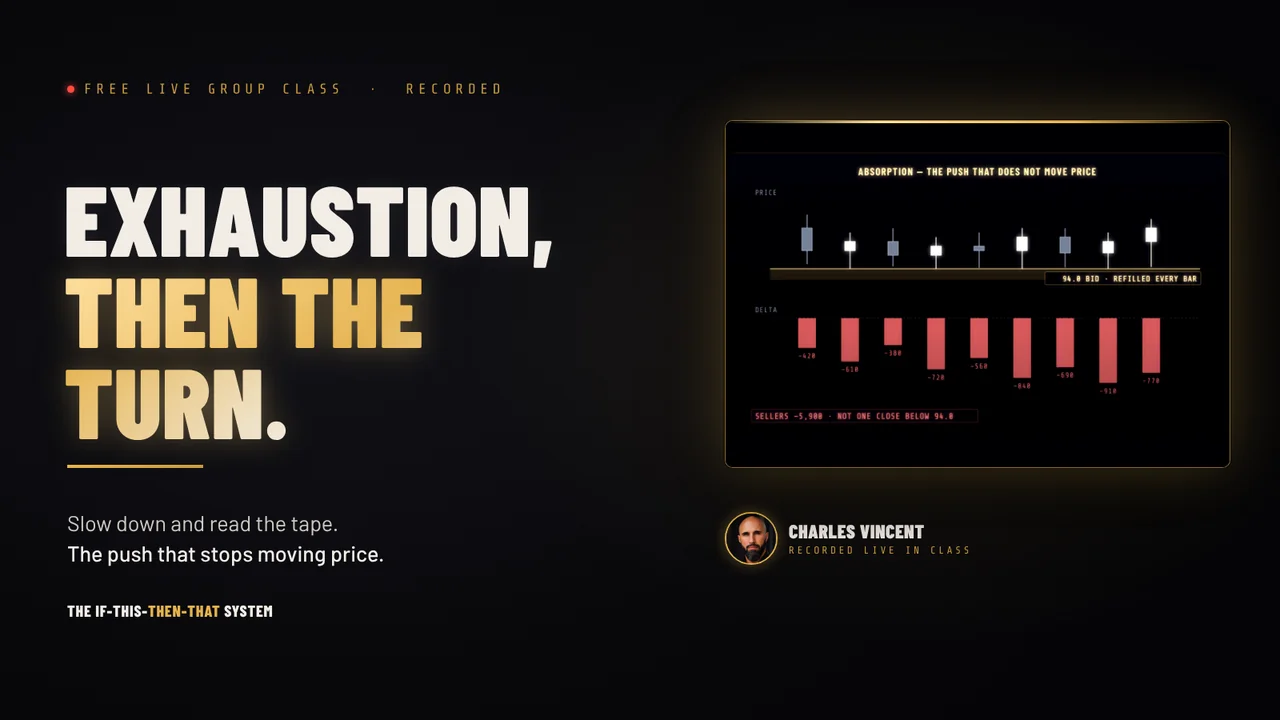 Live Group Class · 1:35:47Exhaustion, then the turn
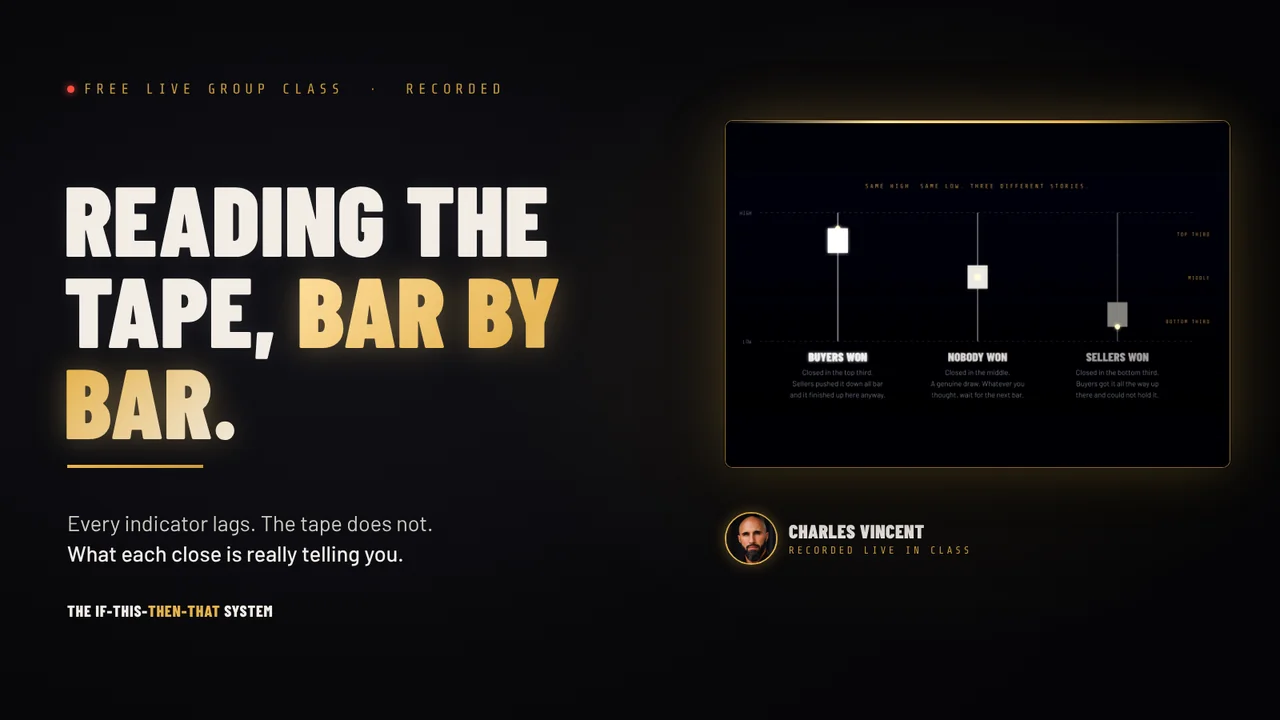 Live Group Class · 53:55Reading the tape, before anything else
Separately, three private 1-on-1 coaching sessions are published with the student’s permission, and are free to watch. They are not classes: What are you looking at? (camera on), Structure, or fear? (camera on) and Elliott Wave, counted not drawn.
Want this one-on-one?
These classes are the group version of the work. The 90-day mentorship is the same method applied to your own charts, your own execution and your own mistakes, with Charles Vincent, three times a week. It starts with a free 30-minute call with me, no card required.
Not ready to talk yet? Sit in on the next free class.