Before you press play: I’m a surfer at heart and I live in the tropics, so I rarely wear a shirt, on camera included. That’s simply who I am. If that bothers you, these videos aren’t for you. — Charles
Full Class Eight · Live Group Class · Free
Ten times easier, read live.Do the math. Then wait for the fourth.
This class was taught live on Sunday 8 November 2026, minutes after ETH dropped hard through its local lows. Nobody in the room knew what would print next, and that was the point: read the tape as it prints, with no hindsight. It opens on a student whose long had just been stopped out, and goes straight back to if this, then that. Charles flips the drop upside down so it reads like a move up and walks the sequence: a corrective move, range breakers, and a 3.9 times multiple engulfing close below the neckline. Then the small timeframes, bar by bar: a selling climax, effort against result worked out by hand, and late in the class a bar that closed about ten times easier up than the three it swallowed, followed by a control bar above the neckline while the class watched. The question after that is the one that matters: what is the entry? The answer is to wait for the fourth to retrace into the OTE, the same CAP setup on repeat.
What the class covers
- 01
Read it as it prints
A student gives his bias, then admits the move just stopped him out, which is exactly the moment to go back to if this, then that. The drop is flipped upside down so it reads like a move up: corrective retraces, a range breaker, the entry of the entry, then a 3.9 times multiple engulfing close through the neckline. A bar that gives back half or more of its move is not strong, and the tape shows intention before any headline explains it. Each student is asked, one at a time, whether they can see it. The tape-reading guide, written out.
- 02
Effort against result, bar by bar
On the three-minute chart after the drop: a selling climax, a control bar up about 2.6 times easier, a push down 1.4 times easier that hits a wall, then a range break about 5.4 times easier up. Does that mean up yet? No. A student does two candles by hand (half the distance on about 1.4 times the volume, so about 2.8 times harder to push down). On the way: why stops in a cluster fill in sequence and then all at once, why the signal timeframe is the tightest cluster of bodies, why a line stays on the chart until price reacts to it, and how wave one projects where a fifth should fail. The Tape Whisperer and Elliott Wave, written out.
- 03
Ten times easier, then the plan
A spring and a test, each push down on less volume. Then one bar closes about 20 percent beyond the three it swallowed: stack their volume and it was about ten times easier to push up, at the area a bullish move would be expected from, and a control bar prints above the neckline live. So what is the entry? Not chasing it. Wait for a fourth to retrace into the OTE, the same CAP setup on repeat, and have a concrete plan for what you are waiting for. The rule of alternation, what to do if it never pulls back, why Charles plays the larger moves, how badly he started, and why the boring repetition is the whole job. The CAP, gate by gate.
Chapters
Tap any chapter to play the class from that point.
Transcript
Read the full transcript · timecoded
0:00 · StudentWhat is the right call for right now? For currently, well, for me, I okay, so my bias is we are in the third of the third. I would like to see,
0:14 · Charles VincentObviously, the third
0:18 · StudentOf the third on a higher timeframe. So on a, you know, on the monthly, weekly, and even our daily, right, we’re in, but I would want to I think see some closes just for the current price action currently right now but also we’ve with the break of structure I’m seeing a couple things so the break of structure we also had back a little bit ago if you were to mouse over on your diagram there no, even back further for a long, for a long bias. I don’t work. Call the dates out. Okay. Yeah. 20 right around the 30th. Yeah. the bigger break of structure there for long. Yeah. Yeah. right.
1:13 · Charles VincentAre you saying for longer? Sure.
1:15 · StudentFor a long, for a long break down is a trigger for a long break up. So yes. Yep. That break. Yep. Yeah. so you know something like that but I think just I’m I’m still currently in a trade but for my bias that’s kind of what I’m seeing so I want to see close I think on a higher time frame but you know also catching it as well
1:51 · Charles VincentSo sorry you’re long you’re in a trade yeah right and so your bias is up because of your prior trade, but what was your invalidation?
2:01 · StudentMy invalidation. I, my invalidation for, well, actually, you know what, with just what, what happened on the current production I’ve been, I’ve been stopped out.
2:17 · Charles VincentSo now we’re back to if this, then that right. What is,
2:21 · StudentThat’s right. Is, what is this? Yeah. So that was actually my, that previous low there. I had, you know, set up off CAP for that trade and exactly what’s happening right now in the price action stopped me out. So yeah, on to the next, if this and that, I would, I would like to mark off that break of structure that I just referred to on the 30th. Mark my fibs once we, once we get a close you, I’m just thinking here.
3:00 · Charles VincentI just want to show you something, because there’s a sequence that unpacks that I don’t know if you guys are watching in real time, but it’s critical to understand. So this is up and down, same thing, it shouldn’t make any difference in your bias, you should see the same thing. And so, if we’re looking at this move, I’m just going to use up because most people have an easier time to see up, then again, this is just a straightforward,
3:28 · Charles VincentI’m not Right? This is a move up that correctively comes back down, right, and then range breaker with another weak corrective move with another range breaker that broke above both ranges. Right? That thing is the entry this way. This thing was also the entry this way, right? Corrective, range broken, engulfing 1, 2, 3, so notch those up and actually slap on what was the, there again, this is, this is upside down so I’ll just flip it so it’s the right direction, but it’s a 3.9 times multiple engulfing range breaker of the entire range lows while also making decisive close below the neckline,
4:23 · Charles VincentRight? So, anything that is sub 50% of the move, like this is close, but it still counts as a close because it engulfed all those while, correctively, this is the yodeling man and the price is right, if any of you guys remember, right, just, we’re waiting for the failure. This is the failure. This is the first and then the second punch, right? Like that thing, remember, if we’re talking about a momentum move,
4:52 · Charles VincentRight, sweep the prior, right in the sweet spot, all the layers of confluence lining up, that.
5:02 · StudentDoes that make sense? It does. So would that be the opposite of what I was saying?
5:09 · Charles VincentWell, no, that would have been your early exit, right? Like if you’re paying attention to these things, you can actually gauge like, okay, what am I looking at? What am I supposed to be looking at? Like, yes, this thing, that’s my stop. Sure. Great. Am I in a trade? Remember, we’re talking about multiple things. You have a bias, which is up, but then immediately intention shows down. This can sideways and easily coil off of what was the the [unclear] and then blast off to infinity. But also the majority, remember this is a super inefficient way.
5:39 · StudentBecause that’s what I thought happened just kind of riding through it. Like you know obviously it can go any way, but I guess once it did make that move down and started chopping like it could have, you know, it could have went.
5:51 · Charles VincentOf course, but the point is to read the tape, right? So in this example, just simply sideways, right? There’s no secret to it. It’s just linearly going through one by one, just printing, what is this? Is this control bar? Again, 50%, so not quite decisive yet. But when we get multiple attempts and failures at what was resistance, that thing is telling us no follow through with the range breaker, which is not just the range, but also the entry to it. That’s a that’s a massive difference and then again, are we seeing a follow-through or a lack of follow-through? And is it directionally telling us strength remember? Supply or not. What is the imbalance again? 3.9 times like 400% easier to push down there’s a I don’t want to go too far down the what is happening now currently with all the Jensen and the Chinese spy and the fucking war and all this shit. It doesn’t matter. It’s just max fear can easily right spark something that will just trigger something and then everything goes but the point is this is the early tell like the the it always you can always read the chart before the the news actually says what’s going on most people don’t understand that because they always just attach a bias after but the point is did that make sense as we’re going through this it did can you see that I’m out is it I can’t see that it gets very
7:23 · StudentInteresting when you said that like how stuff gets priced in as well you know what I mean? Yeah. Like it’s all or things are already priced in a lot of the
7:30 · Charles VincentTime too. Well it’s not priced in, it’s just that the tape tells you before the news ever will. And so the point is most people just don’t actually read the tape. They just, they’re hoping and waiting and again like I’m not saying what you’ve done is wrong for setting an invalidation, letting it so you can get it stopped out. Mechanically trading is good, right? Until you can have a discernment, a level of actually understanding of what’s printing in real time, do that, right? But the point is like in this example, can you guys all like, I’m going to ask each of you individually, can you see what I’m saying? Can you understand that that thing is showing intention in a specific direction over and over again with specific matter or areas that matter or is it invisible?
8:14 · StudentYeah, you guys go. I’m going to shut up. You guys go.
8:18 · Charles VincentMaybe he might go first. Okay. I don’t know if you can hear. Just because he’s had more time.
8:24 · StudentYeah, yeah, I can see it. I see some signs of contradictions, but mostly most of them are showing the same. Yeah, I see it.
8:36 · Charles VincentAnd all we do is just play that thing. So in this example, like zooming in down the lower timeframes, there’s so many cases of what are creeks, what are the specific breaks of it. Remember, this range breaker showed on a whole bunch of different timeframes. And this is not an intentional loop. This is weakness, right? Just something better illustrated on the higher timeframe. But then this is a control bar, regardless of the timeframe. And so our job is to just roll through what is the most signal timeframe. And that’s this, on this cluster. So did any of you guys catch this move? Or would you have caught this move? If it happens again,
9:18 · Charles VincentI’ll take that as a no.
9:20 · StudentI guess because I do range breakers, I will catch this because I see these signs of momentum building toward the up in this scenario when you reverse it. So I think I will catch it, yeah.
9:39 · Charles VincentOkay, good. And so Rafa, what did you take on this?
9:43 · StudentWhat I’m understanding from this is that you have the order block which you’re using as a resistance point. You have the price trying to retrace back and close above the order block, but due to the volume, Due to the The volume is not able to break through. This is a signal that you might have weakness. Then you have a range within side that range and then you have a closure with strong volume outside at the 11 o’clock candle. This is showing that because of the weakness before and then the strength of closing below that, you can then anticipate a further move down.
10:35 · Charles VincentYeah, and this could actually, across history, this is about a 50-50 shot. For all the examples and all the bottomings and all the momentum moves, again, what way it’s going to go, I don’t know. But it usually does tell us. So for example, if in many of the examples this one would have printed down just like it did identically and then reversed immediately, showing us that not today. And that invalidates this, which is great for a bullish move. But if it doesn’t, that’s the key, right? And so to micro-zoom in and actually assess, what is it printing? Is it telling me that thing that we want to see for a bullish retracement, or is it telling me the opposite? Is it telling me immediately range breaker down again, down, like even this is actually technically the range breaker, the entry of the entry. And so again, the best part about this is we just play the moves. And so now, on what was the actual time frame that matters, Because this is still an impulsive move. So in this case, we know, Drew, you’ve mapped this a bunch of times. What wave are we in right now of this from the lows?
11:47 · StudentFrom the lows there, we are in the third wave. Yeah, we’re in the third wave.
11:54 · Charles VincentSo one, two, three, four, five of the third. So this is what?
12:01 · StudentWell, that’s our ABC. This is right there. Fourth wave. The fourth wave, right? Yes.
12:09 · Charles VincentSo the fourth wave of what was the retracement after the third wave. So what comes after the fourth wave? Our fifth wave. Yeah. Right. And so in this example, remember, this is a massive fair value gap. This is still a huge area of support. This is a cluster. I don’t want to go too deep down the weeds, but the point is this across time is a very heavy cluster. And where do we go to a gap and then potentially bounce in reverse? I don’t know that will happen, but the point is there’s a whole bunch of lineup confluences that we still have to understand. We’re, we’re now bouncing down off them once they support that’s bearish, right? Right. Also the count, this count is how it usually plays. And so remember when we, when this printed, cause this a massive important, what’s that? Yeah,
13:04 · StudentBut it’s all wick. You know, it’s everything’s still within structure, right? well, there’s this thing, right?
13:11 · Charles VincentWhat we’re trying to do is assess is the inefficient wick now filled and how many examples have we seen on this entire downtrend that there is even on that link, but there was like a thousand percent wicker 800% away. That thing was an inefficient wick just like this, but on a larger scale the printed consolidated higher high higher low control bar above what was the B again this is upside down the thing but the point is in this example this cluster is what we just left from and just as a simple momentum tell control bar engulfing an entire range weakness weakness that’s not telling us a follow-through up and in this example on the daily we wait for to print, of course, and that tells us further down if we didn’t have a wave count. So this is where the majority usually hop in at max sphere.
14:08 · StudentWhat is usually terrifying, right? And so, yeah, because we’re talking about what the rules of elimination, you know, with our Elliott Wave, even with this retracement, like we could go way deeper, you know, as well and still not be invalidated as far as structure goes, we could go the
14:26 · Charles VincentInvalidations of the, remember, just technically, tell me, tell me rules. What is the invalidation of the Impulsive move?
14:36 · StudentYeah. So like with Elliott Wave, wave two cannot retrace more than wave one. Wave three never is the shortest of one, three and five of our Impulsive legs. It’s never the shortest. And then wave four cannot overlap into wave one’s territory. So that’s something that I’m watching.
14:58 · Charles VincentYeah, right. And so that’s wave one, right? Still blush. Still remember this, this whole map that we’re waiting for. We have this just from the beginning, this is an ABC, a one, two, three, four, five of this is the third of the third. So the point is the low mapped to the high of the move, the structure, the bullish top that’s now punching the sweet spot and the ending diagonal low. And And so these things matter there again, I don’t know that this will fail but just again as a one of the things that is requires practice is to draw lines correctly is critical and so what we do first is we anchor it to the the prior lines with a magnet no exception until again, you’re Back testing it and you’ve already assessed that that’s the line and then we extend and we want to see is that thing breaching or failing and on a smaller time frame there was a control bar down right here on a I can’t remember what a one hour what but the point is that thing showing it to us that tells us not continuation and so just like this that also tells us so far I mean this is a mid print candle so we’re not going to read it but the point is is that just like this is a really strong punch up in an ABC corrective move that’s how they play and so I don’t know what will happen I never do and that’s not the point of this. It’s just to understand when we’re within these internal, the structure of what is a three-wave triangle, we have to understand that to read this is critical to understand our invalidations, not go crazy until we have a proper reclaim of a specific area that then remember, we’re solving for X. Once that’s solved, that we are printed, right? Like this, this thing was very bullish. We have now reclaimed the highest, right? But also, now what more can be counted after this? If this doesn’t reclaim, it’s not that thing. There are no more variants possible. So the point is, we want to see that thing play out like this, something like that. Again, for a bullish continuation, I don’t know that it will. And this sideways does not have to be immediate, it can go in a thousand different ways. But, we wait for what the tape’s telling us. And so now this is where it gets really cool. You can actually zoom in. I’m going to take all this shit off just so you guys can see. But understand,
17:42 · Charles VincentSo that is the lower line, right?
17:51 · Charles VincentI’m going to go to a time frame. Actually, let’s stay here for a minute. So, from here, what do you guys see as far as a directional bias? This is obviously a large move down. But also remember, what’s the math of the distance versus the effort? So what we’re trying to do is assess, what is a weak candle? What is a not strong candle? Something that is retraced immediately, 50% or greater. I would say that this is about 50% of this one, which was the largest volume signature after a massive wake. So, without understanding that this looks big and scary, but also rolling it together, we need to understand from the top down, what are we actually looking at. So these are all intentional moves, right, like large volume. Is the trend increasing, and remember, here I just want to, I can’t go smaller, this is only one minute. The point is that in all of these moves, we look for preliminary support, we look for selling climax, we look for the exhaustion, all of the things, all of the tells in in every move they occur, but I can’t go smaller than this one minute. So a lot of the times, just like on this larger one, this is all condensed into a version. I’m not going to go down to the 30 seconds. It’s not relevant, but it all exists there for us to see. So now we only take what we can see. And so from this example, does that look like a selling climax or does that look like something else? It looks like a selling climax. Yeah, and so now assess. What is what’s actually printing after them?
19:41 · StudentYeah, right Well with the automatic rally You know because like you said like with that So would like dropping down to oh, cuz we’re on a three minute now. Okay, a tiny time frame
19:55 · Charles VincentLike I don’t usually go this low but for this example as it’s printing it’s gonna be relative Yeah Alright, so start from the left and work through. So this is a control bar up, right? Easier. We’re looking at effort versus result, right? So it’s 2.6 times easier to push up, but immediate, remember, immediately after matters because these two things combined equate to a different print than this, right? So that is a strength down, an ease of 1.4 times this, but then immediately punched a wall, which whatever this 1.4 was, that’s about 300% stronger of an inability to go down and then range break up. Both of these. Right, so that thing now 5.4 times easier, that’s a big imbalance. Does that mean that we’re going up yet? Fuck no. No. Right, so...
20:46 · StudentNo, especially on a three minute time frame, right?
20:49 · Charles VincentIt’s not necessarily relevant but it’s specifically helpful to understand the tape as it’s printing.
21:00 · StudentAnd so... yet, check it out on the site and stuff. But I don’t know, I just find it like it’s just such a cool tool that you don’t we don’t need to break this stuff down with a calculator. You know, we got the tool. Well, we got the tool when you can do it in your head.
21:15 · Charles VincentIt’s much more helpful. And it’s actually a requires less bandwidth than to look at the Tape Reader.
21:26 · Charles VincentYeah, so this is a much easier conversation with,
21:36 · Charles VincentLike, my brain is math. And so the point is to just understand how this works is much easier than to try to visualize this. If this is your brain type, most people don’t have this brain type. So the point is that in this example, in the calculations, you don’t necessarily have to pull a calculator out. It’s just, which is the differential, up or down? Is And in this example, what do you see in Emad?
22:08 · StudentYeah, I see that selling climax and I see that change of directions. So I guess if I see a close over that big bearish one, there was a sign of taking that FVG on the big candle that is down. Yeah. And it closed over that that can show me a sign of, that, this moved out is ended and we’re going to go off.
22:40 · Charles VincentYeah. And if again, same thing as everything else, as long as it’s not immediately retraced 50% of credit, right. To an invalidation, but that’s the key, right? So, I mean, it would be great if there was a massive amount of participation, but also just like we saw it, how many times we’ve read the tape before, when there’s a member, this is a big, big volume. So look at it in comparison with this is a [unclear]. This is not printing. Yeah, I think two hours away from a close but that versus this Right this thing. Yes, I’m close here But remember on a weekly like we have actually that that is the that’s it That’s a really good example where this time this thing now has two hours to close On every time frame as we go up. It still matters that yes, is there a specific clothes, but this, like every other candle we’ve talked about, can immediately retrace. It doesn’t mean it will. And if it doesn’t, there’s another play, another move in play. But the point is that we just match those things the best we can, as we can.
23:47 · StudentJust like that wick, the previous wick that hit the low on your trend line that you drew, everything’s within structure, it doesn’t matter.
23:55 · Charles VincentYeah, that’s what I mean. And so all we do is just play that thing until it tells us what it’s doing. And so in this example, this is exactly what it’s supposed to do. It’s supposed to create that, remember, just follow the line, break of structure, corrective retrace into resistance, break the uptrend. Remember, this is another one, I go too far down the weeds, but the point is, there is a smaller close that we talked about, break the uptrend. Again, it’s not a precision line, but there is an uptrend that is broken, it is a retest on that thing.
24:36 · StudentToo funny when you say don’t want to go too far down the weeds too, right? With that image, it’s like how old’s that image? Like 80 years old? You know, like this stuff’s still happening. Yeah, and all it is is just following the structure.
24:46 · Charles VincentIt’s a specific sequence of support and resistance repeated across time by a whole bunch of different levels, like fractals upon fractals upon fractals, right? So the point is that what is the area that matters? Where are we specifically looking? like for example if we shorted this my target would be the lows just simply right like it’s not a it’s not a question it’s just that thing while still in a corrective ABC like oh one two three this is the target does it mean it won’t go further no but now I need to see will this come up remember in an impulsive fashion which we did not have before the entire like there are impulsive moves within structures but I want to it break past while containing that member the difference of not immediately being retraced and then showing me impulse from the lows just like this just just like that first move up that tells me bigger trend but also this entire thing is from the lows so that the same math applies compounded across a whole bunch of different timeframes and so now without without actually pulling the trigger on anything. What do you see Rafa? Because I know this is all new.
26:06 · StudentWhat do I see? Okay so where you’ve marked the up close candle would be resistance because we have had the selling climax along with the like the hammer. If we had a strong closure above that resistance with strong volume, paired with the fact that we’ve come off the... paired with the corrective pattern that you just showed us I would then expect you know at least a retracement because like you said you would want fast delivery in terms of a retracement if that makes
27:11 · Charles VincentSense yeah not necessarily fast it’s just within this consolidation pattern this this like everything else like this whatever was the range before the breaker and the range before the breaker this is acceptable it’s a changing of the asset and so that thing doesn’t necessarily matter as much is whatever, remember this thing can go a hundred different ways, it doesn’t matter. It’s whatever the signal time frame tells us, and then the range breaker breaks that. This could fake out a whole bunch of different times. It matters not. It’s just when the range was created, we just simply roll through the time frames to what is the actual signal time frame. And if I get a bunch of dojis, no matter how much wick, I just want that tightest visual cluster of bodies to be broken with a range break Just like it was up here. Just like all of the instances we should talk about before and again, this can just continue
28:08 · StudentSo you’re saying? So you’re saying with the doji’s you then would go to the smaller time frame to then see if there is a range breaker
28:18 · Charles VincentHigher time frame yeah, and so the we always want to go to the lowest possible time frame with the most signal And so this is the tricky part in the beginning especially when you’re learning to read the tape is that what the fuck does that mean? right like Just in an example this so far is a range This so far. I mean we’re talking about something that’s not near closing it if it prints down That’s a range breaker down. This is acceptable because with a doji versus doji It’s not it doesn’t have to be a one-to-one, but this is it’s acceptable the point is is that This move is a massive number, even on the Tape Reader. This is a climax. That thing, that exhaustion, is printing with now slowing. That is a punching of a wall here. Why? It doesn’t matter. It’s just now what do we see? A follow through or not follow through? in many instances, there are what is a punch, a move up, and then that slow grind of inertia coming still from upon high down and then further up. I’m not saying it’s going to happen like that, but the point is that a down move we then gauge with volume. This entirety we want to see is each move adding more volume, more participation, down or up? And is the result increasing? or decreasing and so in these volatile pumps so whatever this was this was a picture it’s a shotgun everybody stops getting triggered at the same time right like that that is a massively low this local low that [unclear] on this screen was a whole bunch of people stops right what that is is now forced sellers here down and so I go into a just a short ramble how market orders work if you guys don’t know, people could have all their stops in a cluster here, you know, below the low, whatever. That doesn’t mean they get filled here. They get filled in sequence of whoever was specifically first, and then as the fills take place, next is in line, next is in line, next is in line, next is in line, and at a specific point it reaches a shotgun of all of them because it moves fast enough to actually get filled, but that doesn’t mean strength necessarily unless it closes strong. Does that make sense?
31:01 · StudentIs that where you’ll get like fair value gaps?
31:04 · Charles VincentWell, it’s all the types of order flow that exist,
31:07 · StudentBut the key to the market, remember,
31:10 · Charles VincentWe’re looking at, is there a follow through or is there not a follow through? And just, what does this tape tell you? I want you to just do these two candles. this. So from here, this is big intention, right? The biggest volume signature, it dwarfs everything else. Right? Like that’s, I mean, aside from the Binance hack, we’re on a five minute, but the point is in this picture from here, the downtrend, strongest candle by far, right? And then we’re friends. What’s next?
31:42 · StudentThen we’re getting less result, but way more effort. We’re getting about a quarter.
31:46 · Charles VincentI’ll hide this. I want you to actually do the math. This is important. So don’t sheet. Yeah. We’re going to have your fucking, your Tape Whisperer turn it off. Right. So, so just, we’re going to use round numbers, right? So for this thing, we’ll call it three thirds, two thirds. Yep. Two thirds, three thirds roughly. So tell me how much harder is getting from this massive move to current?
32:18 · StudentRight so okay well what I can I call that it’s about 50 I’d call that it’s close to 50% isn’t it like can I call that twice or half the result it’s a previous candle sure as far as the candles is going red it’s just half the spread and then I would call it man it’s about 1.4 times the effort okay okay so then I’ll take that yeah so 2.8 times harder to push down
32:58 · Charles VincentOkay so remember that massive move almost 300% harder to push down that doesn’t mean that it will reverse it means that there’s a least call for consolidation before the imbalance is filled right and so in this thing again I don’t throw too much on but we’re still in a tiny time frame but is there a tell so far of strength or weakness in either direction I
33:33 · StudentI don’t I don’t think it’s really telling us too much yet you know it’s still like you know the the volume you know is and the volume signatures oh if you were to try to the volumes there but yeah I think that it’s still making its moves down I think overall but I just don’t know to where
33:59 · Charles VincentYeah and that’s why the question is by reading the tape is more bullish effort taking place or more bearish effort taking place and then the
34:10 · StudentSame with the results right yeah more bearish is it wait yeah no saying that okay wait saying that. No, there actually isn’t. Because if we had our selling climax, after that, you know, if it was an automatic rally and us still having to break that line high there, we’re still making from the low, we’re still making higher lows. And with, I’m just trying to get this right, I think more result, if that makes sense. Remember, just bullish or bearish. Okay. It shouldn’t change, but if it does, then
34:47 · Charles VincentAnd you have to understand you have a blank. So what does this tell you?
34:56 · StudentWith that, it tells me bullish.
35:01 · Charles VincentSo you’re saying bearish? Bearish. Okay. So remember, this thing has now showed us range breaker up, range breaker up, range breaker down. Range breaker down. Right? However, it hasn’t closed below range.
35:20 · StudentThat’s right. Cause it just don’t, they tend to chop just in between, you know, grabbing, I don’t know if I want to go down that. I guess, yeah, I guess there’s, there’s no any sign of either directions, right? The way I see both are fighting together. Yeah.
35:41 · Charles VincentYeah. And so the best part about this is now remember our bias is where this, where we win. So we have to understand, let’s go back. that’s a time frame that I don’t recommend you guys try to play on your own but the point is is that in these examples this again will be beyond what we’ve talked about but just to grasp roughly if we have a climatic event so I’m showing you this move here
36:08 · StudentWe know sorry may I ask something before we proceed of course yeah when you were explaining around ten minutes ago I guess you were you said that when you see orange you zoom out to the
36:28 · Charles VincentTightest Bigger time frame or something like that. I mean the time frame with the highest signal, right? So for example Yeah, this one just because it’s already closed. Oh, that’s easier So like for example this daily if we flip this here Is that helpful that just shows weakness weakness and the control bar would be down here. Not really, right? So does it tell us weakness, weakness? Yes. And does it tell us follow through? Yes. That’s not including any bias, though. And so our job is to assess what is the earliest possible entry signal from that thing. So this is solid. That is breaking of the range. That is a range breaker. But also, is it the earliest one? No. That, much better. Cleaner, again, this is whatever time frame I flip through, it’s going to be slightly different on the trend line. But the point is, is that a solid one? Absolutely. Four hours usually to go to, but as Drew has learned, there is no best timeframe. It’s specifically the amount of candles that are on your screen every time. It just usually is something like that. But in all these instances when we’re printing, just go down the line. So that, that’s the tell. That’s both are the best.
37:39 · StudentOh my God, my candles, the right, you know, distance in the right timeframes and things. Charles, like what months? Months. What’s that? of me trying to, you know, get to the right timeframes of like, you know, having 75% of my screen, you know, that whole thing, right?
37:55 · Charles VincentIt’s not easy. People just, they forget and you get squinty and fucking zoomed in and all this shit. But the point is, as soon as you get it, it’s like second nature and it’s so critical to do that. Like this control bar shows down. If correctively retracing shows weakness. If failing in an order block, also weakness. If immediately bouncing and then control barring down while breaching the uptrend line, also weakness. if immediately telling us no no participation no follow-through like this is now this is the zoom in for what was the resistance failure for an entry here on a smaller time frame whatever this thing is whatever the control but remember swing failure pattern control bar down that range breaker that’s the entry does that make sense
38:45 · StudentYeah, because that’s the entry, because at about 2100, would that be our break of structure? If you go back, go back more, yeah, right around, no, no, not that far back, up closer 2100, the time, right around 2100, no, it shouldn’t be that far back, no, I’m saying the wrong time then, no, it was further closer, yes, right there, that break of structure right there. Is that? Yeah, okay.
39:16 · Charles VincentThat’s all the same depending on what time frame you’re on. But that is a range breaker control work. But also it is a structural break. And so what is structure though, right? Like your, I remember we talked about this a bunch, is that to go through and understand is external structure or is what was the range prior to its structure? And then there’s there, Is there a follow-through or not follow-through? And if each one of these are...
39:50 · Charles VincentSo if each one of these is showing down, all we have to do is now assess, is there a breach and then momentum up or immediately 50% reversal at specifically what was prior resistance showing us now weakness and then the control bar down of the range again. Like there’s so many hidden tells if you’re looking. And so this is where the, we’ve talked about takes a bunch is that all of the trades that if I enter I don’t give a shit I actually don’t care up or down it makes no difference to me if it’s if I’m in a bullish trade and I get stopped out I have a better entry lower but the reason why is because I have the ability to tell I don’t catch all of them sometimes I can actually get stopped out proper like where my stop is but in most cases I’ll cut early and so some of the the dollars that you don’t have to let it run as far as what is in validation if you see the proper thing printing if right sometimes I’m sleeping sometimes I’m fucking riding a scooter with the dogs or whatever it doesn’t matter the point though is is that it’s telling us a very clear story of what’s taking place and so to go back on the did that answer your question you might before I ramble up
41:01 · StudentYeah but yeah most of it yeah thank you okay so what I want to
41:06 · Charles VincentShow is now this is again a little bit beyond what tape reading is kind of but there is a distance that we want to see fulfilled and so when we’re counting what is the the this is a good example of a five wave so this is a five wave down one two three four five how do we gauge the distance of what we want to see roughly a failure of five at not it remember I can zoom in and show you another five up here which this thing also compounds down. But the point is that from here, the distance of this printed forward roughly, that’s where we want to see failure. And coincidentally, it often turns into an area of what is support or resistance. But within that lower time frame, I can zoom in and that same thing, there’s another first to a fifth roughly failing at the same time. Does that mean that there will be a follow through reverse? No. But it’s just a quick tell. And so just like this has a wave 1, 2, 3, 4, 5 and then in ABC we want to see what was that thing of remember 1, 2, 3, 4, 5. Did it already print? Did we already get the distance of what this thing, remember 5th is fulfilled and now ABC is fulfilled and this is another impulse. We just want to print it forward. And again it’s not like a, if you don’t have balance, now I want to see that act as an area of resistance, or supports are. And so that thing prints forward just roughly. If there’s no interaction with that, that tells me that it’s probably not relevant to we’re going down further. However, if there is, this is a different story. I just want to... Hey Charles, sorry,
42:58 · StudentI just went to the bathroom, but you, I came back and I just one following, is that your first, your fifth wave, like distance that you get there? Okay, okay. So what we’re doing is just lining up the areas of confluence,
43:13 · Charles VincentThe max amount of things that line up showing us an interaction or reaction with whatever it is, tells us the most important thing. I don’t care that if it breaches down, that doesn’t mean anything. The fact that it did breach down here is actually incredibly strong and the reaction that followed is not at this point, is not strong. And so is that mean follow-through no but just like a large 15 or 16 wheeler whatever the amount of wheels a big truck coming to a screeching halt the fucking the inertia that is required to stop it doesn’t mean it will be here and just stop it just hits the wall and keep sliding and crushing slowly than that thing before it can turn I don’t know yeah but the point is that I
43:56 · StudentThink he says I think he said something so valuable there I’m curious so let the Emad and Rafa, with that distance there that you were marking for the fifth of the, or the first of the fifth wave, Emad, did you see that? Like that all makes, it probably makes more sense, to me. But, Emad, did that make sense there? Yeah, yeah, yeah, that makes sense. Yeah, it’s super cool how he breaks that down, I just wanted to. Yeah, it is, yeah. Rafa, did you see that yet? Like, do you see that stuff with the first wave to the fifth wave? Yeah, so it’s just measuring the first wave and then using that as a projection to see the turnaround of the fifth wave. Yeah, I’m waiting for the close and so, I don’t know. So cool.
44:46 · Charles VincentYeah, and the trick is to not take the line off, right? Like, most people, when an interaction with the trend line hits, they just take it off. It doesn’t work like that. You always wait for the reaction of the thing. Not a book, it’s broken, that’s a stupid line, it’s not the real line, I have to redraw it. That’s not how this works at all. You just actually print and then go to the right time frame. What is the interaction with that thing? If it shows failure on that thing, then we just look for a move in whatever direction it really comes.
45:17 · StudentYeah, like how many times did you say to me, why did you get rid of the line, you know?
45:21 · Charles VincentYeah, and sometimes the line is required to be kept for months depending on the time frame that you’re in. Yeah, right. This is the hard part, right? So in the beginning, I drew a retarded amount of lines, like literally a fucking screen full of hundreds of lines, thinking that my brain will pick up the usefulness of it and it does not. You must just keep the one singular line, what is the greatest signal, just on, and then see the interaction with the higher time frames. And then as they stack, we can gauge, is it telling us what? Bullish, bearish, nothing. Bullish, bearish, nothing, with every print, right? That’s the key is that it’s just so easy to get distracted. And so, in this, whatever we’re trying to play, this is a conversation Rafa and I were having the other day, just about like, how do you day trade this stuff while assessing bias? So, in this thing, what is you guys’ bias? From what you know so far, from all the things we’ve talked about, from just everything cumulatively and again, if there’s something that you see, aside that I haven’t mentioned bring it up too, but what is you guys’ bias based on this print, on this screen right now?
46:32 · Charles VincentYeah,
46:35 · StudentThe way I see based on that picture that you added to this chart earlier, the reverse of that picture, I try to conceptually, yeah, I try to conceptually understand what’s going on there, not just by charts. I found that when a channel is created and we see that some kind of range appears before something some of the extremes. That can be a sign of a reversal and that needs a test of that extreme. So, at the last part of this move in the channel, I see a triangle, on the picture I made. That triangle is created before that down, so that shows that the buyers are getting into that channel in the midpoint of the channel, not exactly at the bottom of the channel. So and that’s the early sign of a bullish move, but it needs a retest of the bottom of the channel So if the retest and that moving beyond that channel fail Do both sides together? Shows us that the bullish move should happen should happen. So that’s the way I try to conceptually Understand what what’s going on there. So I see the same thing here and this Chart we are in the bearish channel obviously, but we see some signs of extreme rejections of the bottom of the channel So and we see some signs of creating range at the middle of the channel So I guess Buyers are not yet Won this fight but there are some signs of creating the same pattern here. So that’s the way I see that this thing. Okay, Drew. For me, my, like my bias hasn’t changed. I think Emad said something that are important with, you know, waiting for that close and the retest. Also taking away the first to the fifth wave and that potential, I would say marking that instance at the bottom of the channel for, an area of interest to watch, bias still is long. you know, I’ve been stopped out, it’s fresh onto, you know, potentially a new trade. So, I to have my, ah, my bias is still up. Yeah, so
49:48 · Charles VincentThe question is, how do you play this? So what do you mindset is good just waiting for something and then specifically what I want you guys to outline and Rafa I’m not gonna ask you for the What is the trigger point because you shouldn’t know that hit from at least what I teach But the point is that Drew you should know this and so if you don’t that’s fine But there’s many different variants of a thing Remember if we’re at the top or the bottom or whatever you want to make some difference If this is near the 5th, if the 5th is already printed, again, I don’t want to zoom in too much, but if we already had, remember, this wave, this line, this white line, that was the projected 5th lows, right?
50:31 · StudentFrom the first pair, potentially, right?
50:35 · Charles VincentAnd again, like, don’t hold a lot of weight to the one minute, but that was a respect of the thing with just strictly if we’re measuring imbalance, it is easier to push up than it was to push down here yeah is that telling us enough information yet not really but what is it telling us what what is this so far we are in this is a not five wave yet however it’s showing us a potential of what is an ending diagonal with an ABC so ABC one two potentially three the the start of the breakup could it print into a hundred different other things, yes, absolutely. But we just read the tape.
51:17 · StudentBut that could be a break of structure and then, you know, we set up for the retrace and la-di-da and, you know, potentially we don’t get all that, but is that how you’d play it?
51:26 · Charles VincentWell, yeah, just understand, right? So just remember, I don’t know that this will be the case. I’m just telling you if this, then that, right? So if this is respected, I’m not saying that you have to go full crazy right here because that’s retarded. but I am saying if it’s respected and shows you a thing that is potentially a usable remember if we’re bidding this this is not an impulsive move I can’t I’m not gonna go down past the woman because that’s just putting trying to find my subjectivity on it but if we print this and actually use what is this thing is this a ABC of an ending diagonal the prints a ABC and and then a higher, remember, this breach of the trend line, right, move up, move down, this is, again, just like if it was the ending here, I’m not going to draw because it’s the one minute, but the point is, there is an ending here, and this is an A, B, C, and what have we done at the lows, at the, remember, just picture a zoomed out version, the extreme breach down where we currently are, this is, again, a flat version, but just tilt your head sideways, that thing often prints like this. And what’s the tail? Yeah, I don’t know that it’s going to go, but the point is just do them, you use the math, right? So let’s just, yeah.
52:52 · StudentBecause even on this little bit time frame, we’re getting creaks and all sorts of stuff that we can do on here.
52:56 · Charles VincentThey’re always there. That’s the best part. And so just an example, like what we’re trying to do is map. So move up, is this, remember, in all these instances, you guys should be measuring this thing visually to see did the c a failure print roughly here is this a move up with a higher load with a reaction that tells us potentially one two with a breach of what was the declining creek across multiple time frames this doesn’t have to be a fucking straight shot to to up but the point is is that is it telling us remember just comparatively we’re looking at that amount of volume right these are about the same size candles right Yeah. This too? Yeah. Yeah. So let’s just measure it.
53:45 · StudentSo from this one, that much volume required, right?
53:50 · Charles VincentThis one, less volume required. This one, even less volume required for the same size print.
54:00 · StudentI thought it was a bigger candle. I thought it was a larger candle till you just moused over it. It’s like it’s less, less, less, right?
54:07 · Charles VincentAnd again, all we’re doing is counting as a print. That does not mean it will go up. But what we’re trying to see is the interaction with, is this, remember, down punching a wall, does that tell further down or likelihood of up? Up. Does it say for how far? No. And then we measure, is this continued strength or not? And then even less, what does that mean? Up. Does it mean it forever? No. But we just want to see the reaction. Everything that happens, every spring in this instance, this is a spring and this is a test. we want to see the volume and the move and the result come in on the test, right? This does not mean 100% that it will go in any direction. It’s just measuring it to see, is this springing and testing? And is the actual size coming in the result coming in on the test? And remember, just weigh this thing, right? So how many moves?
55:07 · Charles VincentI’m not going volume moved down. And these are still, remember most of this is low volume, it’s all under the average, we’re coming from a large climax so it’s not exactly one to one, but the point is this engulfed multiple of them. So at this point in time, this closed to here engulfs this, this, and this. All of this cluster, right? So we’re measuring what is that, and then is it continued forward, and immediately after it punches the wall this direction so just like this punched a wall it punched a wall there no strong clothes telling us not strength right does that mean further up no yeah right and it could be it could be just a sideways consolidation reclaiming what was the the range maybe it is maybe it turns out to be a swing failure I don’t know that’s not important to me what is important to me though is the neckline of what was the fifth if this is the move down being breached with a higher high, and then retested with a test of low volume, and then met with a bullish interaction up. Just the same math as always, right? Like, all of this stuff, whatever we’re printing, I don’t know that this is the end of the move. I have no idea. However, we just keep printing until it gives us the thing. So is that a negative that it didn’t make it all the way down? No. Because that happened,
56:38 · StudentThat same move, it didn’t make it down the other day, remember? We had a call, we had a call, you and I, last week and the same thing, it didn’t make it down, it just took off, took off, it didn’t make it to the fibs.
56:50 · Charles VincentAnd remember, this is the beautiful part about backtesting, right, like how many times, you’ve backtested CAP setups a lot compared to everybody, but me, probably. The point is that in the example of this, remember wave three lows, the top, I said this is a nice punch, but it could be swept like the infinite amount of things before it that have swept. And again, it can get swept again and again and again and again. But the point is that we just want to see what is the coinciding layers of stacked confluence. So is this a print that tells us the wave that this, what is it, A, B, C is now potentially complete? Yes. One box if it moves past up and reclaims. The next box is this incredibly inefficient wick. Is that also reclaimed? Is the sweet spot being punched? And if we just zoom in, I don’t want to leave this on here because it’s a little confused, but the point is that thing, is it respected?
57:47 · StudentAnd that distance with the first of the fifth that you talked about, right?
57:51 · Charles VincentJust look at the sweet spot, right? There was nothing that actually breached it. And again, like where, where you put this on for log and log non-log is you have to understand what you’re looking at. And in this example, it’s non-log because it’s less than a hundred percent. But the point is that that thing was respected so far. And even if it goes down again, this is a three minute. I’m really not concerned with what that is, but this is a nice print. What does that say? Yeah. Right. The inertia being what with how much volume required. So remember just what is this candle versus the last three? somebody tell me what that math is
58:35 · StudentSay that again so remember we’re comparing
58:38 · Charles VincentIs the move down being reversed and if so what is the imbalance currently
58:46 · StudentWell the the candle before had less volume than the previous one but has a
58:58 · Charles VincentMaybe 50% better close you know try to keep it so you can actually stack
59:02 · StudentThem so so just what Charles Charles can I take a crack yeah I mean let me just
59:08 · Charles VincentMap this out visually so it makes sense so just the math of it is this thing which printed this it closed in about we’ll call it round number 20% roughly again it’s not that but 20% further so what that means is this volume was able to engulf this, this, and this stacked. Right? And then close next to that. But if you weren’t on the signal timeframe, it’s invisible, right? As we’re talking about is this bullish? Is this bearish? You’re not actually looking at what you should be looking at. And that’s the best part of this, right? You just learn to roll these Thank you very much. Thank you. Until it becomes second nature to just roll, don’t, like, don’t. Yeah,
59:54 · StudentThe 15 minute timeframe was much different, right?
59:57 · Charles VincentYeah, and they’re all much different, but the point is just, just now, now that let’s give her a shot at this before you give your shot, Drew, what, what do you see now? Remember, we’re comparing this effort and this result versus these combined, plus we’ve closed 20% beyond, roughly. So
1:00:15 · StudentWhat I was trying to say was, the last three candles had more volume, but with less volume we’ve closed above the range of those three candles, if that makes sense.
1:00:35 · Charles VincentYeah, no, that’s perfect. What I’m asking for is the math, right? So, if this is the amount of gas that we were able to travel 120%, the combined distance of these, we have to stack this volume on top of this volume, both on top of this volume, and compare this to this. That’s the real tell, and then add 20% of these.
1:01:00 · StudentOkay, wait, so we have to, you’re saying add all these, all these sentences together?
1:01:07 · Charles VincentSo, so let me, I’m going to show you the chart, or the table, so just so you can understand this thing. It compounds it for you, right? So what it’s telling you is just a simple math of the amount of distance and it does exact math. So 120% passed all of these combined. It is now a multiple engulfing swallowing this, this and this that in a total effort versus results. So the pressure imbalance at this point at this close, it is 10 times. so one thousand percent easier to push up here than versus all of these right so super it now that you actually understand the math once this prints above this what is the highest point are we looking for a bullish or bearish move I’m bullish exactly and that’s where we zoom in and that’s where we see what is the entry that we can catch right so that that’s the point of all of this it’s after that thing closes whatever the fuck this is I don’t give a shit I’m just looking for a bounce on what is support that’s it how far to again it’s completely separate conversation. But, did that make sense?
1:02:16 · StudentYeah. And this is actually the easy, if you just read this,
1:02:20 · Charles VincentIt tells you like the actual verbiage. I don’t know if it’s a big enough on your screen, but like the, the, the long winded way.
1:02:27 · StudentIt is. I was going to say like it is hands down my favorite tool. and Emad, I want to give you hats off to you. I think you yelled like 11 or 12 for the effort first result. I think you said that. Did he?
1:02:40 · Charles VincentYeah. Yeah. Yeah.
1:02:43 · StudentNice work. Yeah. And that’s the best part, right? Like once you actually
1:02:47 · Charles VincentStarted seeing this stuff, you don’t have to be precise. I mean, what’s the difference between 1000% and 1200%? Does
1:02:53 · StudentThat really fucking matter? Yeah. Like it’s if we’re all
1:02:55 · Charles VincentLooking for the failure, and we see this level of imbalance, what move do we aim for? Like targets? Yeah.
1:03:03 · StudentAnd then with Rafa saying the neckline there, oh, said something that was good, I forget. I forget. I lost it. That’s okay.
1:03:13 · Charles VincentOkay, so was that what you wanted to say about this cluster? Yeah, that was it. Okay, so everybody sees this, right? Yes. So now, what does that mean?
1:03:30 · Charles VincentI’m not saying it’s, remember, mid print. It doesn’t mean anything else. However, do we have a control bar above the neckline? Remember, we talked about down here, what are we looking for?
1:03:48 · StudentYeah, it’s happening. I love when this real-time shit happens. I don’t like to stick on real-time because often if we’re in
1:03:59 · Charles VincentPosition or whatever, our understanding gets clouded by let’s make a profit and fuck I just missed so much money and all this stupid shit. If you focus on this, you’re gonna have a bad time until you learn it like the back of your hand. But what did I say specifically matters for this move. Like what am I looking for to catch the move and where do I catch it? This could just go fucking straight up to infinity.
1:04:23 · StudentBut yeah, that distance to the first or the fifth.
1:04:25 · Charles VincentWell no, we’ve already established that is now control bar. Right. This is again, rolling it with this moving average is a move to a degree because of the amount of volume it shows, not clean that this is above the MA, but also it’s still a control bar. It’s still impulsive so far and it shows us that level of a thousand percent that’s fucking bullish super bullish right at the area that we would have been expected bullish from so now the point is is that when we got the
1:04:54 · StudentClothes above that neckline and with strong volume yeah and so those things
1:05:00 · Charles VincentRemember but the key to all of this right so just like we on this on this I counted a wave cam for us right and so within this wave I gotta take this up just for ease. Within this move there is a what is the entirety of the third has another one two three four five and within the entire first there’s a one two three four five and with this and each of these there is a one two three four five and so on and so on. The point is is that when we’re gauging these things just like this has a nice deep retrace after a five wave what am I looking for? With a bullish intention with a regime pointing up and a control bar telling us up and all the things telling us corrective down and balance up, et cetera, et cetera. What am I looking for now? What
1:05:56 · StudentI was originally looking for, which is what,
1:06:00 · Charles VincentYou know, yes, direction. That’s yeah, but I’m asking you, what is the specific entry? Like, do you just mark out your fucking bank account right now? Or like, what’s the thing, right? We were looking for a position.
1:06:14 · StudentYeah, for sure. would there also be like with our abc as well and our distances there?
1:06:19 · Charles VincentSo everything remember when I said specifically here, what am I looking for? Okay, right and so the answer was I’m looking for a five wave to break Clean, right, right clean with intention with the rules not being broken. So one two Three what is? Remember that, you know all the rules through and then but remember hold on just what comes after that right so the print of whatever the fourth is to the distance of the fifth retraced to what is the area of support or I’m not gonna put the pock on because we don’t need it right now but the point is I haven’t seen a fourth yet I haven’t been able to project this forward for a fifth and then I’m looking for a corrective lower volume with the potentially a selling climax but a lower volume down to what is a really nice sweet spot. Again, just hypothetically, if this, then that, whatever the fuck, right?
1:07:13 · StudentLike, I don’t care what, what’s that? It’s, it’s an exact CAP setup, right? And as long as you just go forever, it could just go down forever. I’m just saying if this right, but if we don’t have our Yeah, that fourth wave retrace and invalidate it, and it’s not validated right?
1:07:33 · Charles VincentWell yeah I mean again it’s not a in all the instances and all the all the setups this is all we look for I mean not all like there’s many layers of confluence that give us extra strength but we just read the tape and then as a prince we project the thing and if it shows us the thing at the thing then we play the thing and then if it shows us the other thing then we play that thing and so on and so on that’s the best part like it just does it on repeat a thousand times over and it’s If you’re concerned about like, fuck, I want it to be long or I want it to be short or I don’t know what to do, well, that is your job is to assess what is it telling you. You could be right. Sure. Does that matter if you’re right most of the time with good money management? Fuck that. That’s exactly.
1:08:18 · StudentYeah. You probably do not care. Yeah. Totally. And like even with that break of structure, like if we are in a third wave with that impulsive candle that we had breaking the neckline, and we are going to get potentially a retrace into with our fourth wave, that retrace would be the, you know, retrace into the OTE and into our potentially our fibs to catch a long setup.
1:08:47 · Charles VincentRight? Yeah, exactly. It’s just the CAP setup playing out over and over and over and
1:08:51 · StudentOver again. It’s just do we play or are we waiting for, remember how many times
1:08:55 · Charles VincentIn the early days, Drew. I’m already in position and whatever, and I’m like, what you doing? What you doing, buddy? Like, are you gonna move? You’re like, oh, I’m just waiting. Like, what are you waiting for? Like, oh, I don’t know, I’m just waiting. Like, oh, okay. The point is to actually have a concreted plan of what the fuck you’re waiting for, and then when it prints, play it. It’s not more complicated than that.
1:09:24 · StudentSo right now we are at the middle of the third wave and you’re waiting a retracement to catch the fifth wave? I’m waiting for it to print the fourth.
1:09:35 · Charles VincentHello boys. What I’m waiting for, remember this is a three minute so let’s just, I don’t like zooming in this low usually, but the point is that so far of this one two, this is a one two three four potentially five. I don’t know that it will stop here. This may be printed to a thousand different things. There’s, remember, what is the rule of alternation? It still applies here so I assume you guys don’t know what that means, but if two is sharp, four should be complex, this could be the end of what is the fifth and so if that’s the case again I don’t know but let’s just map it that potentially lines up with that remember when we have stacked layers of confluence at a specific range remember the order block that sent it all off is important that thing map forward stacked on this on this on this on that all the things lined up if corrected down I’m just waiting for it to do that thing and then yeah
1:10:32 · StudentLike with that impulsive move, right? We had our break of structure there and we can catch either a retrace off the second or the fourth, right? So yeah, that is potentially at the top of the fifth. But if it doesn’t, if we don’t make it down to the fifth, Charles,
1:10:56 · Charles VincentAnd pardon me? I didn’t say anything. Oh, sorry.
1:11:00 · StudentIf we don’t make it down to the fibs and we do get, you know, a reversal, you know, and then we get, it starts going in the direction. Like, how do you play that?
1:11:16 · Charles VincentSorry, say that one again? If we don’t get a reversal and it starts, like it keeps going up.
1:11:20 · StudentWell, if we get, if we, if say, you know, we start to get a retracement here, but it doesn’t quite get down to the fibs, it doesn’t make it down to the 0.382. If it does start to become bullish after that, and that was our bias, how can we enter?
1:11:38 · Charles VincentThere’s a whole... I mean, just again, play the wave. So for example, if this thing, this could be an extended third, this can go way higher than what we are right now. It doesn’t make a difference. All we’re looking for is, remember, just pretend for a second, I was on a larger timeframe or smaller than a minute, and I could zoom in and see that, wait a second, This is a one two three four five and this thing wherever the fuck it ends. I just play the retracement What is here to here fuck and then on a larger time frame? I am the wick I’m just it goes and I’m fucking right here at that whatever the [unclear] is or whatever like it doesn’t it doesn’t make a difference There’s a million different opportunities, but the point is don’t get stuck on one Just recognize like we’re waiting for the larger therm thing to play out We’re looking for the sweep at the top of the fifth and the failure if it’s a fifth to come back down and play the thing accordingly. But also, does it matter? Like, does it actually matter? Remember, where are my targets? Of all these moves, just so you guys understand, my targets are not here or here or here. This is not a, I’m not concerned with this. My targets are more than $1,000 higher pre-leverage. Not, like this is, I play the bigger ones. So the point is, you guys can play your daily stuff, that’s fine. But I don’t. And so you just have to decide if you’re okay or have the patience to do that and if not then play the little stuff and so even in this example if this is a failure at the fifth remember if we’re looking for what is a swing failure pattern with a Breach back down with a very highly potentially retrace into whatever is down I don’t like so you guys understand when I first learned how to do this I’m playing this I’m playing CAP here Show me the retrace and failure this now break of structure is potentially another CAP setup within a Here I want to see failure Re-entry here down to whatever this target is here again if it shows me the thing It’s not like I’m fucking buying into the strength. I’m just saying right now bias is up This is not a strong time to enter without confirmation, and I can’t zoom in more granularly on the one minute So this is not a good trade However, if it shows me another strong rejection and a role then great if it doesn’t then fucking whatever I’ll just catch the next one. Does that make sense?
1:13:58 · Charles VincentCan you take them outside? So anyways, this now, remember we just read the print. So what is this telling us? This is telling us 1, 2, 3, 4, right? And so just keep moving it up. And so there’s also a level that we’re, I don’t know, I assume you guys don’t this but the rule of alternation is now not in play so this is a sharp this is a sharp so what that means is this is still just potentially a one two one two it could roll and that’s fine but the point is we just keep playing it forward until we see the thing and then if it gives us clear sign of reversal with a failure just like we saw up here we just play it and where is the target and then do we start it and
1:14:44 · StudentIf we get our you know our abcs and our correction and it starts playing out to potentially be a fifth. We just start, you know, mapping out with our, with the, you know, the AVC as well for those interactions as well, right?
1:14:59 · Charles VincentYeah, with everything, right? Like it’s just, remember just hypothetically, right? So say this comes down and this gives us a clean AVC, something that is, this is beyond what I think you guys understand yet, but something like this, wherever it is, it’s a one-to-one. We measure it, we create it. If there’s a divergence, if we’re looking at CVD, then is there participation or lack of participation? Is the tapering telling us stronger effort, lacking result, even stronger effort and lacking result, or almost no effort and no result, and then immediate participation in the other direction, right? Like, it’s just all of these things stacked over and over and over. And we could have,
1:15:42 · StudentYeah, and that trend tool, Anyways, it’s just all sorts of tools.
1:15:47 · Charles VincentYeah, and so what I was trying to say is that you don’t need all the shit to play. All you need to do is be able to read the tape and assess at each point of what is, remember, we’re comparing. So this is preliminary what? Support. Supply. Supply. Yeah. And then what happens after preliminary supply?
1:16:12 · Charles VincentIs our climax. Buying climax, right? Yeah. And what happens after our buying climax
1:16:19 · StudentIs a rally is a rally remember no Right, yeah after the selling climax we got our our automatic rally but hold on or remember that is Reversing reverse.
1:16:38 · Charles VincentYeah. Yeah, and so just like this, right? This is a move up that is a highest volume signature after what we should expect it to be preceded Which is the preliminary supply this thing is about 50% so that’s not a strong candle this thing is a 50% So that’s not a strong candle. This is just a channeling of what was same same method remember I don’t want to zoom in to the fucking 30 second but we just keep doing this thing looking for failure and then a breach of The thing was showing us failure control bar. Remember if this is the fourth and this is the potential fifth All we’re doing is gauging is supply entering the arena more so remember the entire move up how much supply not much right until preliminary supply and then the selling class highest volume signature remember like this is a big move however on the other trace but it’s
1:17:28 · StudentIn the fifth wave right not a blow off top but remember do the math
1:17:34 · Charles VincentRight so what is this candle versus this candle
1:17:39 · Student50% ish so the imbalance is what behalf so it’s zero it’s a it’s a nothing right right yeah okay yeah so do
1:17:53 · Charles VincentThe next one you’re at about 75% and about 75% right yeah so what does that mean zero again right the next one again the next one again the next one again this is what we’re aging right that’s it over and over and over on be as it’s printed it’s critical because that tells us the remember if you have the understanding of what is the Fool’s Rally what is the strongest of the waves with remember all of the map this will make sense unless you study Elliott Wave already but in Wyckoff it also is a similar thing just with different names and all we’re looking for is the same math printing forward and so just play with it prints and that this is why it’s funny like again this is not a knock at anyone but I thought the same way I thought like, fuck, I just missed the move.
1:18:50 · StudentHow many fucking infinite amounts of times
1:18:52 · Charles VincentWhile watching shit print? That’s the dumbest thing. I mean, especially like, and again, this is not a knock at you Rafa for trying to play sessions, but the point is there
1:19:02 · StudentAre infinite amount of moves. In session, out session, it doesn’t really matter. It literally doesn’t matter, literally. And like, you’re not going to catch everything, you got to sleep, all that shit, you know?
1:19:13 · Charles VincentThey just pay the opportunity right and so is there a kill zone and fucking like I’ve written how many blogs on this stuff about specific session windows they are useful yes however They don’t they’re not necessary. And so you can do it if you want. It’s just, there’s a wreck. Like you, you must grasp if I’m in session window, that means higher volatility should be present. And if that’s the case and I missed the session window or for whatever reason I’m traveling and I want to see a play on a different timeframe or different market, just want to play it. Like it doesn’t you’re not pinned to those specific things. But we often give ourselves that window be like, oh, fuck, I’ll come back next time. It doesn’t work like that unless you try to force it to work like that. So, this is the hard part to understand especially in the beginning when it doesn’t really make sense that much.
1:20:03 · StudentBut yeah, we are bound to our rules that we create for ourselves. I don’t know if it’s on topic, but with Elliott Wave and everything, it just cuts out so much of the noise. It takes a long time to, you know, try to work with the right timeframes and my god, I just, man, I was a mess in the beginning.
1:20:24 · Charles VincentEveryone else. I was worse than you. I was worse than everyone I’ve ever met. Like, I was bad.
1:20:29 · StudentThat’s why it’s beautiful we have you. It just saves a lot of the pain.
1:20:35 · Charles VincentIt’s a gift. Well, potentially. But the problem is it’s an issue of the consistent, well, I’ll just look at this other thing for a minute and it’s not it’s not one of us it’s all of us all the time it’s like I’ll just look at this other thing and until we can actually recognize like that that picture of what is michael jordan or whoever is you guys’s timeline lebron in the court it’s not the things that he’s getting praised for it’s the boring fucking 4am just three after three after three after three after three after three with no fucking applause or anything that’s what builds this shit we have to stick on that same map or it doesn’t it doesn’t work it’s just like we’re you want to be the guy who watches a whole bunch of fucking karate movies and he’s like I’m a fighter I gotta be a whole bunch of different random shit if I get in the street front I’m gonna do this this this and this or do you want to be the guy who’s practicing in the fucking dojo with the sensei over and over the same fucking thing until he gets a shit kicked out of and then go into a fight completely different fucking stories with most of us we try to be that guy who watches the TV I’m gonna just copy YouTube and I did this more than anyone so I’m not throwing shade it’s it’s funny to look back the
1:21:40 · StudentPoint is you get to choose who do you want to be yeah so what I got so basically essentially most of the time you’re trying to find the reversal in the fifth wave and then each does that is that is that basically what I’m trying to. Yes. Well, you can be trying to find the four and the second four. All of them. The first wave has five waves. The A has five waves. The C has five waves. The three has five waves. The five has five waves. And the fifth of the fifth has also fifth waves. So I’m inceptually rolling these things
1:22:23 · Charles VincentLike layers upon layers upon layers upon layers all the time. And it sounds complex, but once you get used to what is the math of it, it’s actually not. It’s pretty straightforward.
1:22:33 · StudentAnd I’m actually, I’m there and I can attest like that is happening for me currently where I am in my journey with things rolling together and it is very fucking frustrating in the beginning a lot of different things but you know feelings aside when it does start to roll together it really does start to roll together but it’s just yeah I can touch on currently I feel that this is happening for me
1:22:57 · Charles VincentYeah well it is it’s just it doesn’t it takes a long time before you actually see a result. You feel like an idiot for how many months straight? Every fucking time you’re getting called out on all the stupid shit. But that’s how we learn. And if we don’t get called out, we just continue the thing or brush it under the rug or whatever the fucking don’t realize we’re doing it. And then it’s like this, again, I’m not trying to fucking sell anything by saying this, but it’s the truth. I wish I had somebody fucking to guide me in the beginning. It would have saved me so many years and so much money, so much more than I would have spent on fucking the actual training itself but I yeah yeah I’ve been with you
1:23:33 · StudentSince day one and I wouldn’t I wouldn’t have it any other way you know with the
1:23:37 · Charles VincentEverything that we’ve been through 100% yeah so again we’re a little bit over time but it’s a good good time to pause and now ask questions so what questions do you guys have
1:23:51 · StudentAnything yes that well I’ll just continue on that So, for example, what I was trying to gather is that whether we’re in the fifth wave or the second wave or the fifth wave or the fifth wave, most of the time you’re trying to find that reversal on the fifth wave. Is that correct?
1:24:16 · Charles VincentNo, in the sense that if it is a reversal I’m looking for, then yes, I’ll look for that, but also I’m playing the momentum loops. So for example, like in this picture, if this thing is a clean whatever the fuck and within here is a fifth wave, I’m looking for a bounce to what is the lows of the four with currently on a larger time frame, this is what we’re printing, we’re just down here roughly. The point is that this comes after, I’m looking for the catching whatever the direction is of the thing until it’s not the thing.
1:24:46 · StudentSo if it’s a reversal, if it’s a momentum, yes. Hey Charles, is this right in Rafa if, because with our invalidation, as long as it’s invalidated right Charles with that reversal with the fifth and our ABC not breaching the fourth then everything’s still intact right it doesn’t matter like are you talking about the largest part of me like this one with your five count that you had top of the potentially the fifth up with our retrace that we are getting as long as we don’t reach the fourth bottom low there right you know with our abc yeah
1:25:32 · Charles VincentThen we’re still in an option is that what you’re saying yes well remember what is this right so this is roughly right so whatever it actually plays out to be exactly this again not specifically relevant but the point is is that this thing precision and then I’m now looking for it has printed successfully an impulsive move But remember, this is something that will kind of throw a wrench and everything we just talked about, but it’s the truth, is that this can be a A, B, C. C waves are five waves.
1:26:15 · StudentI can’t remember what I was trying to say. I meant with the retrace of our A, B, C, as long as we don’t breach our first wave, not the fourth wave. Because we want to swipe the fourth wave, right?
1:26:26 · Charles VincentYeah, that’s the target. That’s the first target, right? From this failure down. Remember, roll these two things together. what is that? That’s a mostly like 90%, 95% wick with a little tiny body failing perfectly at the order block at the sweet spot with the perfect perspective of it. Like that’s a fucking short. Right, two rare, first target’s fourth. But the actual, like again, if this is a one, two, then I’m just looking for roughly, can it go deeper? Sure. Can this be a C and go fucking straight down to zero? Sure. You’re like, here, no. There
1:27:01 · StudentYou go, but if this and that and just rules elimination, right?
1:27:07 · Charles VincentOkay. Did that answer your question?
1:27:10 · StudentYeah, that doesn’t. That does.
1:27:13 · Charles VincentOkay. And then, what do you got, Emad?
1:27:15 · Charles VincentEmad always asks good questions.
1:27:24 · StudentYeah, but tonight I don’t have any, everything was clear for me.
1:27:31 · Charles VincentOh, awesome. And then, do you have anything more, [unclear]?
1:27:36 · StudentNo. No, I just talk. I got it all out pretty much in the moment.
1:27:41 · Charles VincentOkay. Good. Okay. So yeah, and just we’re going to continue off like last time, every time we just move forward. But between now and then just practice on whatever you found most difficult to understand, but don’t obsess about still reading the tape is the foundation of it all. So again, like, just even even within this, like, you don’t understand yet and this is a lesson beyond tape but if this is a one two complex two this is also potentially a three what is a sharp four two oh yeah right I don’t know what’s gonna happen, but in most cases.
1:28:19 · StudentThat’s a good one to point out. I didn’t see that one.
1:28:27 · Charles VincentYeah, it’s all of the things, right? So if you don’t know the variables, what the fuck are you counting? Like, how can you count unless you know what the potential counts are? is the hard part, right? We get a very difficult, skewed, like, zoomed-in version of a thing that is potentially so many other things. We’re like, oh, I don’t know what I’m doing, it’s invalidatable. Do you know all the variables? Because there’s only so many. It’s not a trick question, it’s just like, as soon as you know them... Just fucking play what you see like it’s yeah, it’s not workable. It does take a while to learn and it in a vacuum of like one thing at a time.
1:29:02 · StudentSo that’s what we got you. So thank you.
1:29:04 · Charles VincentYeah, no worries. So yeah, just yeah, I guess I’ll see you guys next class. And if you have any questions, let me know in the meantime. [the video ends here, at 1:29:12]
The class as uploaded. The recording starts mid-conversation, as a student gives his read for the session. One 39-second personal aside, at 1:20:29, was cut from the video at Charles’s request; nothing else was cut. Before upload Charles corrected the recording’s overall brightness and trimmed the chart window’s bottom toolbar, and the webcam picture was colour-corrected: as daylight came in, the camera’s colour drifted strongly orange and red, from about 19 minutes to just past the hour, so the face inside the round webcam frame was brought back to the natural tone of the first minutes. The charts, the audio and everything outside the webcam circle are untouched. The video ends at 1:29:12, as Charles closes the class; a short exchange after the sign-off is not part of the upload. A short personal exchange with a student is in the video but left out of the transcript. Attendees are labelled Student rather than by name. Speakers were told apart from the audio, so where two people talk at once a few words can sit under the wrong name, and lines from different students share one Student label. Words the audio does not clearly support are marked [unclear] rather than guessed.
In this class Charles talks about his own trades, his own targets (moves of more than $1,000 on ETH before leverage) and how badly he started. That is his own recollection and his own risk profile, told as a warning, not a recommendation and not a track record: nothing in it is advice to do the same, and no one should copy anyone’s size. Students describe their own positions and stops; that is their situation. The multiples read during the class (2.6 times, 3.9 times, about ten times and so on) are readings of single bars at that moment, not statistics, and the live market went on to do whatever it did after the class ended. The language is blunt throughout and is left in. It is a teaching class, not a track record, and nothing in it is a performance claim; the documented results live on the protocol results page, with sample sizes attached. Educational content only — not financial advice, and not individualised to your situation.
Live · Every Sunday · 22:00 UTC
The class runs live, free, every Sunday.
Open to complete beginners, with no sign-up. See the next class in your own time zone, add it to your calendar, or have the link emailed to you before it starts.
See The Next ClassMore recorded classes
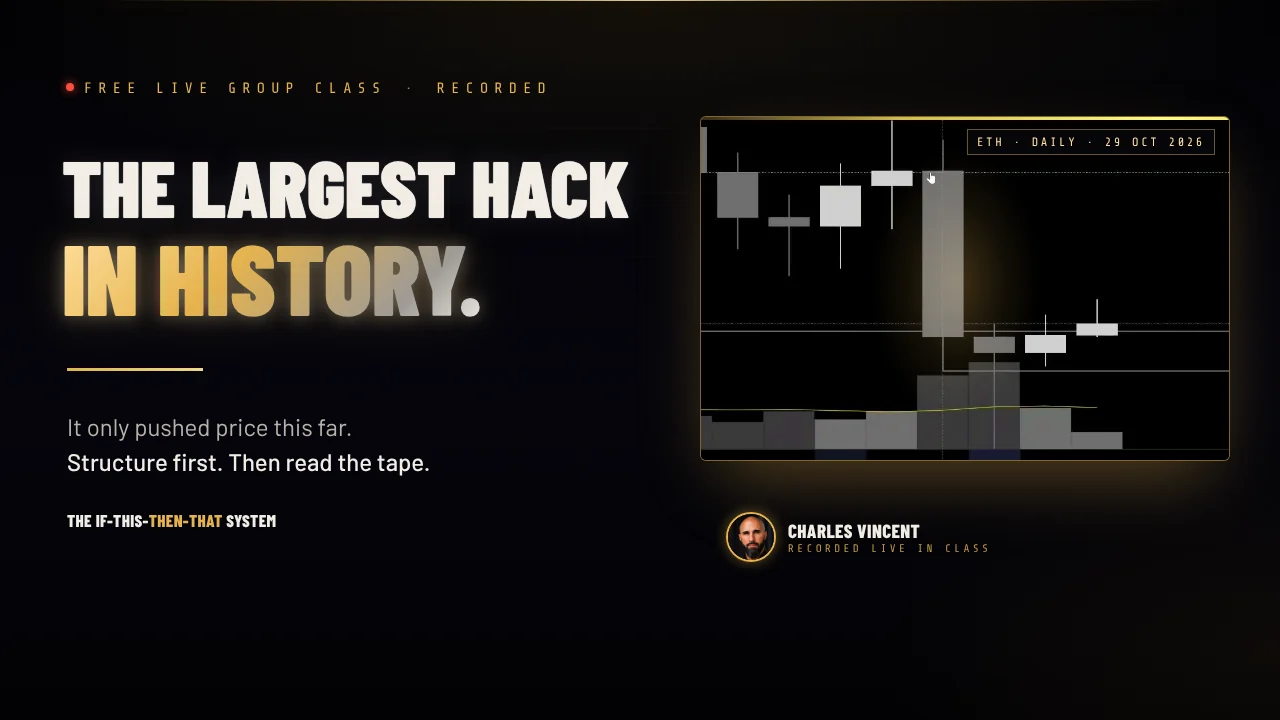 Live Group Class · 1:13:39How to play the largest hack in history
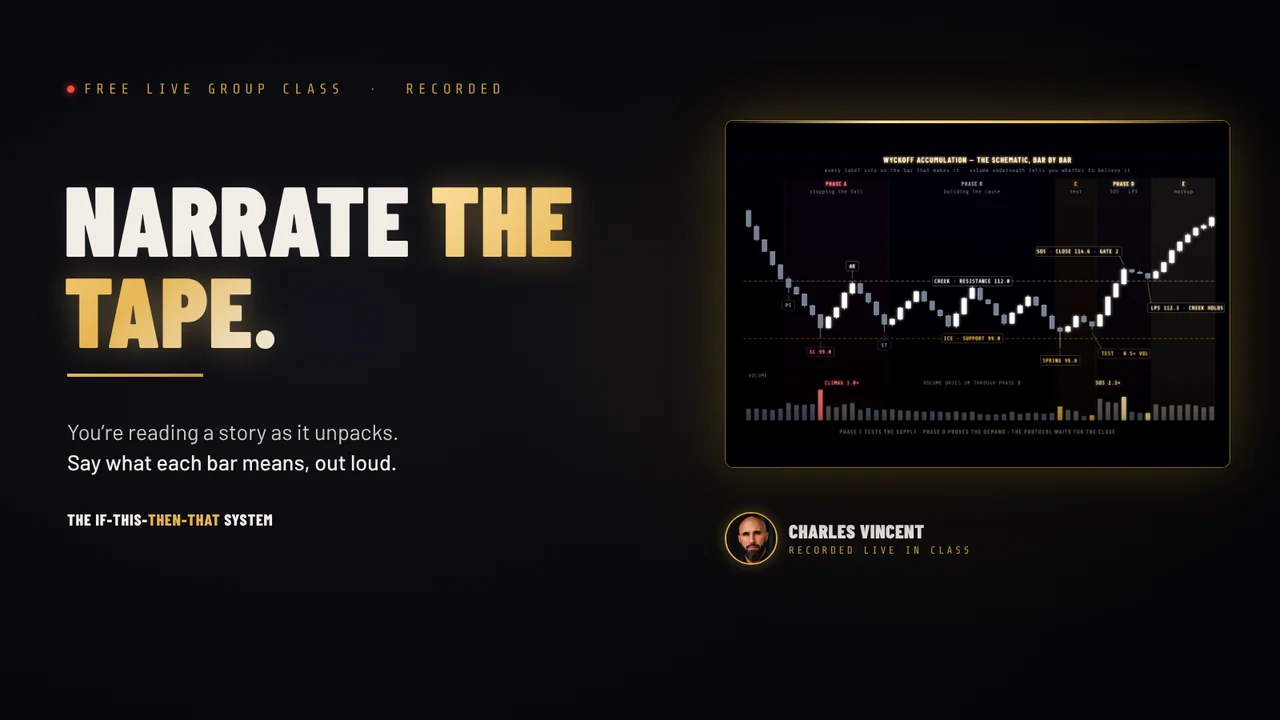 Live Group Class · 1:19:46Narrate the tape, bar by bar
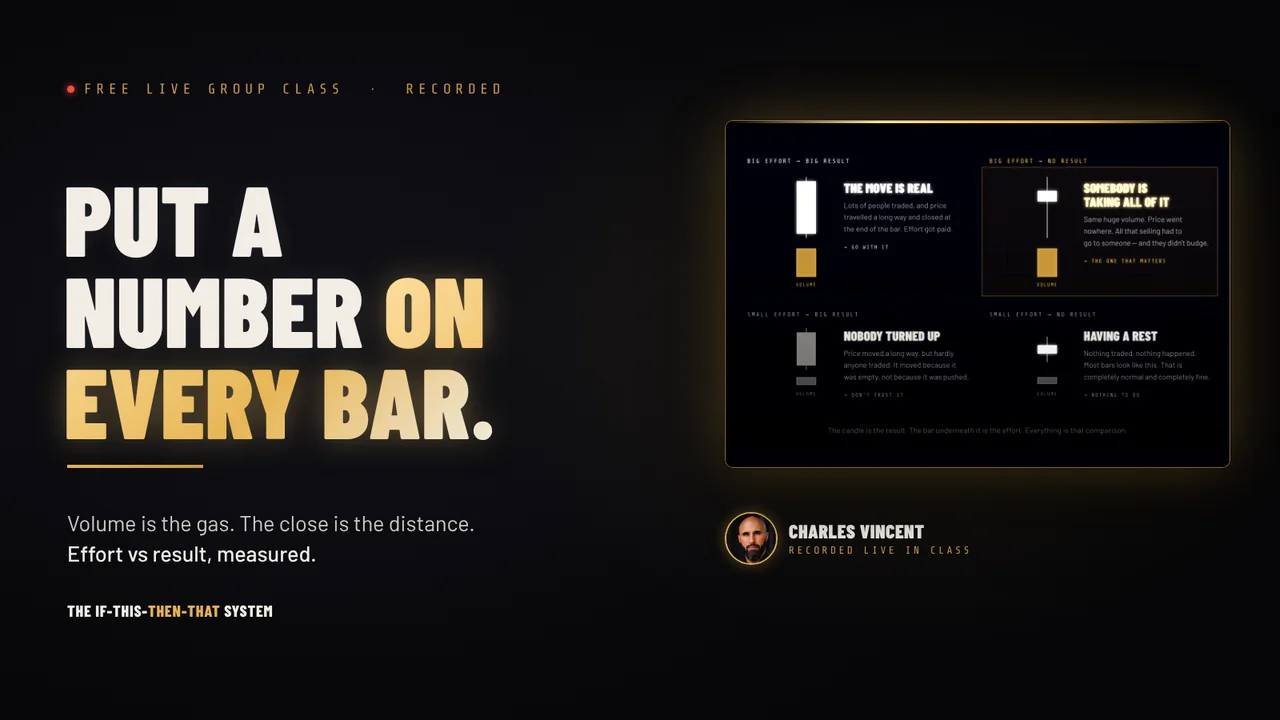 Live Group Class · 1:15:27Put a number on every bar
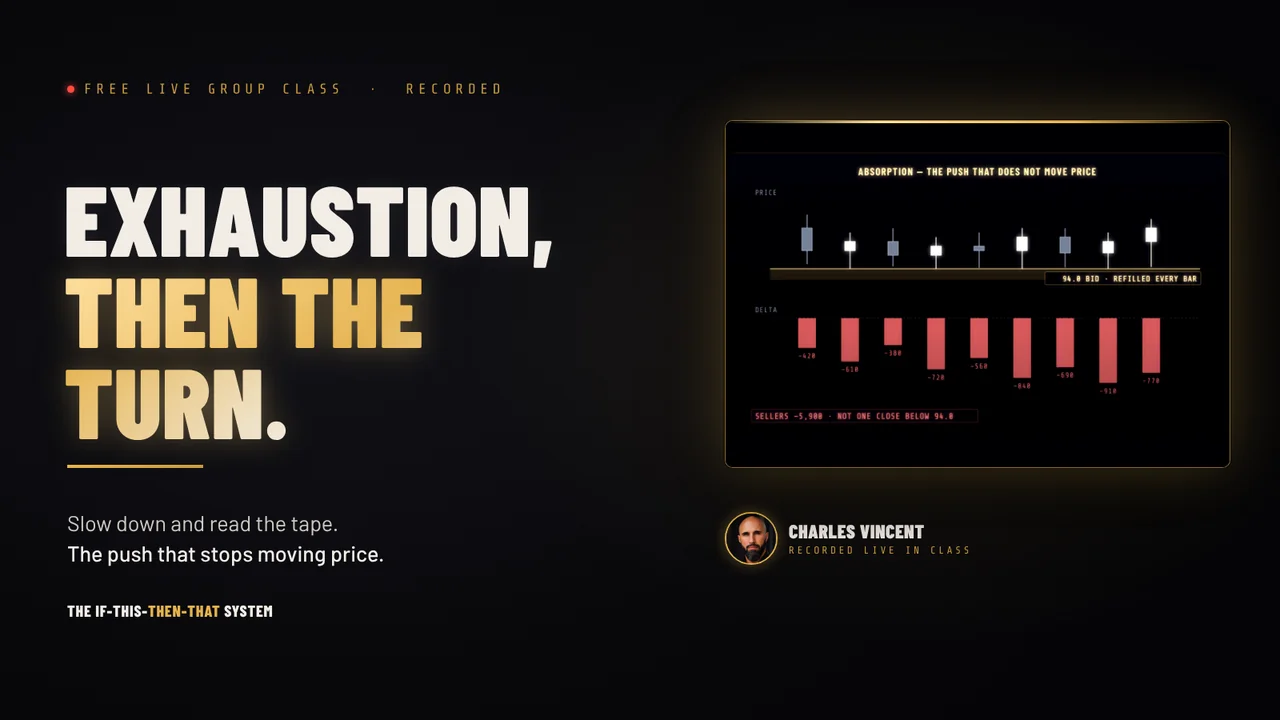 Live Group Class · 1:35:47Exhaustion, then the turn
 Live Group Class · 53:55Reading the tape, before anything else
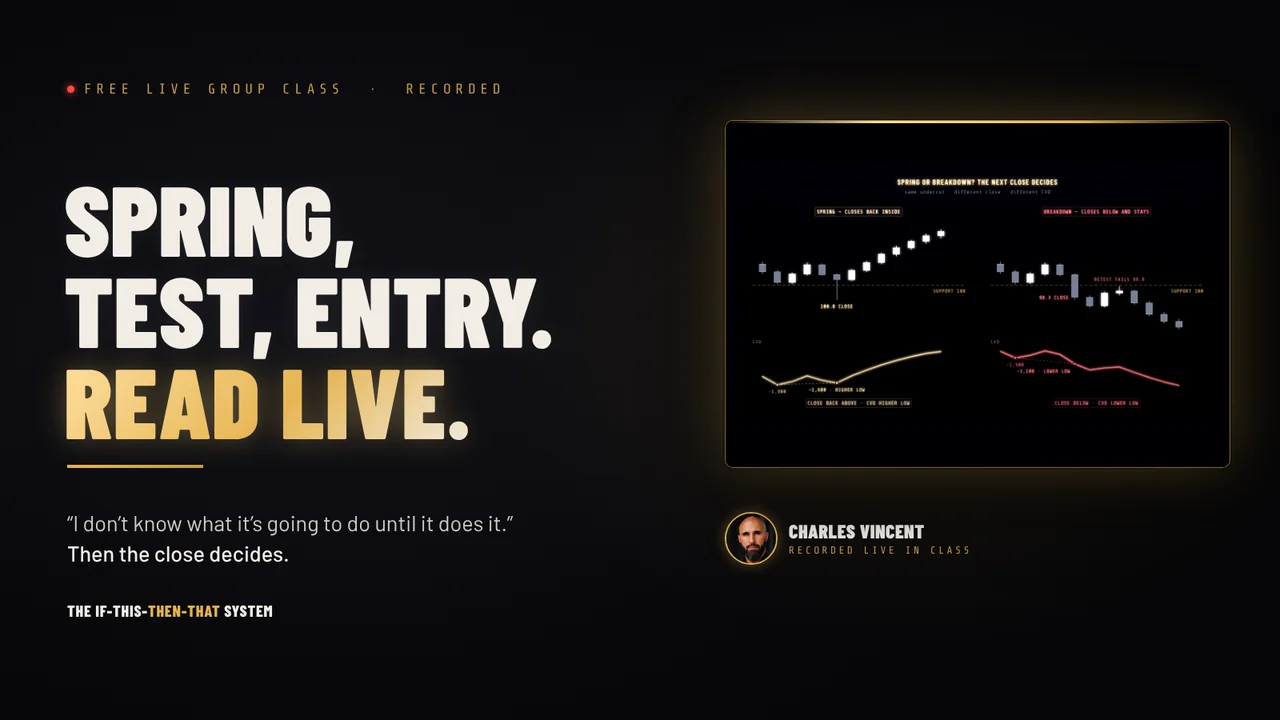 Live Group Class · 1:03:01Spring, test, entry. Read out loud
Separately, three private 1-on-1 coaching sessions are published with the student’s permission, and are free to watch. They are not classes: What are you looking at? (camera on), Structure, or fear? (camera on) and Elliott Wave, counted not drawn.
Want this one-on-one?
These classes are the group version of the work. The 90-day mentorship is the same method applied to your own charts, your own execution and your own mistakes, with Charles Vincent, three times a week. It starts with a free 30-minute application call, no card required.