Before you press play: I’m a surfer at heart and I live in the tropics, so I rarely wear a shirt, on camera included. That’s simply who I am. If that bothers you, these videos aren’t for you. — Charles
Full Class Ten · Live Group Class · Free
What is this plus this?Read the two candles as one.
This class is step one. See what it builds towards: watch my edge in 94 seconds.
This class was taught live on Sunday 22 November 2026 and picks up where the last one left off: the count at the ETH low, finished as it printed. The fifth of the fifth of the fifth, divergence on more than one timeframe, the fourth-wave low reclaimed with a control bar, then the spring, the test and the swing failure pattern entry on LINK. Bitcoin gets its own look on the eight-hour, because it leads. Then the room drives. A student lays out two entries and a target at the order block, and Charles shows what the read was missing: the highest countertrend volume, preliminary support, and two candles that look strong until you roll them into one. What is this plus this? A decisive close, or not. The second half is the part most people skip. Regime first. The rule of alternation is not a law. Max pain runs against the crowd. How much you take out matters more than how often you win. And if a gate does not pass, you do not go.
What the class covers
- 01
Finish the count, then roll the timeframes
The fifth of the fifth of the fifth, measured from the first wave, with divergence printing on more than one timeframe: several points of failure at the same low. The highest-volume fourth-wave low is reclaimed with a control bar, then the spring, the test, the 0.382 respected and the control bar back above the creek. On LINK the same structure prints as a swing failure pattern entry, and on the eight-hour Bitcoin ends a diagonal into an order block from years ago. Pick the entry on the smallest timeframe you can, but make sure a bigger chart is not swallowing it. And because crypto never closes, it has no gaps: what would be a gap up in a traditional market prints here as one sharp candle. Elliott Wave, written out.
- 02
What is this plus this?
A student lays out his plan: context tools, entry tools, two entries and a target at the order block. Charles adds what the read was missing. The highest countertrend volume stops a move and becomes preliminary support, and it should be swept. Two candles that each look strong roll into one bar with no decisive close. Forget the hundred names, a tweezer bottom or anything else: a decisive close or not, strength or not. Then a volume footprint candle, where the orders that pushed the move actually landed, and why knowing the structure is how you let a trade run instead of banking it early. The tape-reading guide, written out.
- 03
The part most people skip
If you don’t know the regime, don’t play. The rule of alternation is not a law. Max pain for the market runs against the crowd, and funding showed the crowd short. A question about tick charts gets a straight answer: Charles has never used them and says he can’t answer it. Then the rules for learning: fluency before the next tool, how much you take out over how often you win, no deadline on yourself, and real money kept out of the lessons. It ends on structure. Nobody is built to hold this much information, so the gates run in order, and if one does not pass, you do not go. Trading psychology, written out.
Chapters
Tap any chapter to play the class from that point.
Transcript
Read the full transcript · timecoded
0:00 · Charles VincentOkay, so what I want to do today is just complete where we left off last time because it’s important we map this and so you understand. And then at the end, I’ll ask you guys if you need clarification or anything and just make sure to speak up because it’s important that I’m going to go through this, I don’t want to say fast, but because I won’t take questions during, it will potentially seem too fast. So just if you have questions, write them down so I can get the idea, I’m going to flip it also. I’ve noticed there’s a bias, easier to see Elliott Wave pop for some reason, for most people. So this is obviously the chart number. Can you guys see my screen? Yeah. So we talked about this as the wave one, right? You guys remember that being the case? Yeah. So the key in most strong moves, there is an extended wave. And as we print it forward, I’ll just start from the beginning. This was a clear 1, 2, 3, 4, 5, complex, sharp, and ABC. And then from here is where we start the third wave. And so how this prints, remember we packed it all the way as 1, 2, 3, 4, 5, ABC, wave one of three.
1:21 · Charles VincentAnd then from this forward was the fifth wave extended. But it’s funny, it actually prints as a symmetry sometimes when we have it now could also print as a third extended and then a fifth regular. Both of the counts are complete, so it’s not, it makes no difference. But I’ll just, I’ll show you guys as the group goes up how it counted. So this is wave one, this is wave, remember, of three. This is a complex, this is a sharp, so four not overlapping one. And then the fifth of what would be, if this is the extended third, and then ABC fourth. And what we’re looking for now here is multiples. So if this is the first, we’re just going to map it right here and just wait. So if we already knew that this printed, we’ll just take first, and this is on non -log, so it will shift as I move it, notice that 9%, 12%. The point is, this is just the rough distance between what it is. So we’re looking for failure at this point, from this to where the four are low prints. But also, if we know that this is a four, then we have a math to figure out what is the end of this. So if this is a leading one, so ABC, into a one, two, three, four, five, this is the fifth of the fifth.
2:40 · Charles VincentAnd then we can zoom in way more granularly and see what of the fifth is the fifth of the fifth of the fifth. So one, two, remember complex, sharp, end. And so that is the fifth of the fifth of the fifth. This is on whether this is an extended fifth extended third, the counts still match on both, so it makes no difference. And so this whole thing, as we’re playing it forward, I’m going to just roll some, you guys don’t use these yet, I think. But the point is we’re looking for a level of at these areas, things lining up. So going down the time frames to see all of these, and I should switch to the kitchen. So this is my average entry is here, which was right there, entered down here and here. But this is in all of the weight, high leverage, leverage, spot, whatever, all of this combined, like 15, 15, 19. But the point is from this thing, I just want to show you guys what it actually prints as. As we’re timing this, because remember, the first wave is measured roughly from the fifth wave, we’re looking for that reversal, which actually coincides with here. So from that point, we’re just going to, our job is to roll the time frames, not just pick one and be like, nope, it’s not better. We actually have to gauge what’s happening. So as we’re, we’re, uh, assessing what’s taking place, note these subtle tells, uh, higher.
3:59 · Charles VincentSo this is a divergence at this point. There’s other ones I’m just going to roll and show you what the actual math is of going, if we find any of these things to be true, like at all from here to here across whatever timeframe it is, that gives us a way to confluence. Is it enough? Not necessarily, but as we go up in timeframe and it gets more obvious, that matters more. And so as we go down also, we can see this on the fifth of the fifth of the fifth taking place from smaller time frames. There was a couple key differences from here to here. That is telling us that just like this was a divergence on the larger scale, this is also occurring at the low, another bullish divergence, which tells us multiple points of failure. And then this point again, I don’t want to go, I was in a three minute camera. Um, but the point is, is that as we’re assessing this, this is the actual bar, the first entry bar, and then the second entry, something like this, like I can’t remember where exactly it was, but this point of, on the right timeframe, so you can see gauging from here.
5:16 · Charles VincentRemember, we’re looking for a reversal right now. And so our job is to, what is the signal timeframe to, uh, if we can pick something granularly as, as, as tiny as possible, great. But we also have to make sure we recognize that we’re not being swallowed by something bigger. And so, um, we’ll, we’ll stick here for now. So the point is, is that this thing, that’s the low, the highest volume, the fourth that we need reclaimed and simply it is reclaimed there. There is a control bar back. So what we’re looking for is failure candles. So not strong candles to be covered. This line reclaimed with the control bar engulfing showing in a balance after stack diversions after the wave count is complete. And then a failure with another control bar. Again, a retest is healthy. A sweep is even healthier. That gives us more, more rocket fuel. And then I’m going to say something, cause I don’t know if you guys are aware, um, I’m going to prove this doesn’t apply to you. The, how this works gaps in your traditional markets are not the same in a digital print. They are something different. So for example, in this, this exact screen, so again, we’re, we’re looking for a necklines being broken.
6:32 · Charles VincentNecklines being broken with control bars, especially after sweeps. But the point is, is that when we have a traditional market and these low, like ABC corrective moves with a sharp shot down and then in this, in a traditional market, this would actually be a gap up. We’d have a candle here and you wouldn’t even see any of this. He’s like, you’d see a down here and then like, as you guys know, a gap and then another candle here. This is what it looks like when it’s actually digital and there’s no gaps. So that thing is the strongest form. Like this is great. This is the, on the smaller other timeframe, this is great, but this is the full CAP proper setup from after those two things compounded, waiting for, remember this spring is one thing and then the test. This is the test, the follow through with the first sign of volume with, if we want to zoom in and remember this, we can, but the point is, is that that thing, uh, I don’t know, I was already in at this point, but it was just confirmation. Um, that thing was there. Failure, sweep, respect the 382, control bar back above. What was the creek and the range and then on the higher time frame, obviously the follow through, but that, that thing, exactly the lows, the test, that’s what we want. And so that was warranted, uh, full size. And this is again, uh, Chainlink as well. The point is that the math is slightly different because, um, this swept the lows where the spring on the other one, uh, didn’t go.
7:54 · Charles VincentThey’ll still show it to you. This is here and here. And so same thing. All of the ranges, all of the things being reclaimed in a specific fashion matter, but also there is another divergence here on, on the RSI. And then this range swept breaker, control bar up. That’s an entry. That’s the full, like, this is the swing failure pattern gap entry. It’s fucking brilliant. Um, and then everything else, obviously followed, um, the clear impulsive up and then it shows clear on this one. And the point is, also actually before I go there, I want to show you guys the print on Bitcoin. So this is, um, Bitcoin, uh, I fail sometimes from not observing the larger big brother because this dictates often where the trend will go. Like it’s a tailwind heaven or what. And so this thing, on an eight hour, which is big, look at the fucking stacking of difficulty. At the, like this is, I don’t know if you guys are watching the actual larger scale move, but that’s a brilliant ending diagonal. Like I just ruthless one. And this is the order block from years ago, um, critically important, same five way account. And then the beauty of it is the respect of the thing is fucking like this, the prior lows. Nope. Fuck no. Control bar back up.
9:09 · Charles VincentSo all of them with another vol through on the test. This is again, maybe it goes down for another test. Maybe it was lower. I don’t know. But the point is, is it, this is what we want to see at this low. And so also you guys would have heard me say already, I’m playing with right now because he’s taking the lead. And we see that in multiple ways in that there are as Bitcoin usually retraces less made new lows. This did not, this is still above range. And the difference between that, what was the Bitcoin? This is not a clean impulsive. This is a one, two, three, four, five, three, and a pulse of the A equals C distance down. Like, I don’t know what the follow through being time will tell, but the point is like, that’s clean as fuck. This is what happens next. When if it reclaims range, it goes through, will tell us what we’re looking for. Because not only if it does print impulsive lead, which it barely is right now, one, two, three, four, five, but this is a first wave looks like a triangle. If it breaks up and reclaims this order block in range, that’s a completely different math. We are now in confirmation of this thing we import. Again, it could sweep all of them, come back down for a bigger test. It doesn’t matter. We’re just, we play what it gives us. And so from this point, this is again, very bullish. And also there was another thing I want to touch on here. There was a last class you said that the play that I took from here. So you said this order block, it’s not because you said it was your accurate.
10:27 · Charles VincentSo I said it. So I took it. The point was you said if it breaks down, you’ll take the failure and exactly what this is how I play too. It’s the CAP. Right. So from this move, and I’ll leave these on to see. So this is the five year old trend line. Very important. This is the range lows. Also important. But the point is, is that we have a break of structure, structure, break of structure, bounce on the underside of an order block, correctively with the distance of A equaling C. And then a failure. And this, [unclear], actually, I don’t asleep at 6 30 p.m. But I stayed up until nine 30. So there was a clear as day thing, especially when it’s printing correctly, grinding up into it, showing failure after failure. The print was just beautiful. And so I waited and played this thing, which was the [unclear]. And then the fucking brilliant print club it retracing with an up thrust and a massive failure right exactly the sweet spot. So there was a smaller entry here, but so full weight entry short down to I think I cut somewhere around here. But the point is, sometimes we’re given gifts, and you just have to keep watching and counting. So there was a lot of information. What didn’t make sense?
11:46 · Charles VincentYou guys must have questions. There’s no fucking way you remember. You guys go. I’m just um, you guys know.
12:00 · StudentYeah, so why understood from that is the reason you took the trade from the bottoms because this was the completion of the fifth within a control bar. And like you were in the last class, you were exploring that you used the the previous liquidity low and then the control bar above that to then say that as a reclaimed the claim price. And then using that to you mark the ABC use the then you got the OTE of that low. That makes sense. And then and then took the trade to the previous liquidity. Well, but yeah, you’re just writing it up.
12:58 · Charles VincentThere’s no reason to do anything now. I’m just like every other instance. I’m counting when I see the waves nearing completion like this, for example, on the way down, this is in a shorter term. This is a one to that. It’s not exactly the point is this thing here like within the third wave is a print. So one, two, three, four, five. So this is the end of the third. Right. But it also could be messy and give me a truncated fifth or whatever the fuck. So I’m fine to get out here. This is a big move. Right. And so we just count. And then ABC and then the fifth, you don’t need to go all the way down. We just catch the meat of the move. And crypto land. These are big swings. Like I don’t know. I know that this is not your own turf, but just for example, ballpark, like 30 percent mover or whatever the bucket is, is huge. Pre -leverage rate. And this is the best part. If just say, for example, you miss this entire thing, like out of the market, taking fucking trades, getting stopped at whatever. It doesn’t fucking matter. If you catch one of these trades, that’s a year for most regular people. If you do it right, like not even with full weight, just done correctly. Because your art is so fucking tight when you have shit like this. It’s like a clear this ever again. I don’t usually play news events, but the light that’s going down was incredibly high based on the retail lack of understanding of what this is.
14:20 · Charles VincentAnyways, the point is it was fucking beautiful. And so this is also the opposite. The same thing, but inverted just there. It’s going down in that fucking huge. Like you saw the that’s a lot of fucking climactic volume. That’s huge. At the lows, complete perfect respect. Like that’s a brilliant fucking effort. So yeah, I guess what did you learn from that, if anything, and what questions?
14:49 · StudentThe main thing for me is trying to understand just re -pitting in my brain how you do count the wave counts, if that makes sense.
15:07 · Charles VincentEasiest way is to watch back the videos at half speed or something and just copy it on your own chart so you can grasp it on re -paint. Yeah,
15:16 · Studentthat makes sense. And then I think also for me, and that way, you just bang that with everything. So then using the going to the high time frame, understanding, okay, this is climactic volume, the slowing down. We’re going back into corrective nature, which we are in. We are now because of the high volume. But also the major areas of support. So we don’t know if this is going to continue up, but because what you’re doing at the same time is pairing these areas with high volumes of support. So if we do get the control bar above the 1760s, then you’re in from the lows, if that makes sense. So it’s just pairing to then obviously positions in. But yeah,
16:26 · Charles Vincentif that makes sense. So yeah, I’m just catching the rhythm of how you view the counts and the markets, if that makes sense. Yeah, it won’t be easy yet because you don’t, there’s still a, again, everything requires massive amount of practice. It will sound like crazy talk until you recognize, holy shit, it’s actually, it plays out and it’s not, it could be multiple things. Like for example, what is an A wave? It is either impulsive or leading. Leading is messy as fuck. New people usually get wrong in like 95% of cases, at least. And then an impulse is just a one, two, higher low, higher high, three, four, five, and an ABC. What that means is this can be an A, this can be a B, and this could print a C, which is corrected and still go down further. So we need to see, there’s a follow through that tells us something different. Just like this is a one, two, three, four, five. This is a A, again, in this example, we can have a triangle, which is a B, but also this can be an expanded flat, which is also a B, and then just an ABC down. Whether or not it prints like that, I don’t know, time will tell. But the point is that there’s only so many variables, it could be, and we just keep ruling stuff out as prints. Yes, over and over and over again. And so once we have that, what is it called?
17:42 · Charles VincentThe tree, the, I don’t know, I have a picture in my head. It’s all of the possible pathways and we just, yeah, like we’re asking out. Yeah, right. And that’s it. That’s the way you can be wrong. It doesn’t matter. You just, that actually gives you less opportunities or less options that it will print something like there’s fewer things I could do after, which is fucking brilliant. Did that make sense? Yeah,
18:11 · Studentit makes sense. And I’m thinking of making the distinguishing between tools. Some of them give me the context and some of them give me entry tools. For example, I find that spring testing as a very good entry tool. Also, I find regaining important zones or breaking the zones as my entry tools and breaking range, something like that. And I find these early waves, price displacement, volume things, and dynamic and static supply or resistance things as my context tools. So I try to combine these things by the help of this context to build the biases and by the help of finding the entry tools to make this risk -rewarding in that situation. That’s the way I’m trying to classify and put things together in my mind.
19:11 · Charles VincentSo to make it simplify that in a term that you can show me in a clear concise, like how does Emad catch this? Like specifically, what would your entries have been?
19:23 · StudentYeah, for this one, I try to have a big picture. I never go through a very small time frames without looking at big time frames. And the first thing that I noticed in this situation, I found that stacking volume did not any further moving down that you mentioned. So that gives me somehow kind of exhaustion in this move. And that makes me to have a reversal bias. So when I see somehow some kind of reversal bias, I try to see this kind of big wicks to identify the first spring. And then I see those big... Yeah, the first red one with very big wicks. Yeah, that can give me a sign that this level have some important resistance. And I try to find some kind of changing direction, some kind of CISD, some kind of control bars. And this one is printing some, for example, the second big white one, the second big bullish one, the two previous one.
20:43 · StudentYeah, this one. There is a very small volume, but a very big move. And after that, there is a very big move trying to sell them, trying to move the price down. But we see they cannot have succeeded in that situation. And it again, closed over the very low of this whole move at the start of the move that you marked it. So that’s another sign of regaining the price to higher prices. And then we again see a big bullish candle with a small volume. And again, after that, similar volume, but a small price down. So I have many signs, many contextual signs that the price is regaining. So then I need to see some kind of entry tools that I mentioned in this situation, in this perfect situation, both zone and both spring are aligned. We see that the spring level is holding and we see that important zone is holding too. So the static resistance and the, sorry, the static support and that important zone plus that spring testing are working both at that very small doogee -like candle.
22:07 · StudentI think it’s no, no, before that. Yeah, this one. Yeah, this one. Yeah. Maybe I go for an entry in this one because of that. Yeah, that can be one of my interest because I see that buyers are gaining the power over that important zone. So they are just building the fighting zone on higher prices. That’s another sign for me. So maybe I go for one entry in that situation after that reclaiming price. And I can add another one at that zone that exactly moves from the starting low that you, that, yeah, maybe I add another one on this one. And I target the big order block over this big move, which is, yeah, which is that small, the small white one before that fall. That can be my, yeah, this is my TP. That’s how I play. I have two entries in that situation and this is my TP. I just, I can have one to three risk rewarding for that because my, my stop loss can be under the biggest limit plus the ATR.
23:33 · Charles VincentSo I think I can have one to three or one to 2.5 risk rewarding on this situation. That’s, that’s how I play. And what you’ve said is obviously, this is sound set up assuming that regime and all these things line up, but I just want to give you guys more context. As you’re speaking, there’s things that you don’t have mentioned. I don’t know if they’re visible or even yet have, but they are critically important to recognize. And this is a, we’ve always talked about reading the tape as being the first step. This is a more advanced tape reading. So just try to bear with me because I’m not, I’m going to leave this time frame while telling you things that are on another time frame that you can see from this time frame. Does that make sense? So this thing in, I’m going to roll things together. So highest counter trend volume signature, stopping a move, preliminary support. It should be swept. Now this line tells us these two things. One, no completion, no follow through, no decisive close to obviously mostly wick on both of these. However, massive imbalance already, but between the weight of this and this, even just comparing them on this timeframe, massive imbalance, but what I’m pointing out this candle plus this candle equates to an actual body from here to here.
24:48 · Charles VincentThat’s it. And the rest are wicks. So no close, no decisive close at all. And then indecision, indecision, this is not a strong candle, not a strong candle, not a strong made any external candle, all low volume after this already showed. And then critically, just like this one, never actually at least remember, just going to draw it because I think you guys see what I’m saying, but that thing by itself.
25:16 · StudentSo I guess, so I guess the first, as you said, the first counter trend candle is a very important thing in identifying things.
25:26 · Charles VincentIt is critical. It’s all in the Elliott Wave. We look for the volume tells a large move. And then the first, what is preliminary in this instance support, look for it to be swept past. And then the key is, is it passed with momentum or not? And then if we just like, this is what actually these two candles look like, if you roll them together on a timeframe, there’s a six minute, this candle plus this candle equals this closing above. That is not decisive close. And then this, remember no actual strong candles down, only strong up closing above, not only the neckline, but also the range. Super important. Those are, it’s not just one strength missing here. That neckline with this, again, enough to warrant the majority of my weight on this entry. And then this following through, again, hard pump down, same thing closing above, but no strong candles at all. No external, no real any ground made. And then the clear, again, this is leading in a five wave up, gate, you see down like all of these tells. And even this one, this remember just way the, what is, what are these things combined? That plus this is a, just like this one, same thing. That, the entire of the candle is this tall and the brick is that big. Yeah. Right. Like sweeping the OTE with strength and that amount of volume, like that is the definition of stopping volume times the minimum is 1.5.
26:49 · Charles VincentThe prior. Right. Like fucking, we don’t often get beautiful prints like that. And like you said, the two on a one minute chart, it’s a beautiful CAP. It’s the exact CAP setup. But like you said, right, like if that is right, catching that two down there, you can do it in the OTE, but also just fucking catch this. Like we’re talking, remember, if we’re like, I’m not saying this is wrong. I’m just saying like, this is not my target. But if you know this structure, that’s where you can let these things run. That’s the, that’s the whole difference, right? Like that’s where the real money is made. And the key to this, I don’t want to go too down the rabbit hole, but like, as you’re, you guys don’t probably know what this is. This is a volume footprint candle. You can actually see in real time what’s taking place with the orders. This is like a Delta volume bubbles, things like this. But the point is we’re seeing stacked where the actual weight came in. Remember, this may not make sense, but if you roll it in, you can see the quantity of things made, the actual strength behind it. Like it’s all measured in a way that you can actually just zoom in, close above the POC and the prior POC and have a massive stacked level of balances at the close beneath the close while a whole bunch of stack buys at the bar. Like this is fucking strange.
27:56 · StudentSo, Hey, Charles, you got an elephant crossing the beach with the sand, right? The footprints.
28:00 · Charles VincentYeah. Right? Yeah. But you can see it in real time. Like you can actually like observe this and that POC and that level of stacked balances, which are critically above the closes neckline. That is the propellant that pushes this thing so fucking far up. And again, I don’t know the continuation, but with this level of impulsivity off of the lows while reclaiming range and just again, vertical division up.
28:24 · StudentAnd you said it was also a leading in the first Yeah. You also said it was a leading in the first two, which is like your, you know, one of your creme of cremes. So catching those two, right?
28:32 · Charles VincentIt’s not me. It’s just the point of like if we’re counting and we’re looking for impulsivity at the lows at a reaction, like just like, remember this is corrected, right? Like this, this is a five wave. And then this is this is another five waves, right? It’s a truncated, but the point is, is that this is just an ABC and that’s not strength. Right? So this can still print to be that if it goes, this can roll in the swing failure pattern all the way down. But the point is that like, where is the at least first stop if it’s showing me impulsivity by wave. And then if it shows me another ABC, I want to see a five wave. And this could be easily be the fourth wave and the fifth wave top. And if I get a swing failure pattern, roll down or the, what is the first wave complex to our fourth wave chart and then a fifth wave top. Like, I don’t know, but we just, we roll out the options as they present, as they print. Right? And so, again, that’s a lot of information. And just my goal is to at least give you something that you didn’t have before we talked about this. So did you guys all learn something? Like, is there, it was a lot, but did that make sense? Yeah. So do me a favor, just so I know that we’re making ground. I want you guys to think of each just one thing that you learn that you can use.
29:49 · Charles VincentAnd then I’ll clarify if needed. And then that’s a good, sorry, going.
29:57 · StudentI mean, yeah, the first point is the first counter volume, high volume counter trend as preliminary support. And then carrying that over to then see how price reacts around that level. So noticing whether we are getting higher. For example, if we’re going to continue down higher, higher clean body closes below with the high volume or the opposite. If we’re getting the opposite, then we’re looking for control bars up in the other direction to then continue using that preliminary support, potentially then marking an OTE to then trade in the opposite direction as a reversal.
30:49 · Charles VincentYeah, but also there’s a key tale that this is context is the most important thing. The regime, the reason why in my system is step one, it’s if you don’t recognize what the regime is, don’t play period. And so in this thing, the fifth of the fifth of the fifth, at least at a minimum warrants a size of a correction that is relative to the entire move that we started from away at the top. So I want to see an ABC that’s visible on that time frame. If it can’t, we are still just bottoming. This could be bottoming for a month, a year, it doesn’t matter. The point is that we need to see at least an ABC of a size that is visible on the entirety of that wave. If we’re catching the fifth of the fifth of the fifth, whatever the fuck, we do not go with that trend unless the correction is printed right. Like unless it’s of again, we need to see that first. It at least has that coming. Does that make sense? Like here. So this is the five wave from here to here. So yeah, this is the fifth of the fifth. Yeah, but but I’m saying like if this is one, like zero, and this is five, I want to see at least something as big as this print.
32:05 · Charles VincentLike this can easily ABC print fail all the way down further. That is okay, but something this small down here, it’s not visible. It is not possible for a large thing like this to give some sort of I mean, it is highly improbable for it to just continue while this prints without a level of balance without giving us some sort of reaction. And again, it’s like, does the rules of alteration help us at all to engage any of this, you know, with the, I guess the second, it’s like, yeah, it does. Yeah. Okay. So like, this is complex, like highly, I guess this is a wrong time to be on, but this is a short. This is, yeah, okay. There’s a, that can help us. Yeah, that’s in all the count when we’re measuring all the things like we want to see remember, like even in this one, this is a complex. This is a sharp. Yeah, right. This is a, remember compared. This is a complex. This is a sharp. Like there’s also a, yeah. The point is that we just keep again, it’s called the rule of alternation, but it is not actually a law. What it means is that it’s showing us that thing. Like we can have, for example, this, if you don’t know, count, this is complex, complex.
33:24 · Charles VincentThis could be another complex and another complex. All this means is we’re still printing extended first wave. And then within that first drive, there’ll be different alternations of the sharp. It’s a, you must observe it if it’s there. And then if it’s not, just wait till it tells you what it’s printing because it’s telling you something. Yeah. Okay.
33:44 · StudentOkay. You guys, I swear we’re learning from one of the best in my opinion,
33:46 · Charles Vincentbut I’m just saying it has nothing to do with that. It’s just, I mean, no, but just observe what it’s printing, right? Like, I don’t know what happened. That’s like, I’ve been wrong. Near infinite amount of times, whatever the number is in the first probably five years, I would say to say that I fucked up more than most people do. But also I learned a lot from it. So yeah, perfect. But what do we do with this? Totally. So from that, there’s not really much more that I want to forget about other. So if you have any questions, ask them out. If there’s any concepts that you guys want expanding on and any feedback as well. What did you take away from that? If anything?
34:31 · StudentTo me, some kind of special candles and the special zones are really important. And in this session, I found that the first counter trend candle and the day next candles closes, respect to that, are really important. So that can be something that I learned in this session. And also this is something I already training, but this session reminded me that I should learn to combine timeframes and seek handles in other timeframes while I’m looking at some kind of time frame. And this session was reminded for me about that subject. So these things are the main things I’m taking from the session.
35:20 · Charles VincentAnd those are fucking game changers, just in themselves. They’re not an instant thing, but just the current recognition. Whenever you have two things beside each other, just practice for a second. Like what is this plus this? What does that actually equate to in water? It’s fucking brilliant because it tells us, like sometimes we don’t get, we know that this is a tweezer bottom and a hundred different names, but also decisive close, not decisive close, strength or not strength. Like those things, they all print and even just like simply this, this, this, this, this, and this print just a doji with the wick down. Same with these just a doji with the control bar up, like failure is punching the wall, right? It just, it sounds like crazy talk until you actually recognize that’s the map. And it’s not the precision that matters. It’s just, if you’re only two is possible at a time, do two, start there and then do four and then so on and so on. But like everything will start rolling together. A weird, like, um, an epiphany is the only word I can use at a certain point. This is, this entire move is just one doji that was swept with a gap up, like, it’s fucking really, yeah.
36:21 · StudentBecause if you didn’t, if you didn’t flip that to the one minute chart, it’s got two actual full candles closing into the OTE, right? Uh, right there. And it’s a pretty, right. So I think with Emad saying that time frame candles, that’s a perfect example right there.
36:36 · Charles VincentYeah. But as well, like with that, remember, and this is where it gets a little bit tricky, but the point is this is the order block that should be respected, which has now been broken, but also with strength, like we’re back in range. We swept, we’ve successfully swept at the completion of the distance of C with the corrective movement and a climactic cell at the bottom. Remember, like just, just picture this. This sounds crazy. What if, for example, this was 2,700, and this was around that low of the fourth wave. And this was the, remember where we just started the wave count from 1, 2, 3, 4, 5. And we just swept the lows and we just fucking reclaimed everything. And then after we swept the prior channel up there, gave it a nice sport bounce and so on and so on. Like this is how it happens over and over and over again on the smaller timeframes first. And it actually is really cool because in most cases you can actually see the forward projection micro, like this is a one minute, but actually play up to some degree on a large time. It won’t be fucking precise ever. Structurally, all we’re looking for is remember, what is the most max pain move that could occur right now after everybody’s short? Like, oh yeah, and also the max negative funding that I think it was like a two year amount of people short at this point. It’s fucking really, and that like this specific thing right here, max people short.
37:57 · Charles VincentLike not just volume, short volume. And then now these people are sitting here like, oh, it’ll probably go further down. And he couldn’t, but the point is is that max pain for the market is not in the direction of everyone. It’s the opposite. And it’s fucking fast enough to do damage. Like give us a little chop around, right? Like give us, we haven’t even reclaimed the proper range. We’re somewhere tickling around here. I want to go too deep, but the point is is that like we can pause at resistance. That’s acceptable. It’s not right here. That could be us right now. And then, right? I don’t know that’ll happen, but sweep the lows, climactic volume, and then reclaim that range with strength. That’s what we want. So again, it sounds crazy, but like we often get a window into what’s going to print with the micro from the smallest time frames. And I don’t know if it’s a, like all of this is institutional testing, right? So like they use a range, the test range, if there’s participation or not participation or the inverse, they’ll make a decision based on that to do the thing. And they don’t always get it right. But the point is that over time, after a certain amount of tests, it becomes more and more obvious. And so just like that, these lower time frames, they can push the market specifically and hard if there isn’t a balance because there’s diminishing returns of one direction. So that in the other direction, just like a break in a wave, pulling you out, like there’s a vacuum.
39:13 · Charles VincentAnd so the point is that these specific fractals occur, they’re usually repeated on a higher timeframe. And what would be max pain from here? I don’t know if that will happen, but there’s many instances across time that it has in Tesla, in Netflix, in Amazon, things that have changed at an exponential rate. Like this is a messy as fuck wave two, like super, super deep retrace. That again, in my opinion, max pain is up in a wall of worry way and then a really fucking fast way with another one. But so.
39:49 · StudentYeah. That’s crazy. And Charles, yeah. And Charles, I have a question that may be a little far from the topic. Is it okay to ask? Yeah, I want to know how to transfer this sense of knowledge to ticks, not just simple candles. And do you suggest doing that or not? Because I think it takes like, no, no, I mean, this is a time limited candles. I mean, the ticks that close after a set of events.
40:33 · Charles VincentI don’t understand.
40:36 · StudentWhen you try to choose the timeframe, you choose candles. Yeah, yeah, you can choose ticks.
40:45 · Charles VincentYeah, yeah. Of this.
40:48 · StudentYeah, yeah. I’m trying to understand how to transfer this set of knowledge to ticks because ticks somehow showing, somehow translate the whole market to the same thing. Then the market is really active and then the market is not active and they are the same event that you’re using the ticks. I’ve never went on that part of because the, the almost always the lower the timeframe,
41:16 · Charles Vincentthe lower the signal. And again, it just not lower the signal, more noise. So it’s just, I’ve never used that. I’ve never done that. I can’t answer that question.
41:31 · StudentI think Charles would have better tool almost. And I’m totally winging it with this, but the first thing that you showed us with the breakdown per candle or Delta bubbles, that kind of stuff.
41:42 · Charles VincentI mean, it’s a different, that’s not what you, that’s not helpful to you. Yeah. No, that’s different. Is that different?
41:52 · StudentSo I missed the last part.
41:55 · Charles VincentSo he’s referring to these like the actual ability to see CBT tick in real time with imbalances and all the things where, where we actually get and how much like this is, in my opinion, way more valuable than everything we talked about, but it’s also very complex. This is next advanced stuff. So he’s referring to give, this would be useful to you instead of a text. But again, this is, I just don’t even know if they like it does similar stuff. I don’t think that they’re, I mean, they’re, it’s all the same information. It’s just different lens. So his question, you might was with the,
42:38 · StudentHey, would this stuff help? Yeah. Yeah. Yeah. Yeah. It helps. I’m I’m I was thinking something. Okay. Oh, and Charles, I can’t hear you. If, uh, I don’t know if I might have kicked off. Totally. I know. And like you said, too, you have been able to roll. Hey, Charles. Yeah. Or you cut out there. Yeah. We can hear you now. I think you guys still hear. Right.
43:11 · Charles VincentCool.
43:12 · StudentSo what was the, I went into just saying that super cool with the reading the tape and even Elliott Wave and we’re going to all learn this together. And then we just started chatting about that stuff a little bit. But I think when you got cut off, you were just asking Emad if, when I had asked, would this help better Emad, like, as far as that kicks up, is this, does this help at all? Remember the volume for the candles or the information? Yeah. Yeah. Something, something that add value to those things. Yeah. Sure.
43:51 · Charles VincentYeah. But it doesn’t solve the question.
43:57 · StudentYeah, not exactly. But maybe I need to, uh, to learn more about takes on the stuff. And I see if they are useful in these things or not. I’m not sure. It’s a little bit can be great for me right now.
44:11 · Charles VincentYeah. And my best advice I can give is however you are intending to use that, it’s not required. Like, like layer it. If you can be profitable off of just the things that you’re learning again enough to have a very comfortable living, then stack things on top of it. Right. Like the point is that this stuff is super fucking helpful, but also very complex. A lot of information moving at the same time. But even just simply like we can see in this candle, this, this one right here, there’s a mass. This is an amount of market orders up and it’s still closed down. That’s an incredible amount of stopping power. Right. That tells us something very important. And that’s against such cold. But also this is an amount of member control bar up from a range while there’s a lot of stacked imbalances, which means it should be revisited and the lows swept again. This, if it prints is a massive failure so far. Right. We’re not close to it. But the point is you don’t necessarily need to go down lower. Like this is an hour. You can go to whatever you want. I was saying like all of the tells are actually right in front of us. Most instances, it’s just learning to actually spot them. And I’m not even talking about this, but learning to spot them. That’s the hard part. It’s just practice of repetition. Not worrying about not understanding it yet. And just rather if, if your process like that. So in my opinion, the rate is not important. Like the important thing is how much you can take out from the market.
45:31 · Charles VincentSo like I’m totally content losing 100 small times and then winning one that dwarfs all of those so many times over. Even if it takes me here, I don’t give a shit. Right. That thing, that difference is what we require time to put in versus actual pay out. That’s all the matter. And so that happens with fluency in a thing, not snapping. Like until you’re back, until you can read it as fast, like go through it just as we did in this class to show like, what is this and how in my being an audience, certain things are, then add something else. I’ve always, I’ve tried to do many things too soon and it all only result in a video with everyone I’ve ever seen. It’s like, you can only it’s wave in tape or you’re alone or game changing shit, you know? Yeah. Totally. But those, those in themselves are years of setting. Right. So don’t take that lightly. It’s not like a thing you just say, uh, you know, I kind of like it. I kind of go like, it won’t make sense. It won’t be possible until you get up to the level of using a consistency. And that takes a whole bunch of failure and attempts first. So yeah, take that for what it is, but it’s, it’s not an easy process. This thing is super fucking complex and it fools most of the people on the planet most of the time. Yeah. Right. So just, um, that’s the advice I can give.
46:41 · StudentThat’s what I was saying to the guys. We’re gonna, we’re gonna learn this
46:46 · Charles Vincenttogether. We’re gonna learn this. Yeah. I mean, it’s just time, right? Like, as long as you don’t quit and you don’t do stupid shit, you’re good. Everyone’s good. But if you put an actual time on yourself, I’m going to complete it by a year or if I don’t make enough money by this, this day, you’re fucked. You are guaranteed for failure. Like, it’s just not possible. That alone in your, the rule you’ve set for yourself, just make sure you fail. It’s a weird fucking thing that happens in this place. So, um, just do it in a healthy way and don’t make it a stressful thing or else you pack that trauma into your lessons. Whenever you go back and learn something, if it was under a size, it’s too much or, or a fucking timeframe that’s too little, like, like, uh, condensed, you’re going to fuck yourself. Like guaranteed. And every person I’ve ever seen has been myself a thousand times over. It’s those things cannot exist with the lessons. That’s why I hate talking about real time stuff. Uh, in class, it, when we’re like, you know, if we were down there and the execution was happening right then, that’s super fucking, brutal for you guys, for, for newer people to try to manage money, like real world couch, like pain with a lack of understanding. It’s, it’s a recipe for disaster. So you just have to separate them entirely. It was a perpetual failure. So, but anyways, I don’t want to ramble too much. So did you guys have any questions for this?
48:12 · StudentUm, I think, uh, the, the, the, the, the, the question that I had is the, I mean, it’s basically going to come down to the same kind of answer, but like, how to kind of understand like how to know when to play each thing, if that makes sense. Do you mean all the other members? Yeah, exactly. How to, how to play, play the reverse. Obviously, we’re just pairing everything together. Obviously the fact that we was at the support that we got the community support in this and that. Um, so I do understand that, but it’s also sometimes it’s kind of hard to see that in real time, especially because we’re like, if you’re looking, if you’re zooming out from like you were obviously in such like a crazy downtrend to understand that, uh, we’re like spraying that with, okay, this is the fifth of the fifth and to like you saying, it’s just praying all those things until the process of elimination. So I think for me, it’s just kind of more, uh, uh, trying to download all this information.
49:30 · Charles VincentWell, one of the best lessons that I’ve learned is, and it definitely makes sense. One of the most valuable things is that we as humans are not designed to take this much information and especially not take this as much information in without some sort of structure. Like that, that’s why I built this. Like it’s this thing, again, I’m not like, this is not a sales pitch. It’s just to tell you like the reason why I built all of these things is so you can study the fuck out of it, like understand what the actual differences are. And then when it gets time to trigger, you only like you go through the gates in a linear fashion, check like each one you review. Is this present? Is it not present? Is this present? Is it not present? Like are we up bigger? Move up bigger? Move down. What is the actual, uh, again, you calculate your exact stop distance, your exact amount of money based on your average R all of these things. Once you have them stacked, they equate to grades that tells you it’s a C grade or it’s a B grade or it’s an A grade or it’s a fucking very rare S and pull the trigger. Right? Like, and if, remember, what is the probabilities of this thing playing out with these level of confluence is stacked. The probability is 75% or whatever. The point is that if you don’t know that information, like if you don’t have a back test of those things, the first step is to back this list things for whatever your system is. And I’m not, the CAP is separate, like do whatever system.
50:46 · Charles VincentI’m just saying you must first recognize how much you need to know roughly to have an idea. But if these things will even play out and win, and it’s, for example, first thing is bias, right? A strong move down the broke the swing or whatever. Like all of these are required to tell you what is your bias and what is your trigger. And if there is enough confluence is or not. And if there’s a gate that is not passed that if, if any one of the five doesn’t pass, period. And so that thing, you must also build in rules for what restricts you from trading critically important. One of the most important things I’ve learned is that is that if there’s a no go, you just don’t go. And so again, I don’t want to go too far. Attention, that’s what’s required here. A rigid fucking mechanical structure. Like there cannot be air quotes discernment, because no one of this class has a track record to one self discernment, you can guess. But unless you’ve tested enough, you have to break it down mechanically, like our brains are just not wired this way to recognize what the fuck is actually valuable yet. And so that again, it sounds really mean and whatever. But the point is, is like, I learned this the hard way, I’m not saying this is negative. I’m saying, just actually do the thing enough so that you have a system even have 1000 hours of back testing put into it, right?
52:03 · Charles VincentLike, there’s almost 11,000 trades. But the point is, is that I was trading profitably before that. And you don’t need that many trades. I’m just saying like, if you have a system, you have at least one visible thing. So, stack the balance or I have a fucking fifth wave or whatever it is, just back test the fuck it out thing. And then once you have add the next layer with that thing, and the next layer with those things, and so on and so on. And yeah, like me, I tested so many fucking things. And it ruled like my testing showed that most of them were if only irrelevant. So I only kept it was good. So most people when they’re throwing all these I threw Bollinger Bands in and as fucking all different variants, EMAs, single, simple, EMAs, like all of this stuff was included in all the things I asked AI to pull every fucking possible trading method and include it. And then filter out the garbage. Like this is so the point is I’m not biased on like what I’m using for any other reason than I tested all the things possible that I know.
53:00 · StudentSo yeah, and that whole set up that you went over in the call here today for with the fibs and everything it’s exact it’s exact CAP set up that has been laid out.
53:10 · Charles VincentSo it’s like, just understand, like the CAP is just something I made. But it’s not I’m not this inventor of things. I just take things and make them better if I can. So like, I like, I just take the best of each you combine them. Yeah, yeah, that’s actually no, that’s exactly it right there. And again, you make your own like it doesn’t you don’t have to use my style and just this is what I found to be the most profitable and most easily visible. But even look at Elliott Wave for giving the clarity on letting the runners run, right? So that’s the money for sure. Like again, I’m saying this from my first Bitcoin being bought at $1,000. Like I have made some fucking mistakes, but I’ve also made a lot of money by making the runners run. And so what is the right thing in this place? 100% letting the runners run. How do you know that a runner is a runner without an actual bias? A little bit of real bad, like a larger thing. Yeah, again, not a simple thing. But if you can get that down your goal and then just stack everything on top of one by one. There you go. We’ll get there. Yeah, kind of a ramble. But if not, any more questions?
54:20 · StudentYeah, that’s cool.
54:21 · Charles VincentYeah, thank you. Cool, no worries. Yeah, I’m glad something was learned. And then we’ll pick up from next time. And then if you guys are...
54:31 · StudentCould I... Well, actually, I’ll just go to Mark’s question, actually. So from this point, what would you say you’re looking for? Would you say that you’re waiting to see whether we get like a control bar above this range to then continue up or to see if this is an ABC corrective and go back further down? Yeah, so I mean, this is exactly that, right?
54:58 · Charles VincentRemember, we’re rolling two different things together. So Bitcoin is the leader generally of all crypto. It’s a market capital as many times as many other things. And so that thing is the tailwinder headwind. And so if that thing prints, remember, so far, the imbalance is good. We’re looking at in both instances that this thing is now about equal in district and actual weight. But we have not reclaimed the range. This is a massive stack thing. But again, we can still have a rollover to test. I don’t know. But I want this to close above here with strength. And for ETH and alts, this actually made it a point in time which we have over here. That I’ll show you because we’re here is that Bitcoin’s dominance rolls over and it’s just it’s done something spectacular. It’s broken the ice of the range. And then when this goes down, all alts, including ETH, go up as a fucking rocket ship, like beyond what people think is possible. And so whether or not this holds, this is so far volume in, but nothing of real strength yet. I will see follow through. And then the same thing with the BTC bear. Again, this is probably too much information, but the point is, is that we’re we’re doing all the things together at the same time with it, which is a beautiful level of confidence. I just want to see multiple points. So I want this to break up. I want Bitcoin to break up. I want this to give me some sort of strength.
56:14 · Charles VincentAnd then that order block being broken above and ideally retested, but it could get a higher faster. It doesn’t matter. I just want to see, take this liquidity, take this liquidity, give us a corrective retest. Like all of the signs from down here, just for the.
56:31 · StudentSo, yeah, so basically the same is the same day on the, like you took the smaller thing on this high time. It’s exactly the same. That’s the best part.
56:42 · Charles VincentIt’s it gives that first remember this is on a larger timeframe. P S right. Right. And so we want to see a swept. And then we want to see a control bar back up. And again, this is not the ideal timeframe. We just go through all of them. The biggest signal is that control bar. Yes. Is it a decisive, super strong controller? No. Did it give us a break past year? Just fucking bear. So what does that warrant? That warrants a channel, at least some sort of correction, a coil, then a pump. If it’s going to continue, I don’t know, but I just want to see what takes place and then play what takes place because identical math, like literally the same. We are on a larger scale. Like this is still the second control bar from that little three minute flip down here. Like on what I’m saying, like my entries are down here. I’m not playing here. This is a very different map. So do people are, are you able to actually hold for that? But this is what I do. This is I catch this all leverages and spot and whatever the fuck. And I just run it till wherever my next team is. Yeah. So again, like this is why I say I don’t care about any of this stuff. It will probably present another opportunity for me to enter again. Like unless it goes straight up, I will definitely enter again.
57:58 · Charles VincentI need to see every trace. I need to see a corrective retrace. I can play. I can play momentum in smaller timeframes, but my big stuff, it’s this is running. There’s no, no concern. So yeah, I’ll post the class. The telegram group is almost invisible. I don’t know if you guys are even in there, but that’s where you’re going to say to call us. You guys are here next week, right? You guys are on call. Awesome. We’ll see you guys next week.
58:35 · StudentI’m really grateful for you. Thanks guys. Thank you guys. Looking forward to seeing you next week. Yeah. See you next week. Hope you highly great. Great. You too. Bye guys.
The class as uploaded. The recording runs 58:45, from the opening to the goodbyes. The webcam picture is as recorded, with no colour correction, and Charles stays at the desk throughout, so nothing is blurred. At about 42:50 Charles drops off the call for a few seconds and the students talk among themselves until he is back. It is left in. Around 49:30 and 52:00 the shared screen briefly shows the call window, where attendees appear only as initials, and Charles’s own pre-trade checklist. Attendees are labelled Student rather than by name. Speakers were told apart from the audio, so where two people talk at once a few words can sit under the wrong name, and lines from different students share one Student label. A phrase the audio does not clearly support is marked [unclear] rather than guessed.
In this class Charles talks about his own entries, his position across leverage and spot, and the cycles he has traded since he bought his first bitcoin at $1,000. That is his own history and his own risk profile, told as context, not a recommendation and not a track record: nothing in it is advice to do the same, and no one should copy anyone’s size. The student’s plan, with its own entries, stop and target, is his situation and is worked on in the open as an example of how to think. At one point Charles says a probability out loud as a rough example of how graded confluence works. It is not a published figure. The almost 11,000 trades he mentions are his backtest, not live trades. The language is blunt throughout and is left in. It is a teaching class, not a track record, and nothing in it is a performance claim. The documented results live on the protocol results page, with sample sizes attached. Educational content only. Not financial advice, and not individualised to your situation.
Live · Every Sunday · 22:00 UTC
The class runs live, free, every Sunday.
Open to complete beginners, with no sign-up. See the next class in your own time zone, add it to your calendar, or have the link emailed to you before it starts.
See The Next ClassMore recorded classes
 Live Group Class · 1:08:59Leave your lines on, read live
 Live Group Class · 1:29:12Ten times easier to push up, read live
 Live Group Class · 1:13:39How to play the largest hack in history
 Live Group Class · 1:19:46Narrate the tape, bar by bar
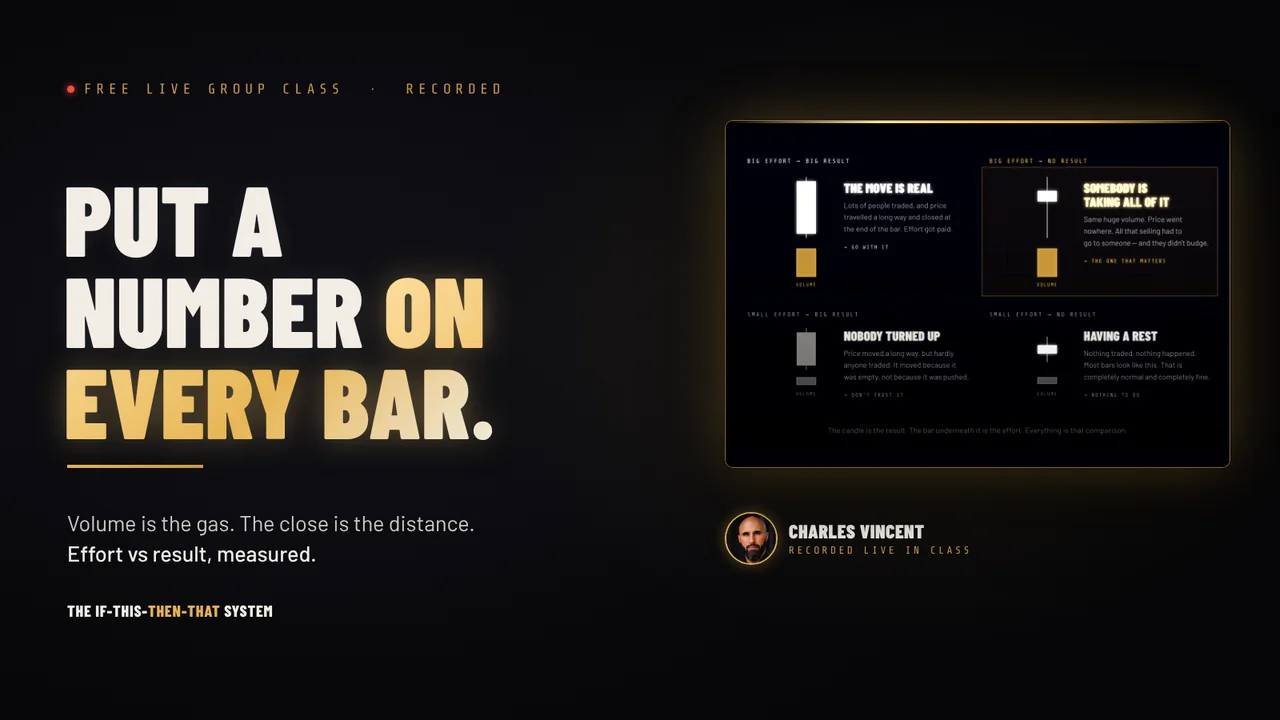 Live Group Class · 1:15:27Put a number on every bar
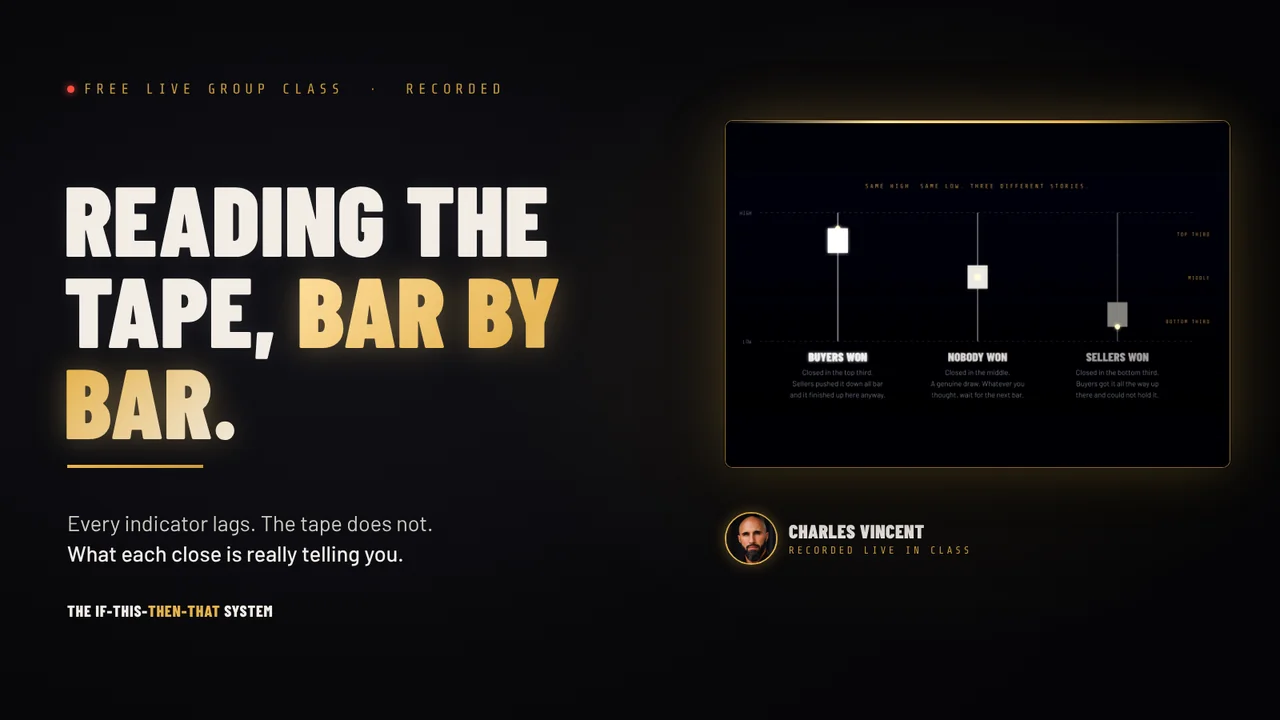 Live Group Class · 53:55Reading the tape, before anything else
Separately, three private 1-on-1 coaching sessions are published with the student’s permission, and are free to watch. They are not classes: What are you looking at? (camera on), Structure, or fear? (camera on) and Elliott Wave, counted not drawn.
Want this one-on-one?
These classes are the group version of the work. The 90-day mentorship is the same method applied to your own charts, your own execution and your own mistakes, with Charles Vincent, three times a week. It starts with a free 30-minute call with me, no card required.
Not ready to talk yet? Sit in on the next free class.